## Diagram: Commutative Diagram of K-Theory
### Overview
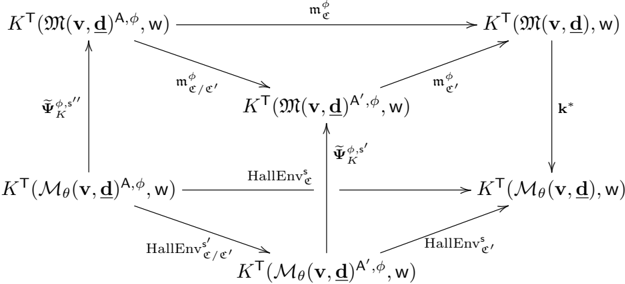
The image is a commutative diagram in K-theory, illustrating relationships between different K-theory groups associated with moduli spaces of objects. The diagram consists of nodes representing K-theory groups and arrows representing morphisms between these groups. The diagram shows how different operations and transformations relate these K-theory groups.
### Components/Axes
* **Nodes:** Each node represents a K-theory group, denoted as K<sup>T</sup>(X, w), where X is a moduli space and w is a weight. The moduli spaces are variations of M and M<sub>θ</sub>, with additional parameters A, A', φ, and v, d.
* **Arrows:** Arrows represent morphisms between K-theory groups. These morphisms are labeled with symbols such as m<sub>e</sub><sup>φ</sup>, m<sub>e/e'</sub><sup>φ</sup>, HallEnv<sup>s</sup><sub>e</sub>, HallEnv<sup>s'</sup><sub>e/e'</sub>, k<sup>*</sup>, and Ψ̃<sub>K</sub><sup>φ,s'</sup>, Ψ̃<sub>K</sub><sup>φ,s''</sup>.
* **Parameters:** The parameters include:
* v, d: Parameters likely related to dimension vectors or other invariants of the objects being classified.
* A, A': Parameters likely related to algebras or other algebraic structures.
* φ: A parameter likely related to stability conditions or other parameters in the moduli problem.
* w: A weight.
* e, e', s, s': Indices or parameters used in the morphisms.
### Detailed Analysis or Content Details
The diagram consists of six nodes arranged in a roughly rectangular shape with two nodes in the middle. The arrows connect these nodes, indicating morphisms between the corresponding K-theory groups.
1. **Top-Left Node:** K<sup>T</sup>(M(v, d)<sup>A,φ</sup>, w)
2. **Top-Right Node:** K<sup>T</sup>(M(v, d), w)
3. **Middle-Left Node:** K<sup>T</sup>(M(v, d)<sup>A',φ</sup>, w)
4. **Middle-Right Node:** K<sup>T</sup>(M<sub>θ</sub>(v, d), w)
5. **Bottom-Left Node:** K<sup>T</sup>(M<sub>θ</sub>(v, d)<sup>A,φ</sup>, w)
6. **Bottom-Right Node:** K<sup>T</sup>(M<sub>θ</sub>(v, d)<sup>A',φ</sup>, w)
The arrows are as follows:
* From Top-Left to Top-Right: m<sub>e</sub><sup>φ</sup>
* From Top-Left to Middle-Left: m<sub>e/e'</sub><sup>φ</sup>
* From Top-Right to Middle-Right: k<sup>*</sup>
* From Middle-Left to Top-Right: m<sub>e'</sub><sup>φ</sup>
* From Middle-Left to Middle-Right: Ψ̃<sub>K</sub><sup>φ,s'</sup>
* From Middle-Right to Bottom-Right: HallEnv<sup>s'</sup><sub>e'</sub>
* From Bottom-Left to Top-Left: Ψ̃<sub>K</sub><sup>φ,s''</sup>
* From Bottom-Left to Middle-Left: HallEnv<sup>s</sup><sub>e</sub>
* From Bottom-Left to Bottom-Right: HallEnv<sup>s</sup><sub>e/e'</sub>
* From Bottom-Right to Middle-Left: Ψ̃<sub>K</sub><sup>φ,s'</sup>
* From Middle-Right to Bottom-Right: HallEnv<sup>s'</sup><sub>e'</sub>
### Key Observations
* The diagram connects K-theory groups of moduli spaces M and M<sub>θ</sub>.
* The morphisms involve operations denoted by m, k<sup>*</sup>, HallEnv, and Ψ̃<sub>K</sub>.
* The parameters A, A', φ, v, d, w, e, e', s, and s' play a role in defining the K-theory groups and morphisms.
* The diagram is commutative, meaning that any path between two nodes yields the same result.
### Interpretation
The commutative diagram illustrates relationships between K-theory groups associated with moduli spaces of objects. The morphisms represent operations that transform these K-theory groups. The commutativity of the diagram implies that the order in which these operations are applied does not affect the final result. This diagram likely represents a key result in K-theory, demonstrating how different constructions and transformations are related. The specific meaning of the moduli spaces, parameters, and morphisms would require further context from the surrounding document. The diagram suggests a deep connection between the K-theory of different moduli spaces and the operations that relate them.