## Diagram: Two-Phase Attention Mechanism with Quantization and Kernel Operations
### Overview
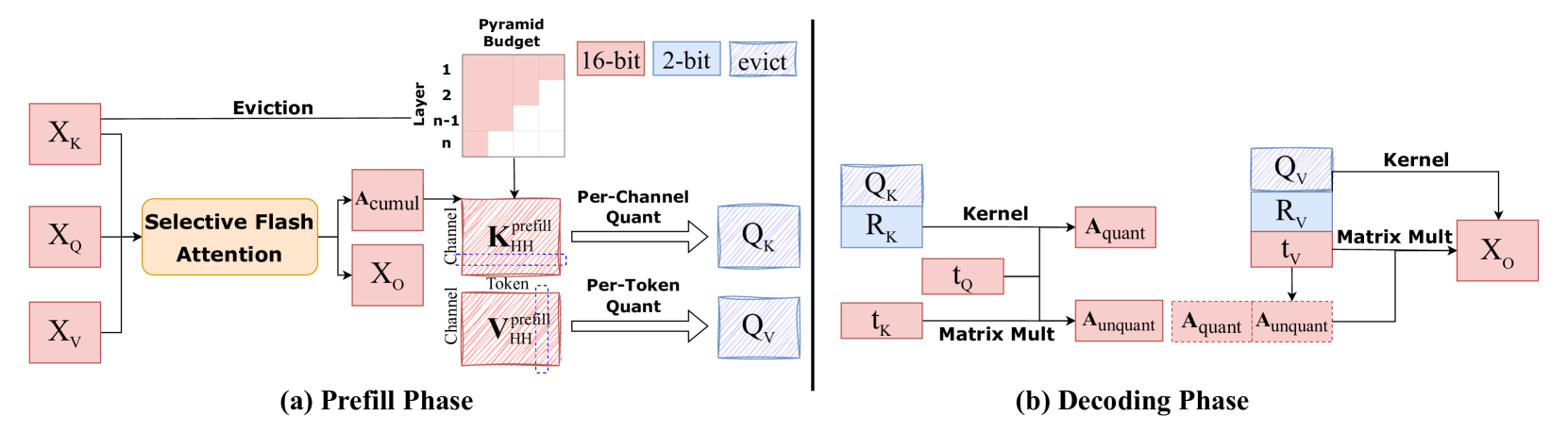
The diagram illustrates a two-phase computational process involving attention mechanisms, quantization, and kernel operations. The left side (Prefill Phase) focuses on input processing and selective attention, while the right side (Decoding Phase) emphasizes kernel-based transformations and output generation. Arrows indicate data flow between components.
### Components/Axes
#### Prefill Phase (a)
- **Inputs**:
- `X_K`, `X_Q`, `X_V` (three input matrices)
- **Core Components**:
- **Selective Flash Attention**: Central block processing inputs
- **Pyramid Budget**: Visualized as a triangular structure with layers 1 to n, annotated with "16-bit", "2-bit", and "evict" labels
- **Per-Channel Quant**: `K_prefill` (key matrix) and `V_prefill` (value matrix)
- **Per-Token Quant**: `Q_K` (query key) and `Q_V` (query value)
- **Outputs**:
- `A_cumul` (cumulative attention)
- `X_O` (output matrix)
#### Decoding Phase (b)
- **Inputs**:
- `Q_K`, `R_K`, `t_K`, `t_Q`, `Q_V`, `R_V`, `t_V`
- **Core Components**:
- **Kernel Operations**:
- `Kernel` block connecting `Q_K`/`R_K` to `A_quant`/`A_unkuant`
- `Matrix Mult` block combining `A_quant` and `A_unkuant`
- **Output**:
- `X_O` (final output matrix)
### Detailed Analysis
#### Prefill Phase
1. **Input Processing**:
- Three input matrices (`X_K`, `X_Q`, `X_V`) feed into the Selective Flash Attention block
- Attention mechanism generates `A_cumul` and `X_O`
2. **Quantization**:
- `K_prefill` and `V_prefill` undergo per-channel quantization
- `Q_K` and `Q_V` result from per-token quantization
3. **Memory Management**:
- Pyramid Budget structure suggests tiered memory allocation (16-bit for top layers, 2-bit for lower layers, with eviction policies)
#### Decoding Phase
1. **Kernel-Based Transformations**:
- `Q_K` and `R_K` processed through Kernel block to produce `A_quant` and `A_unkuant`
- `Q_V` and `R_V` similarly transformed
2. **Matrix Operations**:
- `t_K` and `t_Q` matrices multiplied with attention outputs
- Final `X_O` generated through matrix multiplication of quantized and unquantized attention components
### Key Observations
1. **Phase Differentiation**:
- Prefill Phase emphasizes attention computation and quantization
- Decoding Phase focuses on kernel operations and matrix multiplications
2. **Memory Optimization**:
- Pyramid Budget visualization implies hierarchical memory management
- 2-bit quantization in lower layers suggests aggressive compression
3. **Output Generation**:
- `X_O` appears in both phases but with different processing paths
4. **Attention Mechanisms**:
- Selective Flash Attention in Prefill Phase
- Kernel-based attention in Decoding Phase
### Interpretation
This diagram represents a hybrid attention mechanism combining:
1. **Efficient Prefill**: Uses selective attention and quantization to reduce memory footprint while maintaining key-value relationships
2. **Optimized Decoding**: Employs kernel operations and matrix multiplications for efficient output generation
3. **Memory Management**: Pyramid Budget structure suggests adaptive memory allocation based on layer importance
The system appears designed for:
- **Large-scale NLP tasks** requiring efficient attention computation
- **Hardware-optimized inference** through quantization and kernel fusion
- **Memory-constrained environments** via tiered quantization and eviction policies
The dual-phase approach balances computational efficiency with attention quality, potentially enabling:
- Faster inference through kernel optimizations
- Reduced memory usage via quantization
- Maintained model accuracy through selective attention mechanisms