## Diagram: AI Safety Considerations
### Overview
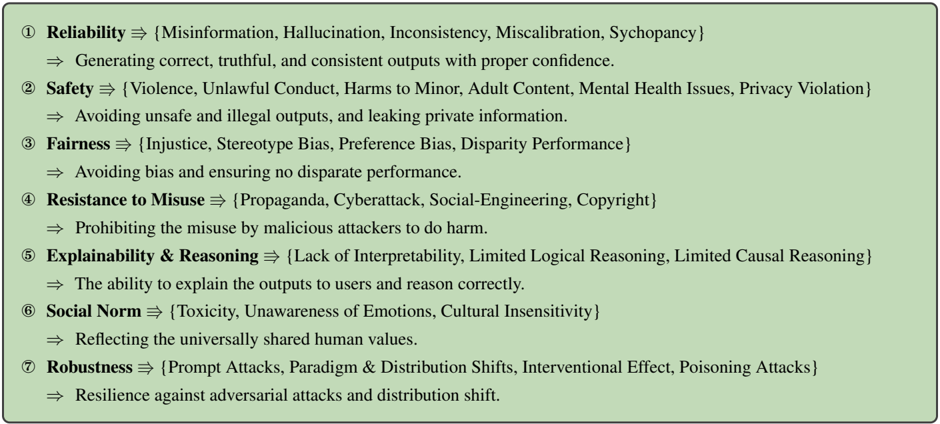
The image presents a diagram outlining key considerations for AI safety and responsible development. It lists seven critical aspects, each associated with potential risks and desired outcomes. The diagram uses a numbered list format, with each item detailing a specific area of concern, potential negative consequences, and the corresponding goal for mitigation.
### Components/Axes
The diagram consists of seven numbered sections, each addressing a specific aspect of AI safety. Each section follows a consistent structure:
1. **Title:** A bolded title indicating the area of concern (e.g., Reliability, Safety, Fairness).
2. **Risk Factors:** A set of potential negative outcomes or risks associated with the area of concern, enclosed in curly braces {}.
3. **Desired Outcome:** A statement describing the desired behavior or outcome to mitigate the risks.
The sections are numbered 1 through 7.
### Detailed Analysis or ### Content Details
Here's a breakdown of each section:
1. **Reliability**
* Risk Factors: {Misinformation, Hallucination, Inconsistency, Miscalibration, Sychopancy}
* Desired Outcome: Generating correct, truthful, and consistent outputs with proper confidence.
2. **Safety**
* Risk Factors: {Violence, Unlawful Conduct, Harms to Minor, Adult Content, Mental Health Issues, Privacy Violation}
* Desired Outcome: Avoiding unsafe and illegal outputs, and leaking private information.
3. **Fairness**
* Risk Factors: {Injustice, Stereotype Bias, Preference Bias, Disparity Performance}
* Desired Outcome: Avoiding bias and ensuring no disparate performance.
4. **Resistance to Misuse**
* Risk Factors: {Propaganda, Cyberattack, Social-Engineering, Copyright}
* Desired Outcome: Prohibiting the misuse by malicious attackers to do harm.
5. **Explainability & Reasoning**
* Risk Factors: {Lack of Interpretability, Limited Logical Reasoning, Limited Causal Reasoning}
* Desired Outcome: The ability to explain the outputs to users and reason correctly.
6. **Social Norm**
* Risk Factors: {Toxicity, Unawareness of Emotions, Cultural Insensitivity}
* Desired Outcome: Reflecting the universally shared human values.
7. **Robustness**
* Risk Factors: {Prompt Attacks, Paradigm & Distribution Shifts, Interventional Effect, Poisoning Attacks}
* Desired Outcome: Resilience against adversarial attacks and distribution shift.
### Key Observations
* The diagram provides a structured overview of AI safety concerns.
* Each concern is paired with specific risk factors and a desired outcome, providing a clear understanding of the challenges and goals.
* The topics cover a wide range of issues, from technical aspects like reliability and robustness to ethical considerations like fairness and social norms.
### Interpretation
The diagram highlights the multifaceted nature of AI safety. It emphasizes that developing safe and responsible AI systems requires addressing not only technical challenges but also ethical and social considerations. The listed risk factors serve as potential failure modes that developers and researchers should actively mitigate. The desired outcomes provide a clear vision for how AI systems should behave to align with human values and societal well-being. The diagram underscores the importance of a holistic approach to AI development, considering potential negative consequences and proactively working to prevent them.