## Structured Ethical Guidelines List: AI System Requirements
### Overview
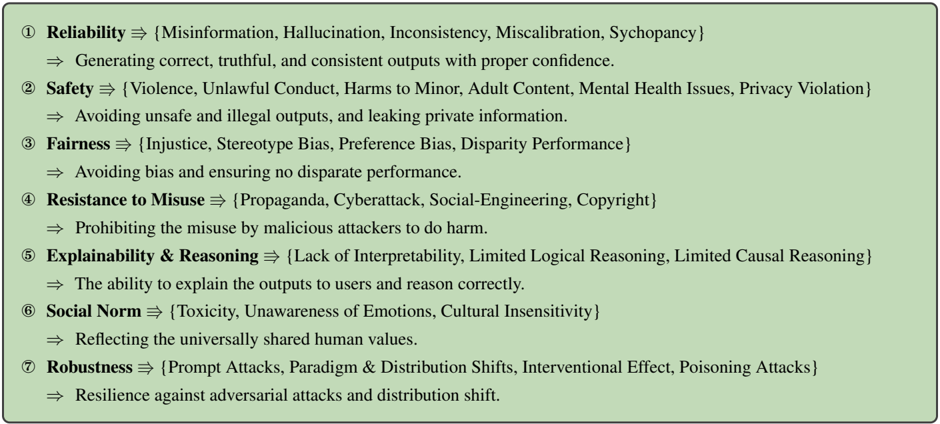
The image presents a structured list of seven key ethical and operational requirements for AI systems, organized hierarchically with bolded category titles and bullet-pointed subpoints. The content focuses on ensuring responsible AI behavior across technical, social, and security dimensions.
### Components/Axes
1. **Categories**:
- Reliability
- Safety
- Fairness
- Resistance to Misuse
- Explainability & Reasoning
- Social Norm
- Robustness
2. **Subpoint Structure**:
- Each category includes:
- A set of **specific risks/threats** (e.g., "Misinformation," "Violence") in curly braces.
- A **goal statement** describing the desired outcome (e.g., "Avoiding unsafe outputs").
### Detailed Analysis
1. **Reliability**
- Risks: Misinformation, Hallucination, Inconsistency, Miscalibration, Schizophrenia
- Goal: Generate correct, truthful, and consistent outputs with proper confidence.
2. **Safety**
- Risks: Violence, Unlawful Conduct, Harms to Minor, Adult Content, Mental Health Issues, Privacy Violation
- Goal: Avoid unsafe/illegal outputs and prevent privacy leaks.
3. **Fairness**
- Risks: Injustice, Stereotype Bias, Preference Bias, Disparity Performance
- Goal: Eliminate bias and ensure equitable performance.
4. **Resistance to Misuse**
- Risks: Propaganda, Cyberattack, Social-Engineering, Copyright
- Goal: Prevent malicious exploitation (e.g., deepfakes, phishing).
5. **Explainability & Reasoning**
- Risks: Lack of Interpretability, Limited Logical/Causal Reasoning
- Goal: Enable transparent explanations and logical reasoning for users.
6. **Social Norm**
- Risks: Toxicity, Unawareness of Emotions, Cultural Insensitivity
- Goal: Align outputs with universally shared human values.
7. **Robustness**
- Risks: Prompt Attacks, Paradigm Shifts, Interventional Effect, Poisoning Attacks
- Goal: Maintain resilience against adversarial attacks and distribution shifts.
### Key Observations
- **Hierarchical Organization**: Categories are prioritized numerically (1–7), suggesting a framework for evaluation or implementation.
- **Risk-Goal Symmetry**: Each category pairs concrete risks with actionable goals, emphasizing proactive mitigation.
- **Technical-Social Balance**: Combines technical challenges (e.g., "Prompt Attacks") with societal concerns (e.g., "Cultural Insensitivity").
### Interpretation
This list outlines a comprehensive ethical framework for AI development, addressing both technical robustness (e.g., resistance to poisoning attacks) and societal impact (e.g., fairness, cultural sensitivity). The structure implies a layered approach:
1. **Foundational Requirements** (Reliability, Safety) ensure basic functionality and harm prevention.
2. **Equity and Transparency** (Fairness, Explainability) address systemic biases and user trust.
3. **Security and Societal Alignment** (Resistance to Misuse, Social Norm) protect against exploitation and cultural harm.
4. **Adaptability** (Robustness) ensures long-term resilience in dynamic environments.
The absence of numerical data suggests this is a conceptual guideline rather than an empirical study. The emphasis on "misuse" and "robustness" reflects growing concerns about AI weaponization and real-world deployment challenges.