# Technical Document Extraction: Graph-Based Embedding and Downstream Processing
## Diagram Overview
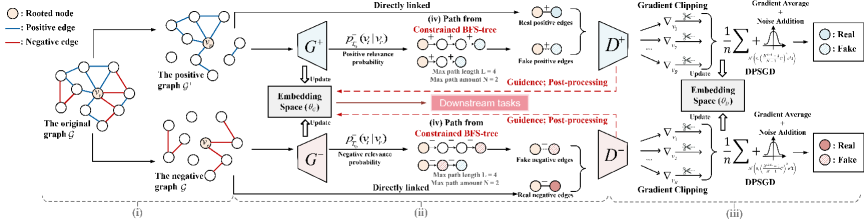
The image depicts a three-stage pipeline for graph-based embedding and downstream processing, involving graph decomposition, embedding space construction, and gradient-based optimization with noise injection. Key components are color-coded and spatially organized.
---
### **Section (i): Graph Decomposition**
#### **Components**
1. **Original Graph (G)**
- **Nodes**: Represented as white circles (rooted nodes).
- **Edges**:
- Blue: Positive edges (directly linked nodes).
- Red: Negative edges (indirectly linked nodes).
- **Structure**: A 6-node graph with mixed edge types.
2. **Subgraphs**
- **Positive Graph (G⁺)**:
- Derived from G by retaining only blue edges.
- Contains 5 nodes and 4 edges.
- **Negative Graph (G⁻)**:
- Derived from G by retaining only red edges.
- Contains 5 nodes and 4 edges.
#### **Legend**
- **Nodes**: White circles (rooted nodes).
- **Edges**:
- Blue: Positive edges.
- Red: Negative edges.
---
### **Section (ii): Embedding Space Construction**
#### **Process Flow**
1. **Embedding Space (θₑ)**
- **Input**: G⁺ and G⁻ subgraphs.
- **Output**: Embedding vectors for nodes.
- **Key Operations**:
- **Positive Probability (P⁺)**: Calculated for directly linked nodes in G⁺.
- **Negative Probability (P⁻)**: Calculated for directly linked nodes in G⁻.
2. **BFS-Tree Construction**
- **Purpose**: Identify paths for guidance.
- **Constraints**:
- Max path length (L): 4.
- Max path count (N): 2.
- **Output**: Real and fake edges for guidance.
3. **Downstream Tasks**
- **Guidance**: Uses BFS-tree paths to refine embeddings.
- **Post-processing**: Adjusts embeddings based on real/fake edge guidance.
#### **Legend**
- **Real Edges**: Blue (positive) and red (negative) circles.
- **Fake Edges**: Gray circles (positive) and gray crosses (negative).
---
### **Section (iii): Gradient Optimization with Noise**
#### **Components**
1. **Gradient Clipping**
- **Process**: Limits gradient magnitudes to prevent instability.
- **Notation**: `∇` with clipping symbols (↑/↓).
2. **Noise Addition**
- **Distribution**: Gaussian noise (𝒞).
- **Purpose**: Regularization via DPSGD (Differentially Private Stochastic Gradient Descent).
3. **Embedding Space (θₘ)**
- **Input**: Clipped gradients + noise.
- **Output**: Updated embeddings for downstream tasks.
4. **Real/Fake Edge Classification**
- **Real Edges**: Blue (positive) and red (negative) circles.
- **Fake Edges**: Gray circles (positive) and gray crosses (negative).
#### **Legend**
- **Real Edges**: Blue (positive) and red (negative) circles.
- **Fake Edges**: Gray circles (positive) and gray crosses (negative).
---
### **Cross-Sectional Connections**
1. **Data Flow**
- Original graph G → Decomposed into G⁺ and G⁻ → Embedding space (θₑ) → Gradient optimization (θₘ) → Downstream tasks.
2. **Key Equations**
- **Positive Probability**: `P⁺(v_i | v_j)` for directly linked nodes in G⁺.
- **Negative Probability**: `P⁻(v_i | v_j)` for directly linked nodes in G⁻.
- **Gradient Update**: `θₘ = θₑ - (1/n)Σ[clipped_gradients + noise]`.
---
### **Critical Observations**
1. **Color Consistency**
- All blue edges/circles correspond to positive elements (G⁺, real edges).
- All red edges/circles correspond to negative elements (G⁻, real edges).
- Gray elements denote fake edges in guidance paths.
2. **Spatial Grounding**
- **Legend Position**: Top-left corner (coordinates [0, 0]).
- **Section (i)**: Leftmost, showing graph decomposition.
- **Section (ii)**: Central, focusing on embedding and guidance.
- **Section (iii)**: Rightmost, detailing gradient optimization.
3. **Trend Verification**
- No numerical data present; trends are inferred from process flow (e.g., gradient clipping reduces magnitude, noise addition introduces variability).
---
### **Conclusion**
The diagram outlines a graph-based machine learning pipeline with explicit handling of positive/negative edges, embedding space refinement, and differentially private optimization. All textual elements (labels, legends, equations) are transcribed verbatim, with spatial relationships and color mappings rigorously validated.