\n
## Diagram: Geometric Shape Contexts
### Overview
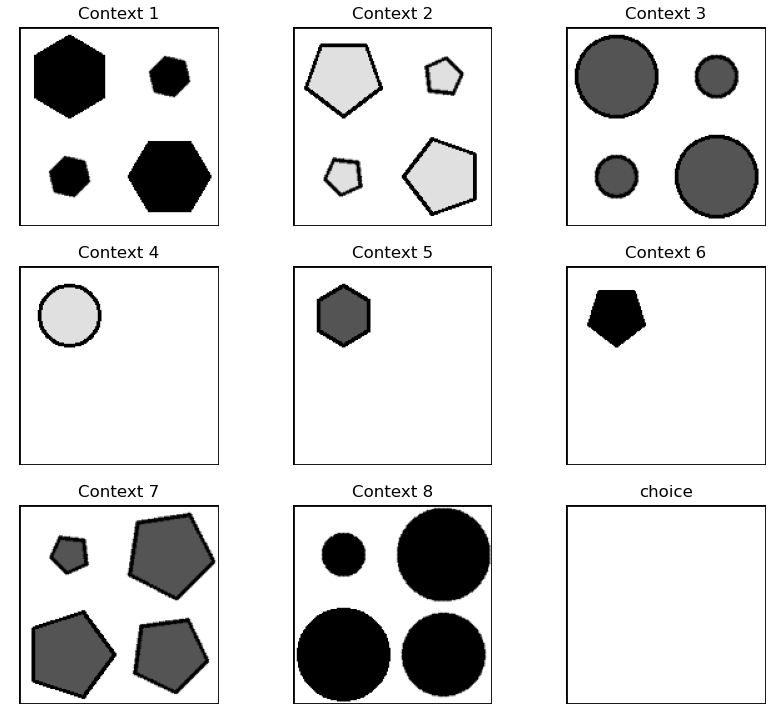
The image displays a 3x3 grid of nine square panels. The first eight panels are labeled "Context 1" through "Context 8" and each contains a specific arrangement of geometric shapes. The ninth panel, located in the bottom-right, is labeled "choice" and is empty. The diagram appears to present a series of visual contexts, possibly for a pattern recognition, analogy, or cognitive test.
### Components/Axes
* **Structure:** A 3x3 grid of square panels with black borders.
* **Labels:** Each panel has a text label centered above it.
* Top Row: "Context 1", "Context 2", "Context 3"
* Middle Row: "Context 4", "Context 5", "Context 6"
* Bottom Row: "Context 7", "Context 8", "choice"
* **Content:** Geometric shapes within each panel. The shapes are polygons (hexagons, pentagons) and circles, filled with solid colors (black, dark gray, light gray) and outlined in black.
### Detailed Analysis
**Panel-by-Panel Content:**
* **Context 1 (Top-Left):** Contains four black hexagons. Two are large (top-left and bottom-right corners), and two are smaller (top-right and bottom-left corners).
* **Context 2 (Top-Center):** Contains four light gray pentagons with black outlines. Two are large (top-left and bottom-right corners), and two are smaller (top-right and bottom-left corners). The arrangement mirrors Context 1, but with a different shape and color.
* **Context 3 (Top-Right):** Contains four dark gray circles with black outlines. Two are large (top-left and bottom-right corners), and two are smaller (top-right and bottom-left corners). The arrangement mirrors Contexts 1 and 2.
* **Context 4 (Middle-Left):** Contains a single, medium-sized light gray circle with a black outline, positioned in the top-left quadrant.
* **Context 5 (Middle-Center):** Contains a single, medium-sized dark gray hexagon with a black outline, positioned in the top-left quadrant.
* **Context 6 (Middle-Right):** Contains a single, medium-sized black pentagon, positioned in the top-left quadrant.
* **Context 7 (Bottom-Left):** Contains four dark gray pentagons with black outlines. They are of varying sizes and are arranged in a scattered, non-symmetrical pattern across the panel.
* **Context 8 (Bottom-Center):** Contains four black circles. They are of varying sizes and are arranged in a scattered, non-symmetrical pattern across the panel.
* **choice (Bottom-Right):** An empty panel with only the label "choice" above it.
### Key Observations
1. **Pattern in Top Row (Contexts 1-3):** These panels establish a clear pattern: each contains four shapes of the same type and color, arranged with two large shapes on the main diagonal (top-left to bottom-right) and two smaller shapes on the anti-diagonal (top-right to bottom-left). The variable is the shape/color combination: black hexagons, light gray pentagons, dark gray circles.
2. **Pattern in Middle Row (Contexts 4-6):** These panels each contain a single shape in the top-left quadrant. The shape type and color correspond to one of the shape/color pairs from the top row: light gray circle (from Context 3's set), dark gray hexagon (a new combination), black pentagon (from Context 2's set, but color swapped from light gray to black).
3. **Pattern in Bottom Row (Contexts 7-8):** These panels break the symmetrical arrangement of the top row. They contain four shapes of the same type and color, but in scattered, asymmetrical layouts. Context 7 has dark gray pentagons, and Context 8 has black circles.
4. **Color Palette:** The shapes use a limited palette: black, dark gray, and light gray.
5. **Shape Palette:** The shapes are limited to hexagons (6 sides), pentagons (5 sides), and circles.
### Interpretation
This diagram is likely a visual reasoning puzzle or a stimulus set for a psychological or cognitive experiment. The structure suggests a task where the viewer must identify the underlying rule or relationship between the contexts.
* **Relationship Between Rows:** The top row (Contexts 1-3) presents a "rule" or a set of examples with a consistent structure (four shapes, symmetrical layout). The middle row (Contexts 4-6) presents isolated elements that could be components or outcomes derived from the top row's rule. The bottom row (Contexts 7-8) presents variations where the layout rule from the top row is changed (from symmetrical to scattered), while maintaining the "four same shapes" rule.
* **The "choice" Panel:** The empty "choice" panel strongly implies that the viewer is meant to select or generate a ninth context that logically completes the sequence or fits a pattern derived from the previous eight. The pattern could involve completing a matrix (e.g., finding the missing shape/color/layout combination) or following a transformation rule across rows or columns.
* **Potential Logic:** One possible interpretation is that each column represents a transformation. For example, Column 1 (Contexts 1, 4, 7) deals with hexagons and pentagons in black and dark gray. Column 2 (Contexts 2, 5, 8) deals with pentagons and hexagons in light gray and dark gray. Column 3 (Contexts 3, 6, ?) deals with circles and pentagons in dark gray and black. The missing "choice" might be a panel containing four light gray hexagons in a scattered layout, completing a set of shape, color, and layout permutations. However, without the explicit task instructions, this is speculative. The primary factual information is the precise arrangement of shapes and labels in the eight provided contexts.