## Diagram: Contextual Shape Classification Grid
### Overview
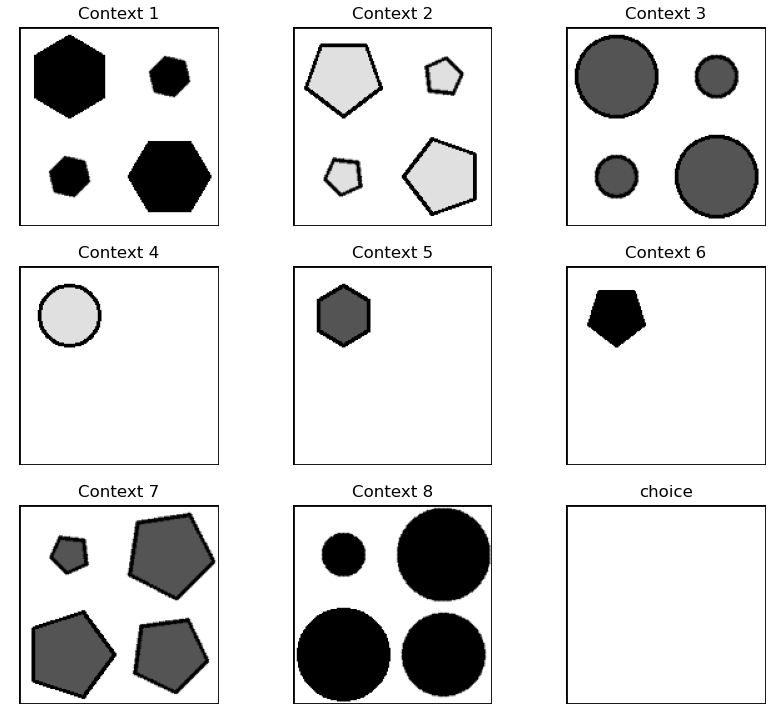
The image presents a 3x3 grid of panels labeled "Context 1" through "Context 8" and a final "choice" panel. Each panel contains geometric shapes with distinct colors and sizes, suggesting a classification or pattern recognition task. No numerical data or explicit legends are present.
### Components/Axes
- **Grid Structure**:
- 3 rows × 3 columns of panels.
- Labels positioned in the top-left corner of each panel.
- "Choice" panel occupies the bottom-right position.
- **Shapes**:
- Hexagons (6 sides), pentagons (5 sides), circles (0 sides).
- Colors: Black, light pink, dark gray.
- Sizes: Varying (small, medium, large).
- **Arrangement**:
- Context panels 1–8 each contain 1–4 shapes.
- "Choice" panel is empty.
### Detailed Analysis
1. **Context 1**: Three large black hexagons and one small black hexagon (top-left cluster).
2. **Context 2**: Two large light pink pentagons and two small light pink pentagons (center-left cluster).
3. **Context 3**: Two large dark gray circles and two small dark gray circles (top-right cluster).
4. **Context 4**: Single large light pink circle (middle-left).
5. **Context 5**: Single medium dark gray hexagon (middle-center).
6. **Context 6**: Single small black pentagon (top-right).
7. **Context 7**: Four dark gray pentagons (small, medium, large, and medium) arranged in a loose cluster (bottom-left).
8. **Context 8**: Three black circles (small, medium, large) aligned vertically (bottom-center).
9. **Choice Panel**: Empty square (bottom-right).
### Key Observations
- **Color Grouping**:
- Black shapes dominate Contexts 1, 6, and 8.
- Light pink shapes appear in Contexts 2 and 4.
- Dark gray shapes occupy Contexts 3, 5, and 7.
- **Shape Categories**:
- Hexagons: Contexts 1, 5.
- Pentagons: Contexts 2, 6, 7.
- Circles: Contexts 3, 4, 8.
- **Size Patterns**:
- Larger shapes often appear in clusters (e.g., Context 1, 2, 3).
- Smaller shapes are isolated or paired (e.g., Context 6, 8).
### Interpretation
The grid likely represents a training set for a machine learning model or cognitive test, where participants must identify or categorize shapes based on contextual rules. The "choice" panel suggests a final selection task, possibly requiring the user to pick a shape that fits a hidden pattern (e.g., color, size, or shape category). Notable anomalies include the isolated single shapes in Contexts 4–6, which may test edge-case recognition. The absence of explicit rules implies the task relies on implicit pattern inference, such as grouping by color or shape type.