## Diagram: Star Polygon and 3D Representation
### Overview
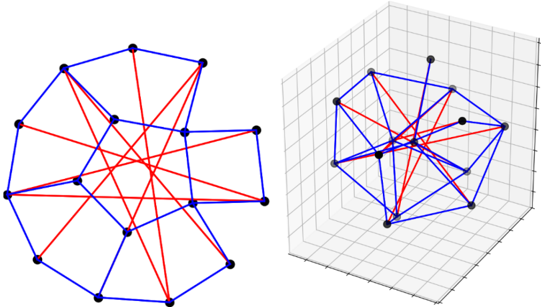
The image presents two visualizations of a geometric structure. On the left, a 2D representation of a star polygon is shown. On the right, a 3D representation of a similar structure is displayed within a gridded coordinate system. Both visualizations use blue lines to connect adjacent vertices and red lines to connect non-adjacent vertices. Black dots mark the vertices of the structure.
### Components/Axes
* **Left (2D Representation):**
* Vertices: Represented by black dots.
* Edges: Represented by blue lines connecting adjacent vertices.
* Diagonals: Represented by red lines connecting non-adjacent vertices.
* **Right (3D Representation):**
* Vertices: Represented by black dots.
* Edges: Represented by blue lines connecting adjacent vertices.
* Diagonals: Represented by red lines connecting non-adjacent vertices.
* Coordinate System: A 3D grid provides spatial context. The grid lines are light gray.
### Detailed Analysis
* **Left (2D Representation):**
* The polygon has 12 vertices.
* The blue lines form the perimeter of the polygon.
* The red lines connect each vertex to several non-adjacent vertices, creating a star-like pattern within the polygon.
* **Right (3D Representation):**
* The structure appears to be a polyhedron with 10 vertices.
* The blue lines form the edges of the polyhedron.
* The red lines connect vertices within the polyhedron, creating a complex network of diagonals.
* The 3D grid provides a sense of depth and spatial orientation.
### Key Observations
* Both representations use the same color scheme: blue for edges and red for diagonals.
* The 2D representation is a planar projection, while the 3D representation provides a spatial view.
* The 3D representation is more complex due to the added dimension and the resulting network of diagonals.
### Interpretation
The image illustrates the relationship between 2D and 3D geometric structures. The star polygon in the 2D representation is a projection of a more complex polyhedron in the 3D representation. The use of color-coding (blue for edges, red for diagonals) helps to distinguish the different types of connections between vertices. The 3D representation provides a more complete understanding of the spatial relationships between the vertices and edges of the structure. The image demonstrates how a simple polygon can be extended into a complex polyhedron by adding diagonals and spatial dimensions.