## Network Diagram: 2D and 3D Representation of a Connected System
### Overview
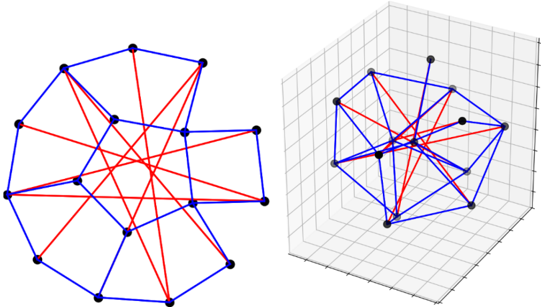
The image presents two views of a network diagram: a 2D projection on the left and a 3D perspective on the right. The network consists of **black nodes** (vertices) connected by **red and blue edges** (links). The 3D view is overlaid on a grid background, suggesting spatial orientation. No textual labels, legends, or axis markers are visible in the image.
### Components/Axes
- **Nodes**: Black circular points representing entities or data points.
- **Edges**:
- **Red edges**: Likely denote primary connections or high-priority relationships.
- **Blue edges**: May represent secondary or auxiliary connections.
- **Views**:
- **2D View (Left)**: Flat, planar representation with overlapping edges.
- **3D View (Right)**: Perspective projection with depth, showing nodes and edges in a grid-aligned space.
### Detailed Analysis
- **Node Distribution**:
- Approximately **15–20 nodes** are visible in both views.
- Nodes are clustered in the center of the 3D view, with sparser distribution toward the edges.
- **Edge Density**:
- Red edges dominate the central region, forming dense interconnections.
- Blue edges are more peripheral, connecting outer nodes to the core.
- **Spatial Grounding**:
- The 3D grid provides a reference frame, but no explicit axis labels (X, Y, Z) are visible.
- Nodes and edges are evenly distributed across the grid, with no clear positional bias.
### Key Observations
1. **Color Coding**: Red and blue edges are spatially segregated, suggesting a categorical distinction (e.g., priority, type, or direction).
2. **Network Complexity**: The 3D view reveals overlapping edges and nodes, indicating a highly interconnected system.
3. **Missing Metadata**: No legends, axis titles, or numerical data are present to quantify relationships or node attributes.
### Interpretation
The diagram likely represents a **complex network system** (e.g., social, technological, or biological) with hierarchical or layered relationships. The red edges may signify core interactions, while blue edges could represent peripheral or auxiliary links. The absence of labels or legends limits quantitative analysis, but the spatial segregation of edge colors implies a structured hierarchy. The 3D perspective emphasizes depth and connectivity, suggesting the system’s multidimensional nature.
**Note**: No textual or numerical data is extractable from the image. The analysis is based solely on visual patterns and spatial relationships.