## Diagram: Conceptual Relationship Between M_i, C^v_i, and N_i
### Overview
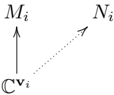
The diagram illustrates a conceptual relationship between three labeled elements: **M_i** (top-left), **N_i** (top-right), and **C^v_i** (dashed arrow from bottom-left to top-right). Arrows indicate directional flow or transformation, with **C^v_i** serving as an intermediary between **M_i** and **N_i**.
### Components/Axes
- **M_i**: Positioned at the top-left, labeled with an upward-pointing arrow. No numerical or categorical axis associated.
- **N_i**: Positioned at the top-right, labeled with a rightward-pointing arrow. No numerical or categorical axis associated.
- **C^v_i**: Represented as a dashed arrow originating from the bottom-left and terminating at the top-right, connecting **M_i** and **N_i**. No axis labels or scales provided.
### Detailed Analysis
- **M_i**: Acts as a source or input, with its upward arrow suggesting a vertical or hierarchical relationship.
- **C^v_i**: Functions as a transformation or mapping process, visually bridging **M_i** and **N_i** via a diagonal dashed line.
- **N_i**: Represents an output or resultant state, with its rightward arrow implying horizontal progression or dependency.
### Key Observations
1. **Directional Flow**: The diagram emphasizes a unidirectional flow from **M_i** → **C^v_i** → **N_i**, with no feedback loops or bidirectional relationships.
2. **Dashed Arrow Significance**: The dashed line for **C^v_i** may indicate uncertainty, abstraction, or a non-physical process (e.g., computational or theoretical mapping).
3. **Spatial Positioning**:
- **M_i** and **N_i** are anchored at the top, while **C^v_i** spans the vertical axis, suggesting a layered or multi-stage process.
- No numerical values, units, or legends are present, confirming the diagram’s conceptual rather than quantitative nature.
### Interpretation
The diagram likely represents a **systemic or algorithmic process** where:
- **M_i** could denote an initial state, input, or variable.
- **C^v_i** symbolizes a transformation, function, or operation applied to **M_i**.
- **N_i** represents the output, result, or final state after applying **C^v_i** to **M_i**.
This structure aligns with common representations in fields like computer science (e.g., data flow), mathematics (e.g., function composition), or engineering (e.g., control systems). The absence of numerical data or explicit units reinforces its role as a high-level conceptual model rather than an empirical analysis.