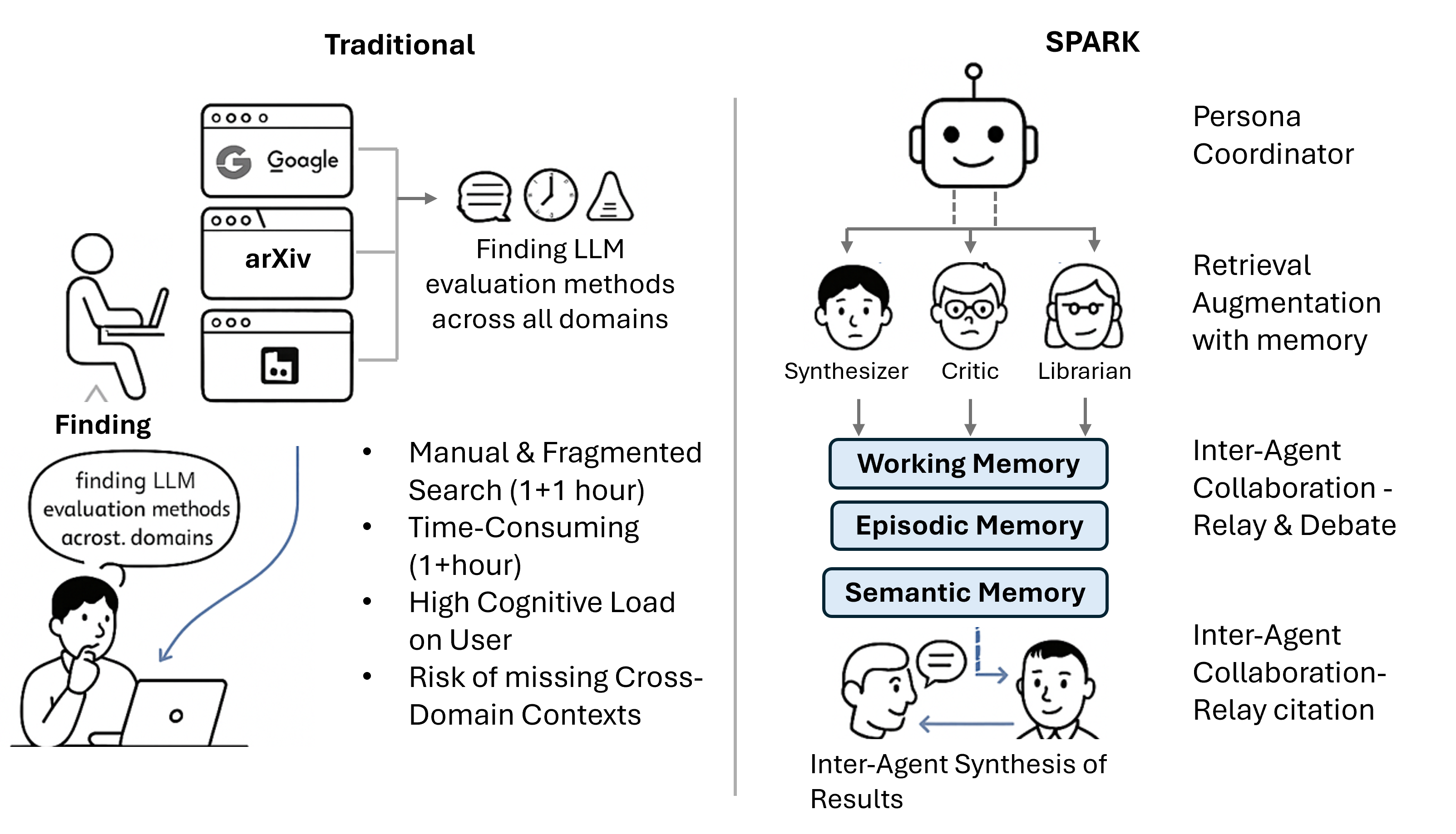
## Diagram: Traditional vs. SPARK Methodologies for LLM Evaluation
### Overview
The diagram compares two approaches to finding Large Language Model (LLM) evaluation methods across domains:
- **Traditional**: Manual, fragmented search with high cognitive load and risk of missing cross-domain contexts.
- **SPARK**: A structured, agent-based system with memory components and inter-agent collaboration for synthesis.
---
### Components/Axes
#### Traditional Side:
- **Labels**:
- "Traditional" (top-left header).
- "Finding" (sub-header under the human figure).
- "finding LLM evaluation methods across domains" (thought bubble text).
- Website icons: "Google," "arXiv," and a document icon.
- **Icons**:
- Speech bubble, clock, and test tube (symbolizing communication, time, and experimentation).
#### SPARK Side:
- **Labels**:
- "SPARK" (top-right header).
- "Persona Coordinator" (robot icon).
- "Synthesizer," "Critic," "Librarian" (three human figures).
- "Working Memory," "Episodic Memory," "Semantic Memory" (three blue boxes).
- Functions:
- "Retrieval Augmentation with memory" (Synthesizer).
- "Inter-Agent Collaboration - Relay & Debate" (Critic).
- "Inter-Agent Collaboration - Relay citation" (Librarian).
- Final output: "Inter-Agent Synthesis of Results."
---
### Content Details
#### Traditional Workflow:
1. A human manually searches Google, arXiv, and other platforms.
2. Challenges listed:
- Manual & Fragmented Search (1+1 hour).
- Time-Consuming (1+ hour).
- High Cognitive Load on User.
- Risk of missing Cross-Domain Contexts.
#### SPARK Workflow:
1. **Persona Coordinator** (robot) orchestrates three roles:
- **Synthesizer**: Uses "Retrieval Augmentation with memory" to gather data.
- **Critic**: Engages in "Inter-Agent Collaboration - Relay & Debate" to refine results.
- **Librarian**: Manages "Inter-Agent Collaboration - Relay citation" for accuracy.
2. **Memory Systems**:
- **Working Memory**: Short-term data processing.
- **Episodic Memory**: Stores past interactions.
- **Semantic Memory**: Encodes contextual knowledge.
3. Final output: "Inter-Agent Synthesis of Results."
---
### Key Observations
- **Traditional Limitations**:
- High time investment (1+1 hour).
- Cognitive overload due to fragmented searches.
- Risk of incomplete cross-domain context.
- **SPARK Advantages**:
- Modular roles (Synthesizer, Critic, Librarian) reduce cognitive load.
- Memory systems enable efficient data reuse and context retention.
- Inter-agent collaboration improves result reliability through debate and citation.
---
### Interpretation
The diagram contrasts a **linear, human-centric approach** (Traditional) with a **modular, agent-driven system** (SPARK). SPARK’s use of memory hierarchies and collaborative agents addresses the Traditional method’s inefficiencies:
- **Memory Systems**: Episodic and semantic memory allow SPARK to retain and contextualize information, mitigating the risk of missing cross-domain contexts.
- **Inter-Agent Collaboration**: The Critic’s debate mechanism and Librarian’s citation relay ensure rigorous validation, reducing errors from fragmented searches.
- **Synthesis**: The Synthesizer aggregates results, enabling holistic evaluation.
SPARK’s design suggests a shift toward **automated, context-aware evaluation frameworks** that minimize human effort while enhancing accuracy through structured collaboration and memory integration.