## Bar Chart: Activation Rate Comparison by Model
### Overview
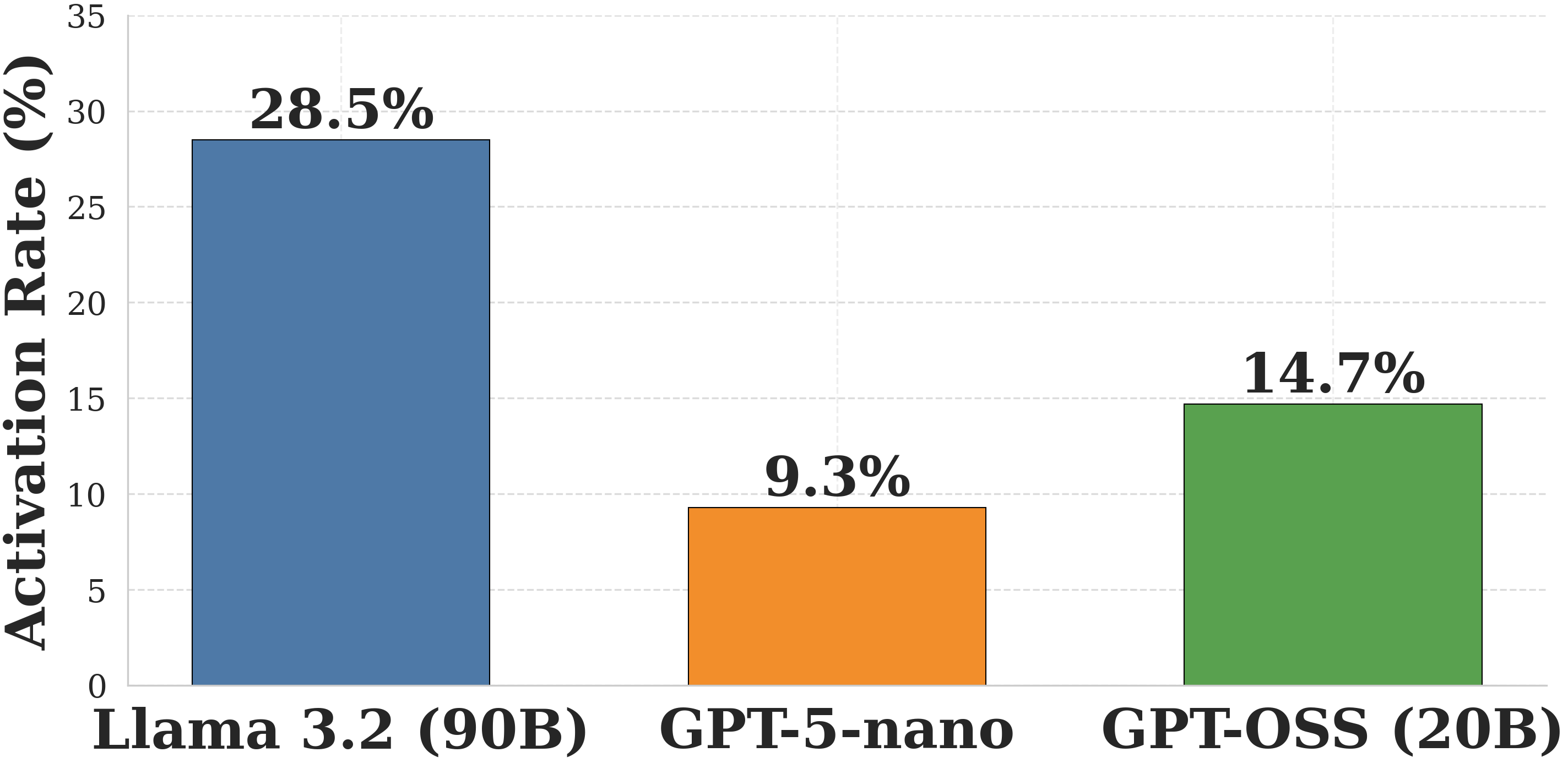
The image is a vertical bar chart comparing the "Activation Rate (%)" across three distinct AI models: Llama 3.2 (90B), GPT-5-nano, and GPT-OSS (20B). The chart uses a grid-based background to facilitate the reading of values on the Y-axis.
### Components/Axes
* **Y-Axis (Vertical):** Labeled "Activation Rate (%)". The scale ranges from 0 to 35, with horizontal dashed grid lines marking increments of 5.
* **X-Axis (Horizontal):** Contains three categorical labels corresponding to the bars:
* "Llama 3.2 (90B)"
* "GPT-5-nano"
* "GPT-OSS (20B)"
* **Data Series:** Three vertical bars representing the activation rate for each model.
* **Blue Bar:** Corresponds to Llama 3.2 (90B).
* **Orange Bar:** Corresponds to GPT-5-nano.
* **Green Bar:** Corresponds to GPT-OSS (20B).
### Detailed Analysis
The chart displays the following data points, extracted from the labels positioned directly above each bar:
1. **Llama 3.2 (90B)**
* **Position:** Leftmost bar.
* **Color:** Blue.
* **Value:** 28.5%.
* **Trend:** This is the highest value in the dataset, significantly exceeding the other two models.
2. **GPT-5-nano**
* **Position:** Center bar.
* **Color:** Orange.
* **Value:** 9.3%.
* **Trend:** This is the lowest value in the dataset, representing roughly one-third of the activation rate of the Llama model.
3. **GPT-OSS (20B)**
* **Position:** Rightmost bar.
* **Color:** Green.
* **Value:** 14.7%.
* **Trend:** This value sits between the other two models, approximately 5.4 percentage points higher than the GPT-5-nano model.
### Key Observations
* **Significant Variance:** There is a substantial disparity in activation rates between the models, ranging from 9.3% to 28.5%.
* **Model Density:** The Llama 3.2 (90B) model exhibits a much higher activation rate (28.5%) compared to the GPT variants.
* **Ordering:** The activation rates follow the order: Llama 3.2 (90B) > GPT-OSS (20B) > GPT-5-nano.
### Interpretation
* **Technical Context:** In the context of Large Language Models (LLMs), "Activation Rate" typically refers to the percentage of parameters or neurons that are active (firing) during a forward pass (inference).
* **Architectural Implications:**
* The significantly lower activation rates of the "GPT" models (9.3% and 14.7%) strongly suggest that these models utilize a **Sparse Architecture**, such as a Mixture-of-Experts (MoE). In MoE models, only a subset of the total parameters is activated for any given token, which allows for high parameter counts with lower computational costs.
* The higher activation rate of the Llama 3.2 (90B) model (28.5%) suggests it is likely a **Denser Model** compared to the GPT variants, or it utilizes a different routing mechanism that requires more active parameters per inference step.
* **Investigative Note:** The inclusion of "GPT-5-nano" is notable, as it implies a specific, likely highly optimized or experimental, small-scale version of a future-generation model. The data suggests that as models move toward "nano" or "OSS" (Open Source Software) designations, there is a clear design trend toward higher sparsity (lower activation rates) to optimize for inference speed and efficiency.