## Bar Chart: Activation Rate (%)
### Overview
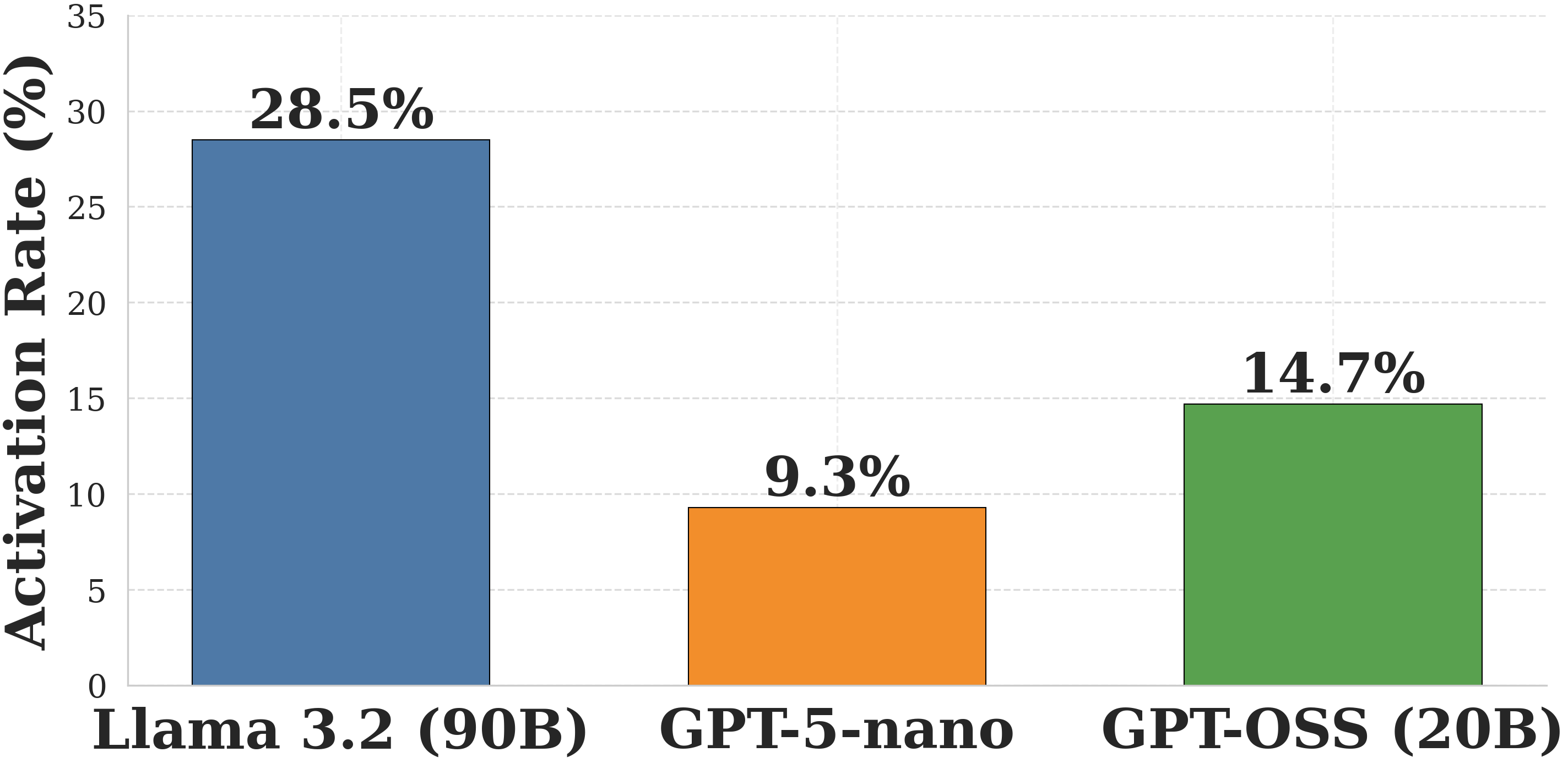
The bar chart compares the activation rates of three different models: Llama 3.2 (90B), GPT-5-nano, and GPT-OSS (20B). The activation rate is measured as a percentage and is displayed on the y-axis, ranging from 0% to 35%. The x-axis lists the three models.
### Components/Axes
- **Y-axis**: Activation Rate (%), ranging from 0% to 35%.
- **X-axis**: Models, including Llama 3.2 (90B), GPT-5-nano, and GPT-OSS (20B).
- **Legend**: Not visible in the image.
### Detailed Analysis or ### Content Details
- **Llama 3.2 (90B)**: The highest activation rate at 28.5%.
- **GPT-5-nano**: The second highest activation rate at 9.3%.
- **GPT-OSS (20B)**: The lowest activation rate at 14.7%.
### Key Observations
- Llama 3.2 has the highest activation rate, indicating it is the most active model among the three.
- GPT-5-nano has the lowest activation rate, suggesting it is the least active model.
- The activation rate for GPT-OSS is significantly lower than the other two models.
### Interpretation
The data suggests that Llama 3.2 is the most active model, with an activation rate of 28.5%. This could indicate that Llama 3.2 is more frequently used or is more effective in generating responses compared to GPT-5-nano and GPT-OSS. GPT-5-nano has a moderate activation rate of 9.3%, which is lower than Llama 3.2 but higher than GPT-OSS. GPT-OSS has the lowest activation rate of 14.7%, which could imply that it is less frequently used or less effective in generating responses compared to the other two models.
The activation rate is a measure of how often a model is used or how frequently it generates responses. A higher activation rate indicates that the model is more active and is likely to be more effective in generating responses. The data suggests that Llama 3.2 is the most active model, while GPT-5-nano and GPT-OSS are less active.