\n
## Chart: Importance Score vs. Reasoning Step
### Overview
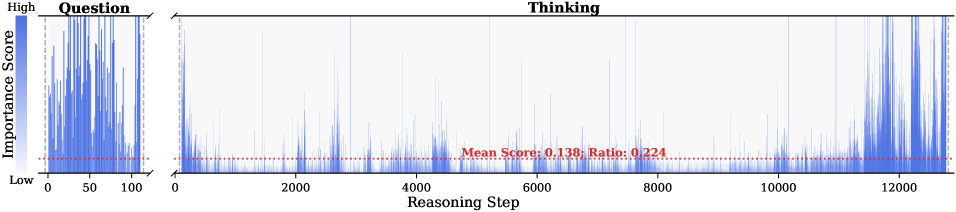
The image presents a chart visualizing the "Importance Score" against "Reasoning Step". The chart appears to represent the importance of each reasoning step during a question-answering or problem-solving process. The chart is divided into two sections labeled "Question" and "Thinking".
### Components/Axes
* **X-axis:** "Reasoning Step", ranging from approximately 0 to 12500.
* **Y-axis:** "Importance Score", ranging from "Low" to "High". The scale is not explicitly numerical, but visually represents relative importance.
* **Data Series:** A single fluctuating line representing the Importance Score over Reasoning Steps.
* **Annotations:**
* "Question" label positioned above the first section of the chart (Reasoning Steps 0-100).
* "Thinking" label positioned above the second section of the chart (Reasoning Steps 100-12500).
* A horizontal dashed red line labeled "Mean Score: 0.138; Ratio: 0.224".
### Detailed Analysis
The chart shows a high concentration of importance scores in the initial "Question" phase (Reasoning Steps 0-100). The Importance Score fluctuates significantly during this phase, with many peaks reaching towards the "High" end of the scale. After the initial phase, the Importance Score generally decreases and remains relatively low throughout the "Thinking" phase (Reasoning Steps 100-12500). There are occasional spikes in the Importance Score during the "Thinking" phase, but these are less frequent and generally lower in magnitude than those observed in the "Question" phase.
* **Question Phase (0-100 Reasoning Steps):** The Importance Score fluctuates rapidly between low and high values. The peaks are frequent and relatively high.
* **Thinking Phase (100-12500 Reasoning Steps):** The Importance Score remains mostly low, with occasional, smaller spikes. The line is generally closer to the "Low" end of the scale.
* **Mean Score:** The average Importance Score across all Reasoning Steps is 0.138.
* **Ratio:** A ratio of 0.224 is provided, but its meaning is not explicitly defined in the image.
### Key Observations
* The initial "Question" phase exhibits significantly higher Importance Scores compared to the "Thinking" phase.
* The Importance Score decreases substantially after the initial phase, suggesting that the early reasoning steps are more critical.
* The "Thinking" phase is characterized by relatively low and stable Importance Scores, with occasional minor fluctuations.
* The ratio of 0.224 may represent a metric related to the distribution of importance scores, but its exact meaning is unclear without further context.
### Interpretation
The data suggests that the initial steps of reasoning, likely related to understanding and framing the question, are significantly more important than the subsequent "Thinking" steps. This could indicate that the majority of the cognitive effort is focused on correctly interpreting the problem rather than the actual problem-solving process. The low mean Importance Score and the relatively flat line in the "Thinking" phase suggest that most reasoning steps during this phase contribute little to the overall importance. The ratio of 0.224 could potentially represent the proportion of reasoning steps that exceed a certain importance threshold, but this is speculative. The chart highlights a potential bottleneck in the reasoning process, where the initial question understanding is crucial, and subsequent steps are less impactful. This could be relevant for optimizing AI reasoning systems or understanding human cognitive processes.