## Diagram: Agent Interactions
### Overview
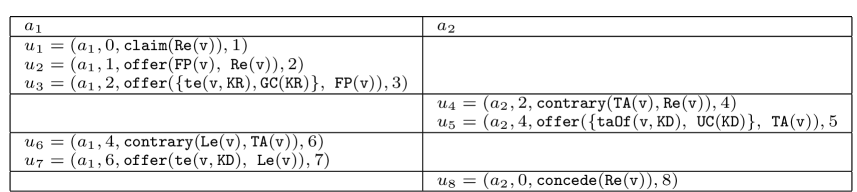
The image presents a table describing interactions between two agents, labeled a1 and a2. Each row represents a specific interaction or action (u1 to u8), detailing the agent involved, a numerical value, the type of action (claim, offer, contrary, concede), and associated parameters.
### Components/Axes
* **Columns:** Two columns labeled "a1" and "a2", representing the two agents.
* **Rows:** Each row represents a specific interaction or action, labeled u1 through u8.
* **Interaction Format:** Each interaction is represented in the format: `u[number] = (a[agent number], [numerical value], [action type]([parameters]), [interaction number])`
### Detailed Analysis or Content Details
**Agent a1:**
* **u1 = (a1, 0, claim(Re(v)), 1)**: Agent a1 makes a claim related to Re(v).
* **u2 = (a1, 1, offer(FP(v), Re(v)), 2)**: Agent a1 makes an offer involving FP(v) and Re(v).
* **u3 = (a1, 2, offer({te(v, KR), GC(KR)}, FP(v)), 3)**: Agent a1 makes an offer involving te(v, KR), GC(KR), and FP(v).
* **u6 = (a1, 4, contrary(Le(v), TA(v)), 6)**: Agent a1 expresses a contrary view regarding Le(v) and TA(v).
* **u7 = (a1, 6, offer(te(v, KD), Le(v)), 7)**: Agent a1 makes an offer involving te(v, KD) and Le(v).
**Agent a2:**
* **u4 = (a2, 2, contrary(TA(v), Re(v)), 4)**: Agent a2 expresses a contrary view regarding TA(v) and Re(v).
* **u5 = (a2, 4, offer({ta0f(v, KD), UC(KD)}, TA(v)), 5)**: Agent a2 makes an offer involving ta0f(v, KD), UC(KD), and TA(v).
* **u8 = (a2, 0, concede(Re(v)), 8)**: Agent a2 concedes regarding Re(v).
### Key Observations
* Both agents perform actions such as "claim", "offer", "contrary", and "concede".
* The actions involve different parameters, including Re(v), FP(v), te(v, KR), GC(KR), Le(v), TA(v), ta0f(v, KD), and UC(KD).
* The numerical values within the interactions seem to represent some form of state or progression.
* The interaction numbers (1 through 8) indicate a sequence of events.
### Interpretation
The diagram represents a simplified model of interactions between two agents in a negotiation or argumentation process. The agents exchange claims, offers, and counter-arguments, eventually leading to a concession by agent a2. The parameters within the actions likely represent different aspects or variables being negotiated. The numerical values could represent the agents' internal states or the progress of the negotiation. The diagram provides a high-level overview of the interaction flow and the types of actions performed by each agent.