## Hexagonal Grid Diagram: Black and Light Gray Pattern
### Overview
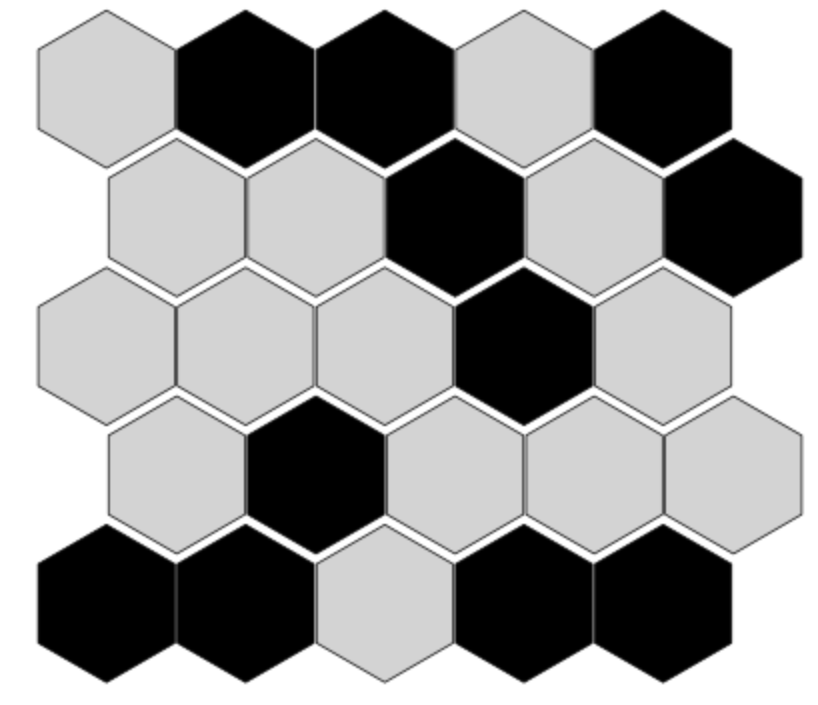
The image displays a diagram consisting of a tessellated grid of hexagons. The hexagons are arranged in a staggered, honeycomb-like pattern. There are two distinct fill colors used: solid black and a uniform light gray. No textual labels, titles, legends, axes, or numerical data are present in the image. The diagram appears to be a visual pattern or a representation of categorical data without explicit metadata.
### Components/Axes
* **Primary Components:** The diagram is composed solely of hexagonal cells.
* **Color Scheme:** Two colors are used:
* **Black:** Used to fill specific hexagons.
* **Light Gray:** Used to fill the remaining hexagons.
* **Layout:** The hexagons are arranged in 6 horizontal rows. The rows are offset, creating the classic hexagonal tiling pattern. The top and bottom rows contain 5 hexagons each, while the four middle rows contain 6 hexagons each.
* **Text/Labels:** **None.** There are no axis titles, category labels, data point labels, legends, or any embedded text within the diagram.
### Detailed Analysis
* **Total Hexagon Count:** 34 hexagons.
* **Color Distribution:**
* **Black Hexagons:** 10
* **Light Gray Hexagons:** 24
* **Spatial Pattern of Black Hexagons (Row-by-row from top):**
* **Row 1 (5 hexagons):** Positions 2, 3, and 5 are black. (Pattern: Gray, **Black**, **Black**, Gray, **Black**)
* **Row 2 (6 hexagons):** Positions 4 and 6 are black. (Pattern: Gray, Gray, Gray, **Black**, Gray, **Black**)
* **Row 3 (6 hexagons):** Position 4 is black. (Pattern: Gray, Gray, Gray, **Black**, Gray, Gray)
* **Row 4 (6 hexagons):** Position 3 is black. (Pattern: Gray, Gray, **Black**, Gray, Gray, Gray)
* **Row 5 (6 hexagons):** Position 2 is black. (Pattern: Gray, **Black**, Gray, Gray, Gray, Gray)
* **Row 6 (5 hexagons):** Positions 1, 2, 4, and 5 are black. (Pattern: **Black**, **Black**, Gray, **Black**, **Black**)
### Key Observations
1. **Non-Random Clustering:** The black hexagons are not uniformly distributed. There is a notable cluster of black hexagons in the top-right corner (Rows 1-2) and a dense cluster in the bottom-left corner (Row 6).
2. **Diagonal Trend:** A loose diagonal line of black hexagons can be traced from the top-right (Row 1, Pos 5) down towards the center-left (Row 5, Pos 2), though it is interrupted.
3. **Symmetry Absence:** The pattern exhibits no obvious rotational or reflective symmetry.
4. **High Contrast:** The use of only two, high-contrast colors (black and light gray) makes the pattern of black hexagons immediately visually salient.
### Interpretation
* **What the Data Suggests:** In the absence of labels, the diagram represents a binary categorical distribution across a hexagonal spatial grid. Each hexagon is in one of two states (black or gray). The pattern could represent anything from the results of a cellular automaton, a map of two types of terrain or zones, a visual encoding of binary data, or simply an abstract design.
* **How Elements Relate:** The relationship is purely spatial and categorical. The state (color) of each hexagon is independent but forms a collective visual pattern. The clustering suggests that the "black" state may have a spatial correlation or propagation rule.
* **Notable Anomalies:** The most striking feature is the dense block of four black hexagons in the bottom row, which contrasts with the more scattered distribution in the middle rows. This could indicate a boundary condition, an initial state, or a concentration of the measured phenomenon at the edge of the mapped area.
* **Peircean Investigative Reading:** As an icon, it directly resembles a honeycomb or tiled surface. As an index, the clustering implies a causal or correlational relationship between neighboring cells (e.g., if one cell is black, its neighbors are more likely to be black). As a symbol, its meaning is entirely dependent on external context not provided in the image—it could symbolize anything from a chessboard pattern to a molecular structure to a demographic heatmap. The primary takeaway is the existence of a non-uniform, clustered binary distribution on a hexagonal lattice.