## Hexagonal Grid: Alternating Pattern
### Overview
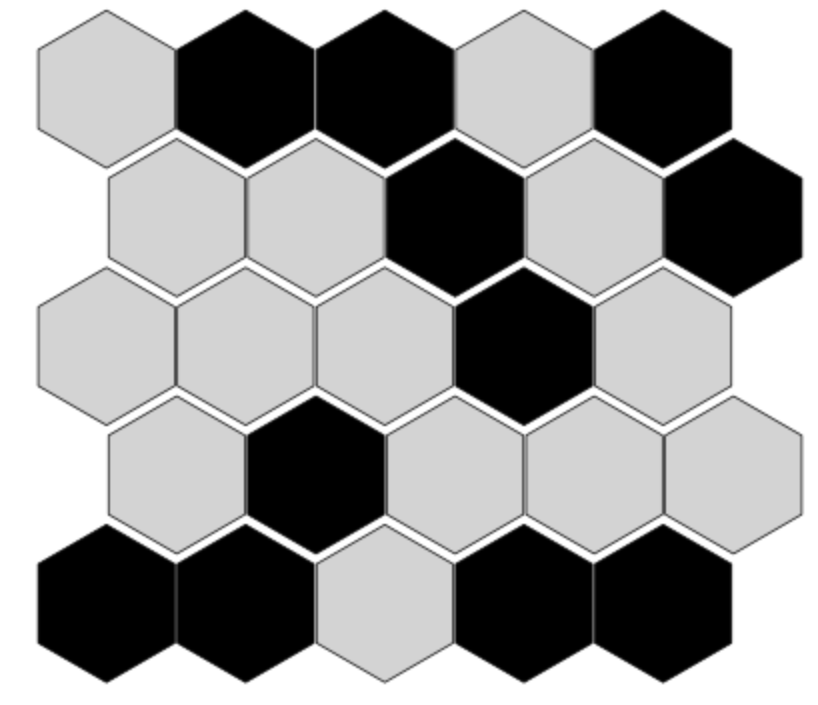
The image shows a grid composed of hexagonal tiles arranged in an alternating pattern of two colors: black and light gray. The grid is roughly square in shape, with some hexagons partially visible at the edges.
### Components/Axes
* **Tiles:** Individual hexagonal shapes.
* **Colors:** Black and light gray.
* **Arrangement:** Hexagons are arranged in a grid-like structure, with each hexagon surrounded by up to six other hexagons.
### Detailed Analysis
The grid consists of 30 hexagons. The hexagons are arranged in 5 rows.
* **Row 1:** Contains 5 hexagons, alternating light gray, black, light gray, black, light gray.
* **Row 2:** Contains 6 hexagons, alternating black, light gray, black, light gray, black, light gray.
* **Row 3:** Contains 6 hexagons, alternating light gray, black, light gray, black, light gray, black.
* **Row 4:** Contains 6 hexagons, alternating black, light gray, black, light gray, black, light gray.
* **Row 5:** Contains 5 hexagons, alternating light gray, black, light gray, black, light gray.
### Key Observations
The pattern is a repeating arrangement of black and light gray hexagons. The pattern is offset in each row, creating a visually interesting and tessellated effect.
### Interpretation
The image represents a simple, repeating pattern using hexagonal tiles. This type of pattern is commonly found in various applications, such as game boards, decorative designs, and scientific visualizations. The alternating colors create a clear visual distinction between adjacent tiles. The arrangement of the hexagons creates a tessellated surface, meaning that the shapes fit together without any gaps or overlaps.