## Hexagonal Grid Pattern: Abstract Tiling Design
### Overview
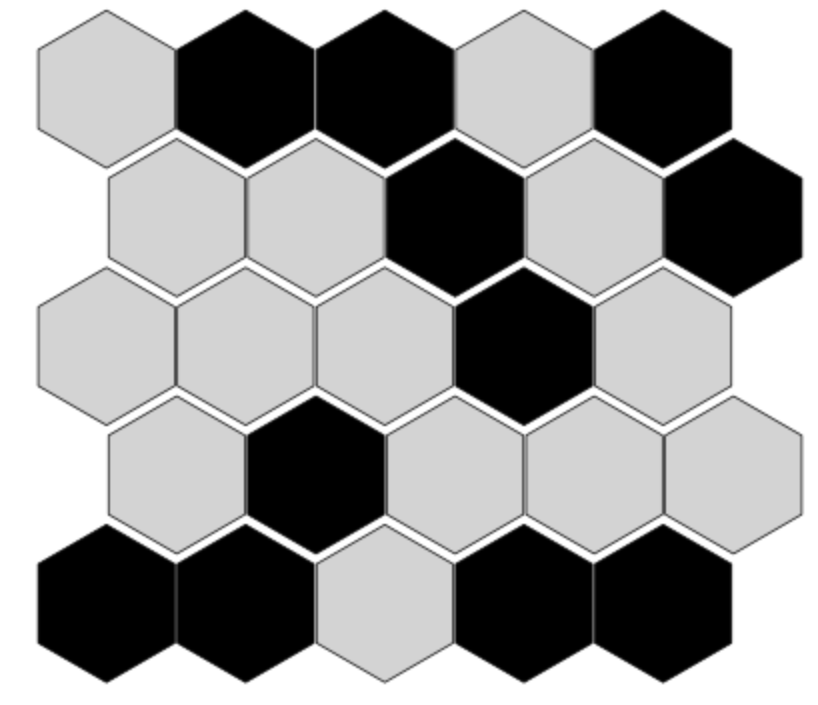
The image depicts a 2D hexagonal grid composed of alternating black and gray hexagons. The grid contains 5 rows and 6 columns, totaling 30 hexagons. Colors alternate irregularly, with no strict checkerboard pattern. No text, labels, or numerical data are present.
### Components/Axes
- **Grid Structure**: Hexagonal tiling with equal-sized cells.
- **Color Scheme**: Two distinct colors (black and gray) used to differentiate cells.
- **Absent Elements**: No legends, axis titles, or annotations.
### Data Analysis
- **Color Distribution**:
- Black hexagons: 14 (46.7%)
- Gray hexagons: 16 (53.3%)
- **Pattern**: Alternating colors with irregular placement. Some rows have clusters of the same color (e.g., Row 1: 3 black, 3 gray; Row 2: 2 black, 4 gray).
- **Spatial Grounding**:
- Legend: Not applicable (no legend present).
- Relative Placement: Colors alternate diagonally and horizontally, but no fixed positional rules.
### Key Observations
1. **Irregular Alternation**: Unlike a strict checkerboard, adjacent hexagons sometimes share the same color (e.g., Row 3: 4 consecutive gray hexagons).
2. **Edge Effects**: Bottom row has 5 black hexagons clustered together, deviating from the alternating pattern.
3. **Symmetry**: No rotational or reflective symmetry observed.
### Interpretation
The grid resembles a tiling pattern or abstract design, potentially used for visual encoding, artistic purposes, or as a placeholder. The irregular color distribution suggests intentional variation rather than a systematic encoding scheme. The lack of labels or context limits interpretability, but the pattern could represent a binary state system (e.g., on/off, active/inactive) if mapped to a dataset.
## No textual or numerical data present in the image.