## Text Analysis: Brahman and Atman
### Overview
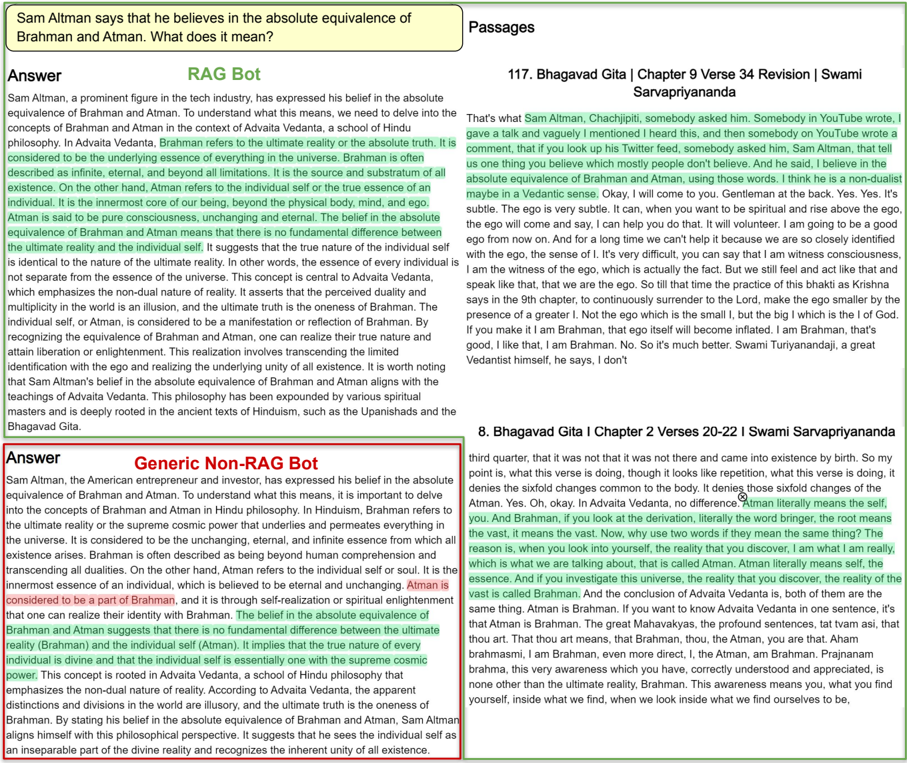
The image presents a question about Sam Altman's belief in the absolute equivalence of Brahman and Atman, followed by two different answers generated by "RAG Bot" and "Generic Non-RAG Bot". It also includes excerpts from passages related to the topic, specifically from the Bhagavad Gita.
### Components/Axes
* **Title:** Sam Altman says that he believes in the absolute equivalence of Brahman and Atman. What does it mean?
* **Answers:** Two answers are provided, one from "RAG Bot" and another from "Generic Non-RAG Bot".
* **Passages:** Excerpts from the Bhagavad Gita are included.
### Detailed Analysis or ### Content Details
**1. Question:**
* "Sam Altman says that he believes in the absolute equivalence of Brahman and Atman. What does it mean?"
**2. Answer from RAG Bot:**
* Sam Altman, a prominent figure in the tech industry, has expressed his belief in the absolute equivalence of Brahman and Atman.
* To understand this, one needs to delve into the concepts of Brahman and Atman in the context of Advaita Vedanta, a school of Hindu philosophy.
* In Advaita Vedanta, Brahman refers to the ultimate reality or the absolute truth. It is considered the underlying essence of everything in the universe. Brahman is often described as infinite, eternal, and beyond all limitations. It is the source and substratum of all existence.
* Atman refers to the individual self or the true essence of an individual. It is the innermost core of our being, beyond the physical body, mind, and ego.
* Atman is said to be pure consciousness, unchanging and eternal.
* The belief in the absolute equivalence of Brahman and Atman means that there is no fundamental difference between the ultimate reality and the individual self.
* It suggests that the true nature of the individual self is identical to the nature of the ultimate reality. In other words, the essence of every individual is not separate from the essence of the universe.
* This concept is central to Advaita Vedanta, which emphasizes the non-dual nature of reality. It asserts that the perceived duality and multiplicity in the world is an illusion, and the ultimate truth is the oneness of Brahman.
* The individual self, or Atman, is considered to be a manifestation or reflection of Brahman.
* Recognizing the equivalence of Brahman and Atman allows one to realize their true nature and attain liberation or enlightenment.
* This realization involves transcending the limited identification with the ego and realizing the underlying unity of all existence.
* Sam Altman's belief aligns with the teachings of Advaita Vedanta. This philosophy has been expounded by various spiritual masters and is deeply rooted in the ancient texts of Hinduism, such as the Upanishads and the Bhagavad Gita.
**3. Answer from Generic Non-RAG Bot:**
* Sam Altman, the American entrepreneur and investor, has expressed his belief in the absolute equivalence of Brahman and Atman.
* To understand this, it is important to delve into the concepts of Brahman and Atman in Hindu philosophy.
* In Hinduism, Brahman refers to the ultimate reality or the supreme cosmic power that underlies and permeates everything in the universe.
* It is considered to be the unchanging, eternal, and infinite essence from which all existence arises. Brahman is often described as being beyond human comprehension and transcending all dualities.
* Atman refers to the individual self or soul. It is the innermost essence of an individual, which is believed to be eternal and unchanging.
* Atman is considered to be a part of Brahman, and it is through self-realization or spiritual enlightenment that one can realize their identity with Brahman.
* The belief in the absolute equivalence of Brahman and Atman suggests that there is no fundamental difference between the ultimate reality (Brahman) and the individual self (Atman).
* It implies that the true nature of every individual is divine and that the individual self is essentially one with the supreme cosmic power.
* This concept is rooted in Advaita Vedanta, a school of Hindu philosophy that emphasizes the non-dual nature of reality.
* According to Advaita Vedanta, the apparent distinctions and divisions in the world are illusory, and the ultimate truth is the oneness of Brahman.
* By stating his belief in the absolute equivalence of Brahman and Atman, Sam Altman aligns himself with this philosophical perspective.
* It suggests that he sees the individual self as an inseparable part of the divine reality and recognizes the inherent unity of all existence.
**4. Passages:**
* **117. Bhagavad Gita | Chapter 9 Verse 34 Revision | Swami Sarvapriyananda:**
* A discussion about Sam Altman's belief in the absolute equivalence of Brahman and Atman, mentioning YouTube comments and the concept of non-dualism. It also touches upon the ego and its role in spirituality, referencing Krishna's teachings in the 9th chapter.
* **8. Bhagavad Gita I Chapter 2 Verses 20-22 | Swami Sarvapriyananda:**
* An explanation of the verses, denying the sixfold changes of the Atman. It explains that Atman literally means the self, and Brahman means the vast. The conclusion of Advaita Vedanta is that Atman is Brahman. It mentions the great Mahavakyas, such as "tat tvam asi" (that thou art) and "Aham brahmasmi" (I am Brahman).
### Key Observations
* Both "RAG Bot" and "Generic Non-RAG Bot" provide similar explanations of Brahman and Atman, emphasizing their equivalence in Advaita Vedanta.
* The passages from the Bhagavad Gita provide context and support for the concept of Brahman and Atman.
### Interpretation
The image presents a philosophical question and provides explanations from two different AI models, along with relevant passages from the Bhagavad Gita. The answers and passages suggest that the belief in the absolute equivalence of Brahman and Atman is rooted in Advaita Vedanta, which emphasizes the non-dual nature of reality and the oneness of the individual self with the ultimate reality. The passages from the Bhagavad Gita offer further insight into the concepts of Brahman and Atman, highlighting their significance in Hindu philosophy. The discussion about Sam Altman's belief adds a contemporary context to these ancient concepts.