TECHNICAL ASSET FINGERPRINT
632062ae7362e1d918c21616
Click to view fullscreen
Press ESC or click to close
FOUND IN PAPERS
EXPERT: healer-alpha-free VERSION 1
RUNTIME: free/openrouter/healer-alpha
INTEL_VERIFIED
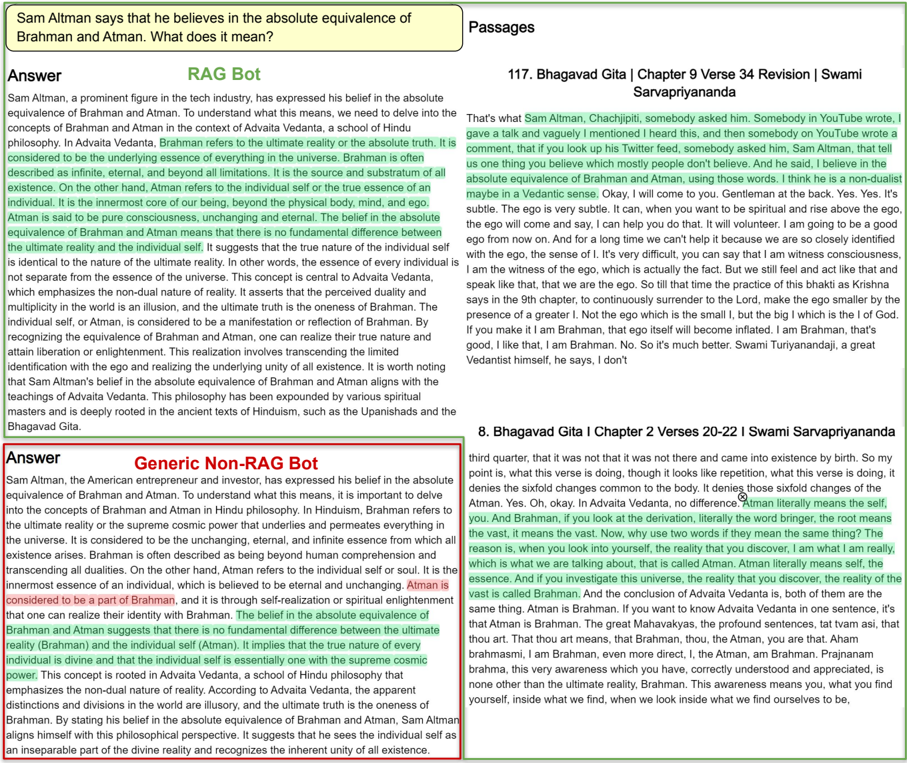
## Screenshot: Comparison of AI Responses on Sam Altman's Philosophical Statement
### Overview
This image is a screenshot comparing two AI-generated responses to the same question about Sam Altman's belief in the "absolute equivalence of Brahman and Atman." The layout is divided into a left column containing the question and two answer boxes, and a right column containing two supporting text passages. The visual design uses color-coded borders (green for "RAG Bot," red for "Generic Non-RAG Bot") and text highlighting to draw comparisons.
### Components/Axes
The image is segmented into the following distinct regions:
1. **Header/Question Box (Top-Left):**
* **Text:** "Sam Altman says that he believes in the absolute equivalence of Brahman and Atman. What does it mean?"
* **Style:** Black text on a light yellow background, enclosed in a thin black border.
2. **Left Column - Answer Boxes:**
* **RAG Bot Answer (Top):**
* **Label:** "Answer" (top-left), "RAG Bot" (top-center, in green).
* **Border:** Green.
* **Content:** A detailed, multi-paragraph explanation. Key terms and phrases are highlighted in light green (e.g., "Brahman refers to the ultimate reality," "Atman refers to the individual self," "no fundamental difference," "Advaita Vedanta," "Upanishads and the Bhagavad Gita").
* **Generic Non-RAG Bot Answer (Bottom):**
* **Label:** "Answer" (top-left), "Generic Non-RAG Bot" (top-center, in red).
* **Border:** Red.
* **Content:** A shorter, less detailed explanation. Key terms are highlighted in light red (e.g., "Brahman refers to the ultimate reality or the supreme cosmic power," "Atman refers to the individual self or soul," "no fundamental difference," "Advaita Vedanta").
3. **Right Column - Passages:**
* **Passage 1 (Top-Right):**
* **Title:** "117. Bhagavad Gita | Chapter 9 Verse 34 Revision | Swami Sarvapriyananda"
* **Content:** A transcript of a spoken discourse. It discusses Sam Altman's statement, non-dualism, the ego, and the practice of *bhakti*. Several sentences are highlighted in light green, which directly correspond to concepts in the RAG Bot's answer (e.g., "I believe in the absolute equivalence of Brahman and Atman," "non-dualist," "Atman is Brahman").
* **Passage 2 (Bottom-Right):**
* **Title:** "8. Bhagavad Gita | Chapter 2 Verses 20-22 | Swami Sarvapriyananda"
* **Content:** Another transcript discussing the nature of Atman, its etymology ("the self, you"), and the core Advaita Vedanta teaching "tat tvam asi" (thou art that). Key definitions and the central equation "Atman is Brahman" are highlighted in light green.
### Detailed Analysis
**Textual Content & Comparison:**
* **RAG Bot Answer:** Provides a structured, academic-style explanation. It correctly defines Brahman (ultimate reality, infinite, eternal) and Atman (individual self, pure consciousness) within the context of **Advaita Vedanta**. It states the core belief: "there is no fundamental difference between the ultimate reality and the individual self." It elaborates on the implications (illusion of duality, path to enlightenment) and cites source texts (**Upanishads, Bhagavad Gita**). The highlighted text aligns perfectly with the definitions and concepts found in the right-hand passages.
* **Generic Non-RAG Bot Answer:** Offers a more general and slightly less precise explanation. It defines Brahman as "supreme cosmic power" and Atman as "individual self or soul." It also states the "no fundamental difference" conclusion and mentions Advaita Vedanta. However, its explanation is less detailed, and it incorrectly states "Atman is considered to be a part of Brahman," which is a nuanced point not emphasized in the RAG Bot's more accurate "identical in nature" phrasing. Its highlighted terms are more basic.
* **Passages:** The two passages from Swami Sarvapriyananda serve as source material. The highlighted text in these passages forms the direct foundation for the RAG Bot's answer. For example, the RAG Bot's definition of Atman as "the innermost core of our being" mirrors the passage's discussion of looking inside oneself to find Atman. The explicit statement "I believe in the absolute equivalence of Brahman and Atman" is quoted in Passage 1.
**Spatial Grounding & Cross-Reference:**
* The **green highlights** in the RAG Bot's answer (left) correspond semantically and often verbatim to the **green highlights** in the passages on the right.
* The **red highlights** in the Generic Non-RAG Bot's answer are more generic and do not show the same direct, detailed correlation with the source passages.
* The legend is implicit: Green border/highlight = RAG Bot (supported by source text). Red border/highlight = Generic Non-RAG Bot (less supported).
### Key Observations
1. **Accuracy & Depth Disparity:** The RAG Bot's answer is significantly more detailed, contextually accurate, and directly supported by the provided source texts. The Generic Non-RAG Bot's answer is correct in broad strokes but lacks precision and depth.
2. **Source Attribution:** The RAG Bot's answer demonstrates clear retrieval and synthesis from the provided passages (e.g., referencing specific schools of thought and texts). The Generic Non-RAG Bot's answer appears to rely on general knowledge without specific source linkage.
3. **Visual Coding:** The image uses a clear color scheme (green vs. red) to visually argue for the superiority of the RAG-based response. The highlighting creates a direct visual map between the RAG Bot's claims and the evidence in the passages.
4. **Content of Passages:** The passages themselves are transcripts of philosophical discourses explaining Advaita Vedanta concepts, using Sam Altman's statement as a contemporary hook. They emphasize the non-dual identity of Atman and Brahman ("tat tvam asi").
### Interpretation
This image is a technical demonstration or marketing material designed to showcase the advantage of **Retrieval-Augmented Generation (RAG)** over a generic large language model.
* **What it demonstrates:** It argues that a RAG system, when provided with relevant source documents (the Bhagavad Gita passages), can generate a response that is not only more accurate and detailed but also explicitly grounded in those sources. The Generic Bot, lacking this retrieval step, produces a plausible but shallower and slightly less accurate answer based on its parametric memory alone.
* **How elements relate:** The layout is a direct comparison. The question is the constant. The two answers are the variables being tested. The passages on the right act as the "ground truth" or reference corpus. The highlighting is the analytical tool that proves the RAG Bot's answer is derived from that corpus.
* **Notable Anomaly:** The Generic Bot's statement that "Atman is considered to be a part of Brahman" is a subtle but important philosophical inaccuracy in the context of strict Advaita Vedanta, which teaches absolute non-difference, not a part-whole relationship. This highlights the risk of hallucination or oversimplification in non-RAG systems.
* **Underlying Message:** The image suggests that for complex, nuanced, or domain-specific queries (like philosophical exegesis), a RAG architecture is essential for producing reliable, verifiable, and high-quality information. It visually argues that "grounding" in source material is key to factual and contextual fidelity.
DECODING INTELLIGENCE...