## Screenshot: Webpage with Textual Content and Highlighted Answers
### Overview
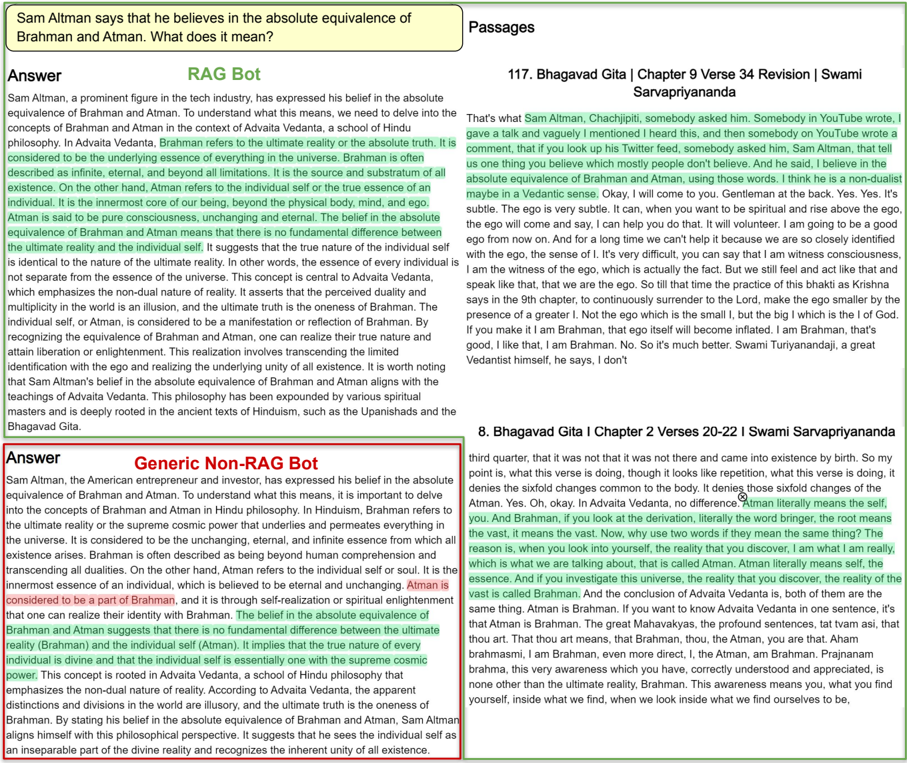
The image is a screenshot of a webpage containing textual content, including two answers to a question about the equivalence of Brahman and Atman in Hindu philosophy. The answers are attributed to a "RAG Bot" and a "Generic Non-RAG Bot," with specific text segments highlighted in green and red, respectively. The page also includes references to passages from the *Bhagavad Gita* and discussions about Advaita Vedanta philosophy.
---
### Components/Axes
- **Main Content**:
- **Question**: "Sam Altman says that he believes in the absolute equivalence of Brahman and Atman. What does it mean?"
- **Answers**:
1. **RAG Bot Answer** (highlighted in green).
2. **Generic Non-RAG Bot Answer** (highlighted in red).
- **Passages**:
- *Bhagavad Gita* (Chapter 9, Verse 34; Chapter 2, Verses 20-22).
- References to Advaita Vedanta, Sam Altman, and Swami Turiyananda.
- **Highlighting**:
- Green highlights in the RAG Bot Answer.
- Red highlights in the Generic Non-RAG Bot Answer.
---
### Detailed Analysis
#### RAG Bot Answer (Green Highlights)
- **Key Text**:
- "Brahman refers to the ultimate reality or the absolute truth. It is considered to be the underlying essence of everything in the universe."
- "Atman refers to the individual self or the source and true essence of an individual. It is the innermost core of our being, beyond the physical body, mind, and ego."
- "The belief in the absolute equivalence of Brahman and Atman means that there is no fundamental difference between the ultimate reality and the individual self."
- "This concept is central to Advaita Vedanta, which emphasizes the non-dual nature of reality."
- **Highlighted Segments**:
- "Brahman refers to the ultimate reality..."
- "Atman refers to the individual self..."
- "Absolute equivalence of Brahman and Atman..."
- "Non-dual nature of reality."
#### Generic Non-RAG Bot Answer (Red Highlights)
- **Key Text**:
- "Brahman refers to the ultimate reality or the supreme cosmic power that underlies and permeates everything in the universe."
- "Atman refers to the individual self or soul, which is eternal and unchanging."
- "The belief in the absolute equivalence of Brahman and Atman suggests that the individual self is divine and essentially one with the supreme cosmic power."
- **Highlighted Segments**:
- "Brahman refers to the ultimate reality..."
- "Atman refers to the individual self..."
- "Absolute equivalence of Brahman and Atman..."
- "Individual self is divine..."
#### Passages
- **Bhagavad Gita (Chapter 9, Verse 34)**:
- Discusses the ego's subtlety and its role in spiritual practice.
- Highlighted: "I am witness consciousness, with the ego, the sense of I. It’s very difficult, you can say that I am witness consciousness..."
- **Bhagavad Gita (Chapter 2, Verses 20-22)**:
- Denies the sixfold changes of the body and emphasizes the non-dual nature of Atman and Brahman.
- Highlighted: "Atman literally means the self, you. And Brahman, if you look at the derivation, literally the word bringer, the root means the vast..."
---
### Key Observations
1. **RAG Bot Answer**:
- Provides a detailed, structured explanation of Brahman and Atman, aligning with Advaita Vedanta principles.
- Highlights emphasize the non-dual nature of reality and the equivalence of Brahman and Atman.
2. **Generic Non-RAG Bot Answer**:
- Offers a more concise explanation but includes similar core concepts (e.g., Brahman as cosmic power, Atman as eternal self).
- Highlights focus on the divine nature of the individual self and its unity with Brahman.
3. **Passages**:
- The *Bhagavad Gita* excerpts reinforce the philosophical context, with Swami Turiyananda’s commentary emphasizing the ego’s role in spiritual practice.
---
### Interpretation
- **Philosophical Context**:
- Both answers align with Advaita Vedanta, which posits that Brahman (ultimate reality) and Atman (individual self) are non-dual. The RAG Bot’s answer is more verbose and directly references Advaita Vedanta, while the Generic answer simplifies the concepts.
- **Highlighting Significance**:
- Green highlights in the RAG Bot Answer emphasize foundational definitions and the non-dual philosophy.
- Red highlights in the Generic answer focus on the individual’s divine nature and unity with Brahman.
- **Notable Patterns**:
- Both answers agree on the equivalence of Brahman and Atman but differ in depth and terminology.
- The *Bhagavad Gita* passages provide scriptural support for these concepts, with Swami Turiyananda’s commentary adding practical insights.
- **Implications**:
- The RAG Bot’s answer appears more aligned with scholarly interpretations of Advaita Vedanta, while the Generic answer may prioritize accessibility.
- The use of highlights suggests an attempt to emphasize key philosophical distinctions or shared ideas.
---
**Note**: No numerical data, charts, or diagrams are present in the image. All extracted information is textual.