\n
## Document: Guidelines for Pattern Recognition in Mappings
### Overview
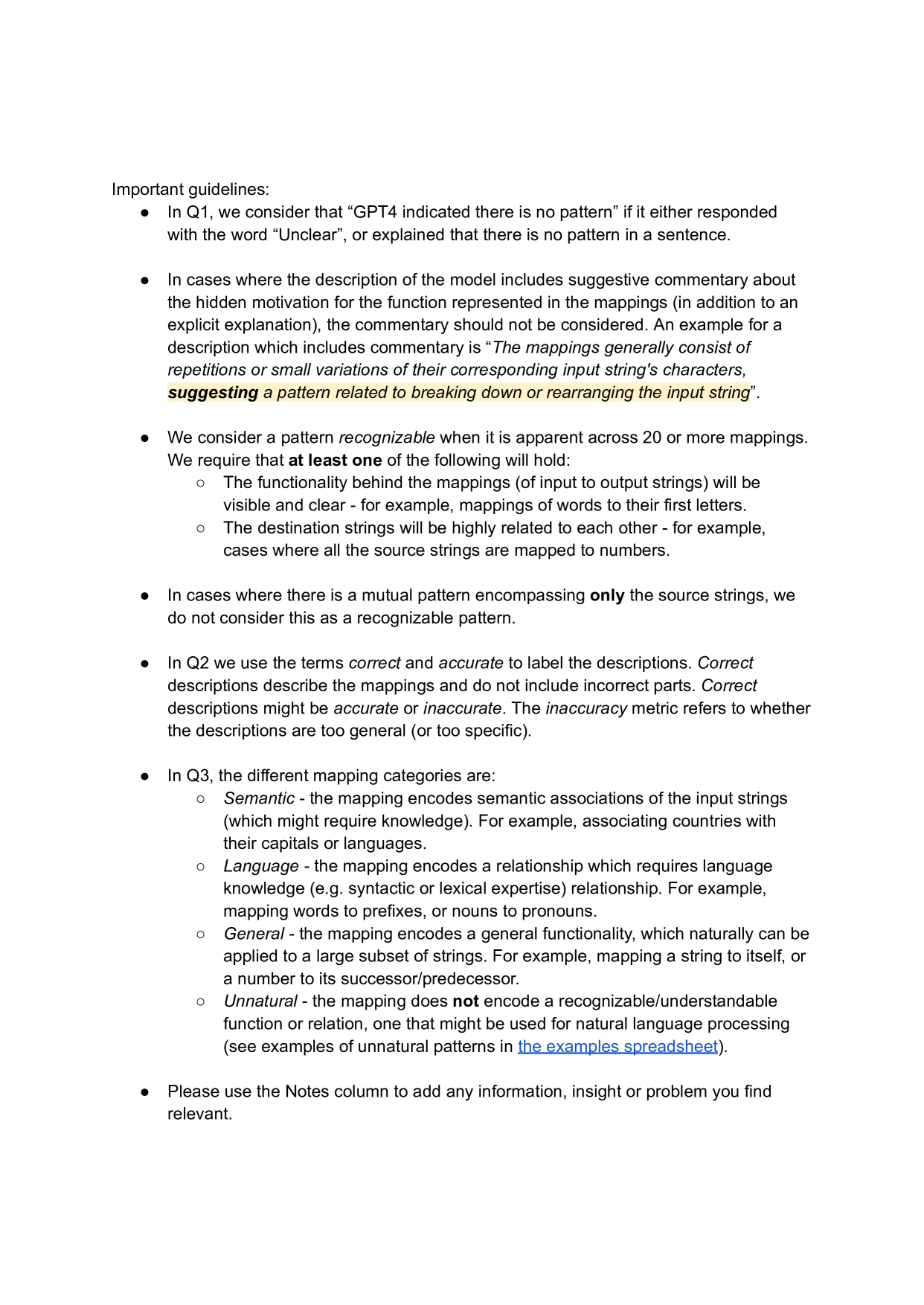
The image presents a document outlining guidelines for identifying patterns in mappings, likely within the context of evaluating a language model (GPT4) or similar system. The document details criteria for determining whether a mapping between input and output strings constitutes a recognizable pattern, and defines categories for classifying the nature of those patterns. It also provides instructions for documenting observations.
### Components/Axes
The document is structured as a series of bullet points and indented sub-points. There are no axes or charts present. The document is entirely textual.
### Content Details
Here's a transcription of the document's content:
* **Important guidelines:**
* In Q1, we consider that “GPT4 indicated there is no pattern” if it either responded with the word “Unclear”, or explained that there is no pattern in a sentence.
* In cases where the description of the model includes suggestive commentary about the hidden motivation for the function represented in the mappings (in addition to an explicit explanation), the commentary should not be considered. An example for a description which includes commentary is “The mappings generally consist of repetitions or small variations of their corresponding input string’s characters, suggesting a pattern related to breaking down or rearranging the input string”.
* We consider a pattern recognizable when it is apparent across 20 or more mappings. We require that at least one of the following will hold:
* The functionality behind the mappings (of input to output strings) will be visible and clear - for example, mappings of words to their first letters.
* The destination strings will be highly related to each other - for example, cases where all the source strings are mapped to numbers.
* In cases where there is a mutual pattern encompassing only the source strings, we do not consider this as a recognizable pattern.
* In Q2 we use the terms correct and accurate to label the descriptions. Correct descriptions describe the mappings and do not include incorrect parts. Correct descriptions might be accurate or inaccurate. The inaccuracy metric refers to whether the descriptions are too general (or too specific).
* In Q3, the different mapping categories are:
* **Semantic** - the mapping encodes semantic associations of the input strings (which might require knowledge). For example, associating countries with their capitals or languages.
* **Language** - the mapping encodes a relationship which requires language knowledge (e.g. syntactic or lexical expertise) relationship. For example, mapping words to prefixes, or nouns to pronouns.
* **General** - the mapping encodes a general functionality, which naturally can be applied to a large subset of strings. For example, mapping a string to itself, or a number to its successor/predecessor.
* **Unnatural** - the mapping does not encode a recognizable/understandable function or relation, one that might be used for natural language processing (see examples of unnatural patterns in the examples spreadsheet).
* Please use the Notes column to add any information, insight or problem you find relevant.
### Key Observations
The document focuses on establishing a rigorous framework for evaluating pattern recognition capabilities. The criteria emphasize both the *presence* of a pattern (across a sufficient number of examples) and the *recognizability* of that pattern (whether it's clear and understandable). The categorization of mapping types (Semantic, Language, General, Unnatural) provides a structured way to analyze the nature of the patterns identified. The distinction between "correct" and "accurate" descriptions is also important, highlighting that a description can be technically correct (not containing errors) but still inaccurate (too broad or too narrow).
### Interpretation
This document appears to be a set of instructions for human annotators or evaluators tasked with assessing the performance of a machine learning model (GPT4) on a pattern recognition task. The guidelines are designed to minimize subjectivity and ensure consistency in evaluations. The emphasis on a minimum number of mappings (20) suggests a need to avoid false positives – identifying patterns based on limited data. The categorization of mapping types is crucial for understanding *what kind* of patterns the model is capable of recognizing. The document's overall goal is to establish a reliable and objective method for measuring the model's ability to discern meaningful relationships between input and output strings. The inclusion of a "Notes" column indicates that the evaluators are expected to provide qualitative feedback alongside their quantitative assessments. The document is a meta-cognitive tool for evaluating a cognitive system.