## Text Document: Guidelines for Pattern Recognition and Mapping Evaluation
### Overview
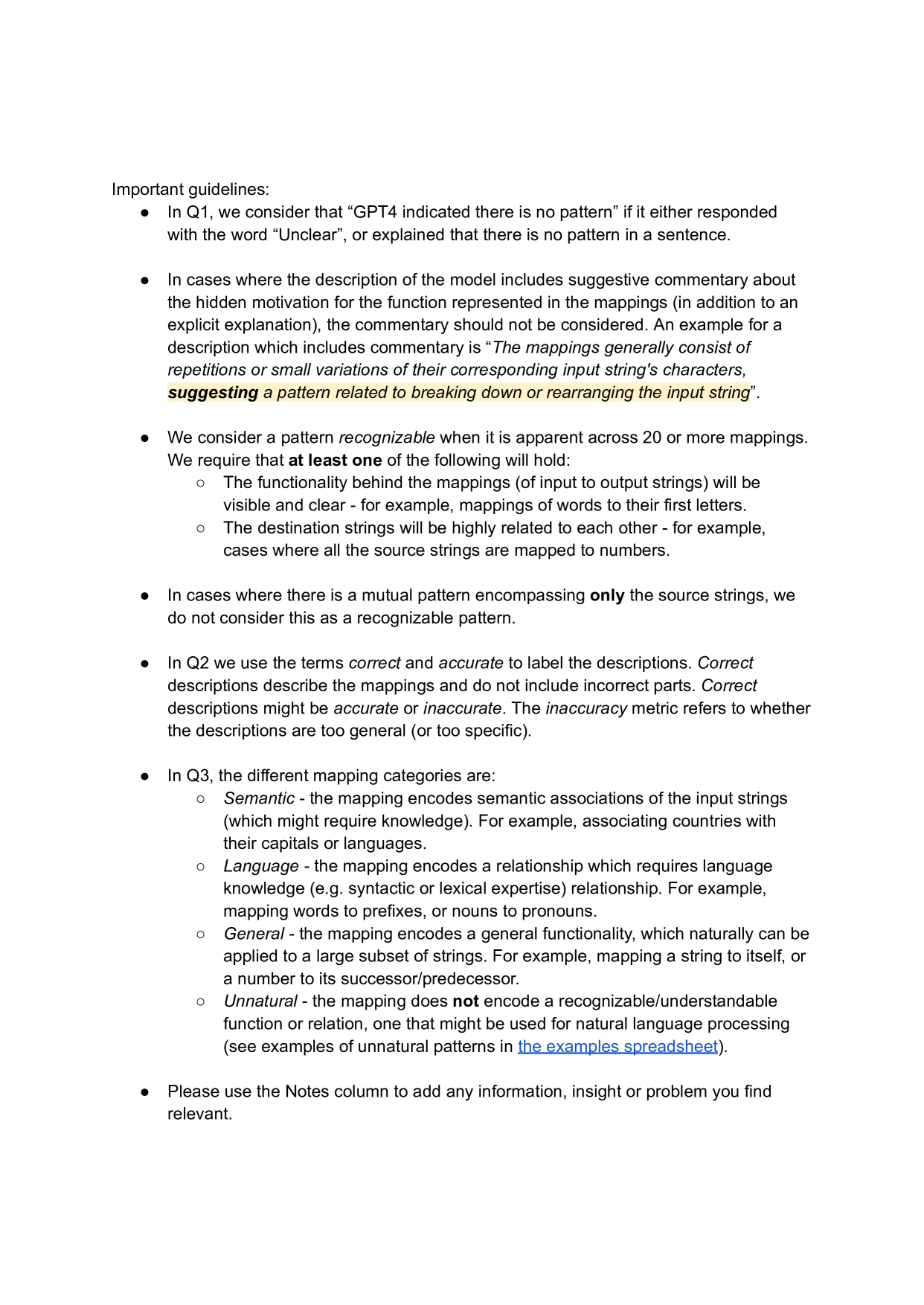
The document outlines critical guidelines for evaluating mappings between input and output strings, focusing on pattern recognition, labeling accuracy, and categorization of mappings. It emphasizes consistency in identifying patterns, defining "correct" vs. "inaccurate" descriptions, and classifying mappings into semantic, linguistic, general, or unnatural categories.
### Components/Axes
- **Headings**:
- "Important guidelines" (main section)
- Subheadings for each guideline (e.g., "In Q1...", "In Q2...", etc.)
- **Bullet Points**:
- Structured as hierarchical rules with subpoints (e.g., "o The functionality...").
- **Highlighted Text**:
- "suggesting a pattern related to breaking down or rearranging the input string" (bolded and underlined).
### Detailed Analysis
1. **Guideline 1 (Q1)**:
- Defines "GPT4 indicates there is no pattern" if the response includes "Unclear" or explicitly states no pattern.
2. **Guideline 2**:
- Excludes mappings with suggestive commentary about hidden motivations unless explicitly explained.
3. **Guideline 3**:
- Requires patterns to appear in **at least 20 mappings** to be considered recognizable.
- Subpoints:
- Functionality behind mappings must be visible (e.g., word-to-first-letter mappings).
- Destination strings must be highly related (e.g., all source strings mapped to numbers).
4. **Guideline 4**:
- Mutual patterns **only in source strings** are not considered recognizable.
5. **Guideline 5 (Q2)**:
- Labels descriptions as "correct" (accurate, no incorrect parts) or "inaccurate" (too general/specific).
6. **Guideline 6 (Q3)**:
- Mapping categories:
- **Semantic**: Associations requiring knowledge (e.g., countries → capitals).
- **Language**: Requires linguistic expertise (e.g., word → prefix mappings).
- **General**: Applies broadly (e.g., string → itself).
- **Unnatural**: Does not encode a recognizable function (e.g., non-linguistic relationships).
7. **Guideline 7**:
- Instructs using the "Notes" column for additional context or issues.
### Key Observations
- **Pattern Recognition Threshold**: A pattern must appear in ≥20 mappings to be deemed recognizable.
- **Labeling Criteria**: "Correct" descriptions are precise; "inaccurate" ones are overly broad or narrow.
- **Mapping Categories**: Four distinct types are defined, with "Unnatural" explicitly excluding non-linguistic relationships.
- **Highlighted Pattern**: Breaking down/rearranging input strings is flagged as a critical pattern to identify.
### Interpretation
The guidelines aim to standardize evaluations of mappings in tasks like natural language processing or data transformation. By requiring patterns to appear frequently (≥20 mappings) and defining strict criteria for "correctness," the document ensures consistency in identifying meaningful relationships. The categorization of mappings (semantic, linguistic, etc.) helps contextualize their utility, while the emphasis on visible functionality and destination string relationships prevents overfitting to trivial or ambiguous patterns. The highlighted text underscores the importance of structural transformations (e.g., splitting/rearranging strings) as a key pattern to prioritize.