## Textual Comparison: Mathematical Reasoning Performance
### Overview
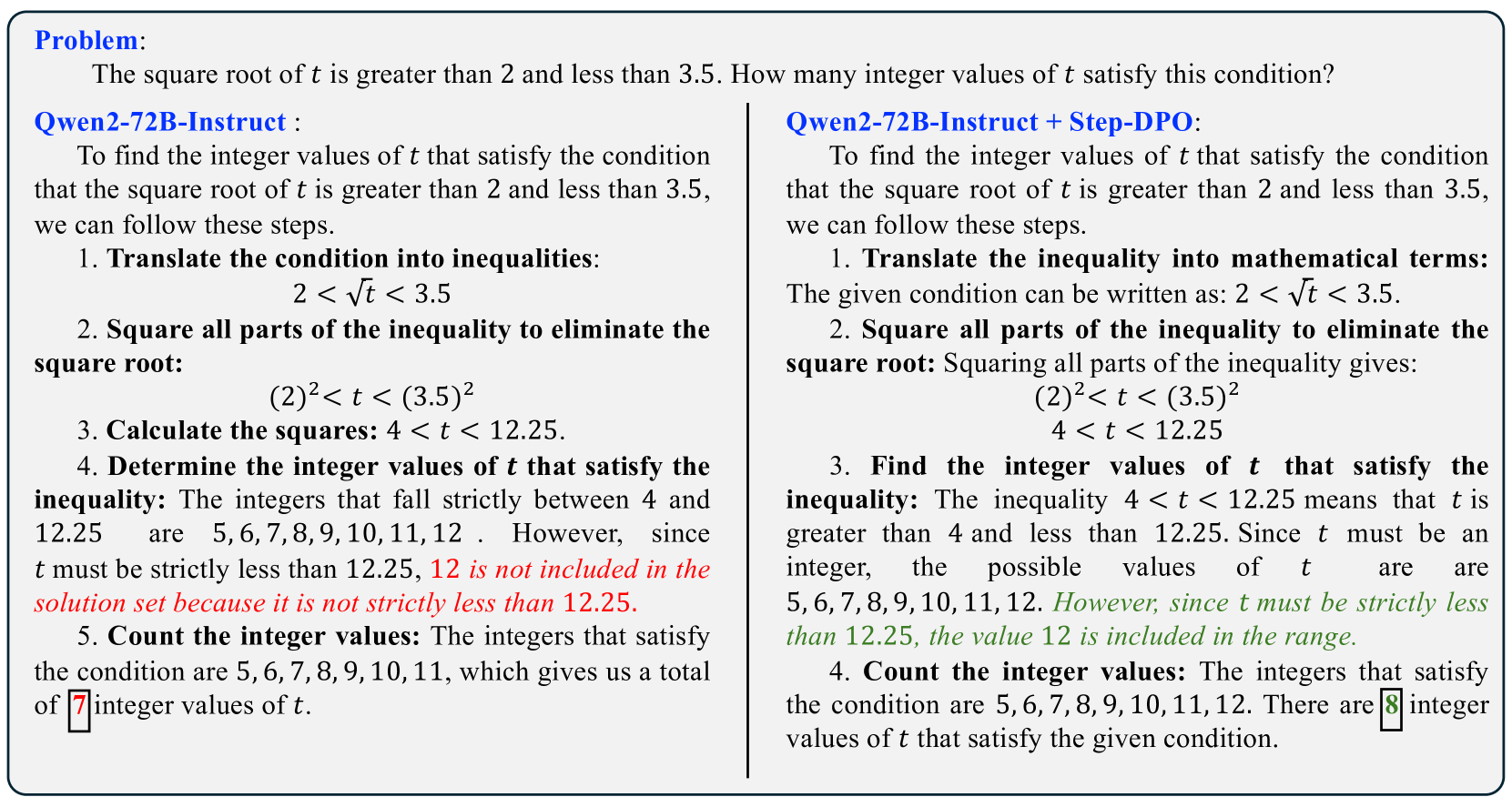
The image displays a side-by-side comparison of two Large Language Models (LLMs) attempting to solve the same mathematical problem. The left column shows the output of "Qwen2-72B-Instruct," while the right column shows the output of "Qwen2-72B-Instruct + Step-DPO." The image serves as a demonstration of how the Step-DPO (Direct Preference Optimization) training method improves the logical reasoning capabilities of the model, specifically regarding inequality boundaries.
### Components
* **Header:** The problem statement, which is common to both models.
* **Left Column (Qwen2-72B-Instruct):** A 5-step solution containing a logical error.
* **Right Column (Qwen2-72B-Instruct + Step-DPO):** A 4-step solution that correctly identifies the solution set.
---
### Detailed Analysis
#### Problem Statement (Top)
"**Problem:** The square root of $t$ is greater than 2 and less than 3.5. How many integer values of $t$ satisfy this condition?"
#### Left Column: Qwen2-72B-Instruct
1. **Translate the condition into inequalities:** $2 < \sqrt{t} < 3.5$
2. **Square all parts of the inequality to eliminate the square root:** $(2)^2 < t < (3.5)^2$
3. **Calculate the squares:** $4 < t < 12.25$.
4. **Determine the integer values of $t$ that satisfy the inequality:** The integers that fall strictly between 4 and 12.25 are 5, 6, 7, 8, 9, 10, 11, 12. However, since $t$ must be strictly less than 12.25, **12 is not included in the solution set because it is not strictly less than 12.25.** (Note: This statement is mathematically incorrect).
5. **Count the integer values:** The integers that satisfy the condition are 5, 6, 7, 8, 9, 10, 11, which gives us a total of **7** integer values of $t$.
#### Right Column: Qwen2-72B-Instruct + Step-DPO
1. **Translate the inequality into mathematical terms:** The given condition can be written as: $2 < \sqrt{t} < 3.5$.
2. **Square all parts of the inequality to eliminate the square root:** Squaring all parts of the inequality gives: $(2)^2 < t < (3.5)^2$; $4 < t < 12.25$.
3. **Find the integer values of $t$ that satisfy the inequality:** The inequality $4 < t < 12.25$ means that $t$ is greater than 4 and less than 12.25. Since $t$ must be an integer, the possible values of $t$ are 5, 6, 7, 8, 9, 10, 11, 12. However, since $t$ must be strictly less than 12.25, the value 12 is included in the range.
4. **Count the integer values:** The integers that satisfy the condition are 5, 6, 7, 8, 9, 10, 11, 12. There are **8** integer values of $t$ that satisfy the given condition.
---
### Key Observations
* **Logical Error:** The standard "Qwen2-72B-Instruct" model fails at the final step of reasoning. It correctly identifies the range ($4 < t < 12.25$) but incorrectly concludes that 12 is not less than 12.25, leading to an incorrect count of 7.
* **Correct Reasoning:** The "Step-DPO" version correctly identifies that 12 is less than 12.25 and includes it in the set, resulting in the correct count of 8.
* **Conciseness:** The Step-DPO version is more efficient, condensing the solution into 4 steps compared to the 5 steps used by the standard model.
### Interpretation
This image is a diagnostic comparison used to validate the efficacy of Step-DPO training.
1. **The Failure Mode:** The standard model exhibits a common LLM failure mode: "boundary confusion." It correctly performs the algebraic manipulation but fails to apply basic arithmetic logic to the resulting inequality ($12 < 12.25$).
2. **The Improvement:** The Step-DPO model demonstrates improved "chain-of-thought" reasoning. It explicitly validates the inclusion of the boundary integer (12), showing that the training process has successfully reinforced the model's ability to verify its own intermediate steps.
3. **Conclusion:** The data suggests that Step-DPO is highly effective at correcting specific reasoning flaws in LLMs, transforming a model that produces a "hallucinated" or logically inconsistent answer into one that provides a mathematically sound result.