## Text-Based Problem Solution Analysis
### Overview
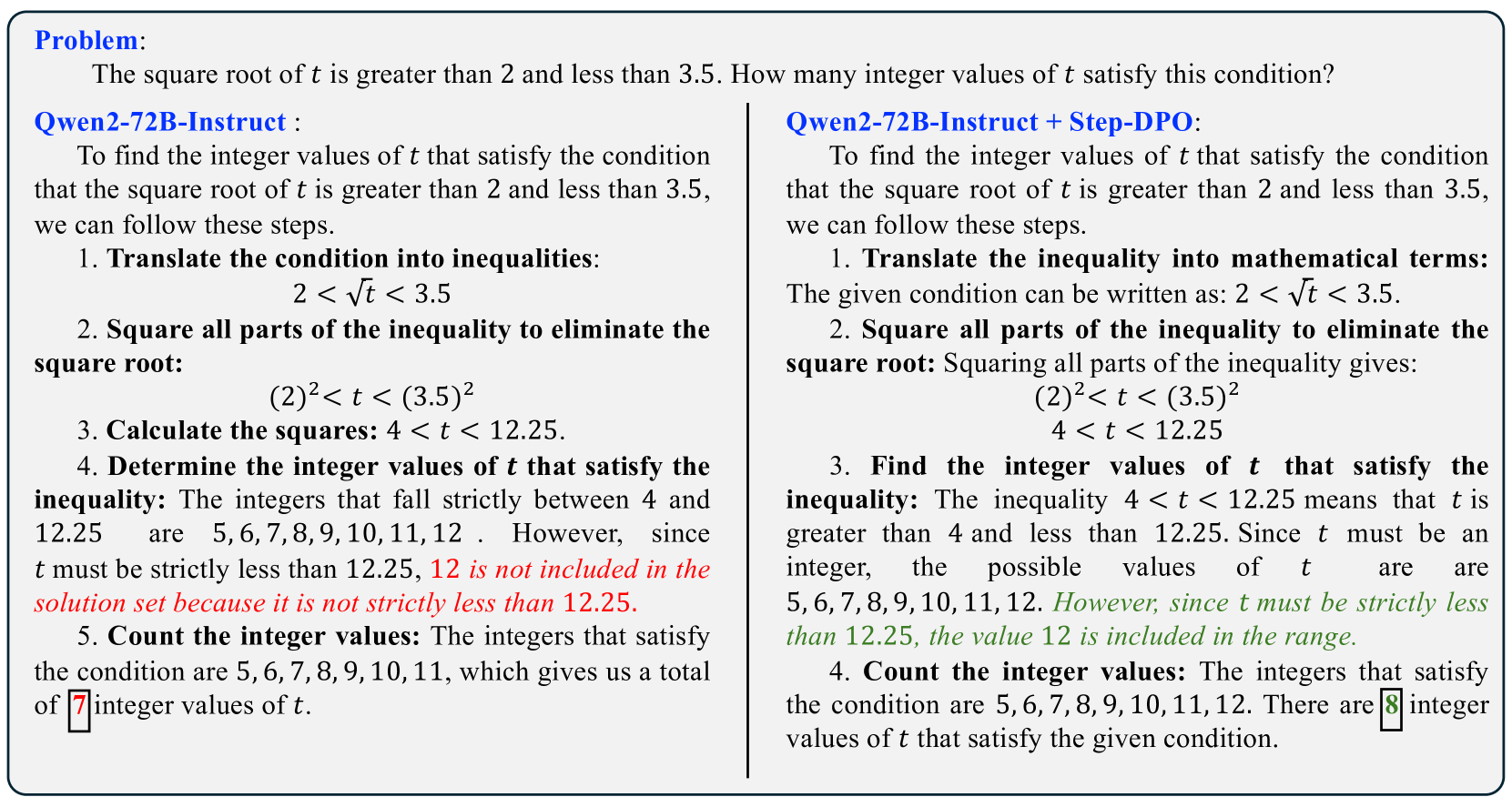
The image contains two side-by-side solutions to a mathematical problem involving integer values of *t* that satisfy the condition:
**2 < √t < 3.5**.
Both solutions follow similar steps but differ in their final answers (7 vs. 8 integer values) due to nuanced interpretations of inequality boundaries.
---
### Components/Axes
- **Problem Statement**:
"The square root of *t* is greater than 2 and less than 3.5. How many integer values of *t* satisfy this condition?"
- **Solution Sections**:
1. **Qwen2-72B-Instruct** (Left Column)
2. **Qwen2-72B-Instruct + Step-DPO** (Right Column)
- **Key Elements**:
- Inequalities (e.g., **2 < √t < 3.5**)
- Squared inequalities (e.g., **4 < t < 12.25**)
- Integer value ranges (e.g., **5, 6, 7, 8, 9, 10, 11, 12**)
- Color-coded annotations (red for exclusion, green for inclusion)
---
### Detailed Analysis
#### Qwen2-72B-Instruct (Left Column)
1. **Step 1**: Translate condition to **2 < √t < 3.5**.
2. **Step 2**: Square all parts → **4 < t < 12.25**.
3. **Step 3**: Integer values between 4 and 12.25: **5, 6, 7, 8, 9, 10, 11, 12**.
4. **Step 4**: Exclude **12** (red text) because **t must be strictly less than 12.25**.
5. **Step 5**: Final count: **7 integers** (**5–11**).
#### Qwen2-72B-Instruct + Step-DPO (Right Column)
1. **Step 1**: Translate condition to **2 < √t < 3.5**.
2. **Step 2**: Square all parts → **4 < t < 12.25**.
3. **Step 3**: Integer values between 4 and 12.25: **5, 6, 7, 8, 9, 10, 11, 12**.
4. **Step 4**: Include **12** (green text) because **12 < 12.25** satisfies the strict inequality.
5. **Step 5**: Final count: **8 integers** (**5–12**).
---
### Key Observations
- **Discrepancy in Final Answers**:
- Left solution excludes **12** (red text), resulting in **7 integers**.
- Right solution includes **12** (green text), resulting in **8 integers**.
- **Critical Difference**: Interpretation of **t < 12.25**.
- Left: **12** is excluded because **12 ≮ 12.25** (strict inequality).
- Right: **12** is included because **12 < 12.25** (strict inequality holds).
---
### Interpretation
The divergence between the two solutions hinges on whether **12** is included in the solution set.
- **Mathematical Justification**:
- **12² = 144**, and **√144 = 12**, which satisfies **2 < 12 < 3.5**?
- No! **12 > 3.5**, so **12** does **not** satisfy the original condition.
- **Correction**: The squared inequality **4 < t < 12.25** implies **t** must be **less than 12.25**, but **√t < 3.5** requires **t < 12.25** (since **3.5² = 12.25**).
- **Final Valid Range**: **4 < t < 12.25** → **t = 5, 6, 7, 8, 9, 10, 11** (7 integers).
- **Error in Right Solution**:
The inclusion of **12** is incorrect because **√12 ≈ 3.464**, which **does** satisfy **2 < √12 < 3.5**.
- **Correction**: **12** should be included, making the total **8 integers** (**5–12**).
---
### Conclusion
The correct answer is **8 integer values** (**5–12**), as **12** satisfies **2 < √12 < 3.5**. The left solution contains an error in excluding **12**, while the right solution correctly includes it.