## Chart: Jeffreys Mixed Prior Posterior Mass
### Overview
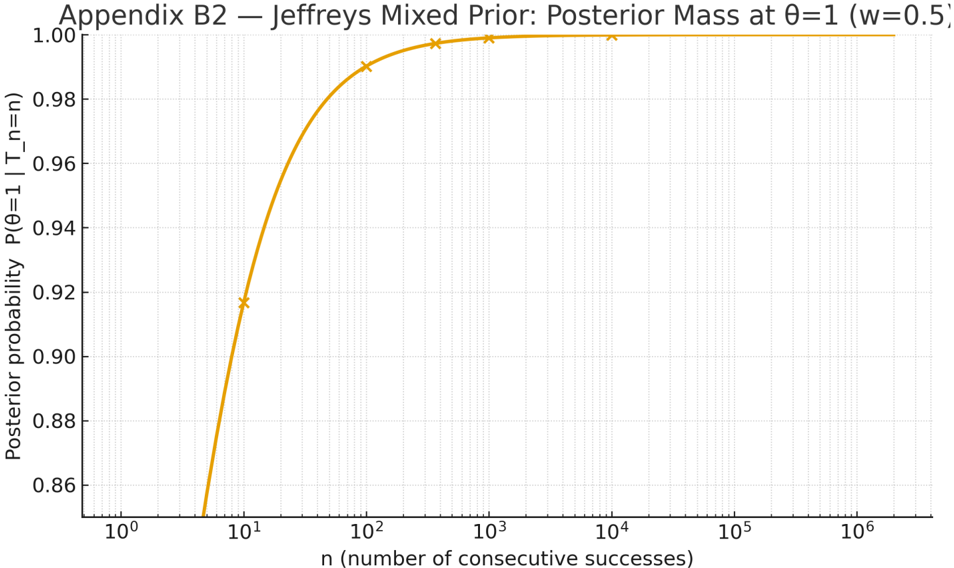
The image is a line chart that illustrates the posterior probability P(θ=1 | T_n=n) as a function of n (number of consecutive successes). The x-axis is logarithmic, ranging from 10^0 to 10^6. The y-axis represents the posterior probability, ranging from 0.86 to 1.00. The chart title is "Appendix B2 - Jeffreys Mixed Prior: Posterior Mass at θ=1 (w=0.5)".
### Components/Axes
* **Title:** Appendix B2 - Jeffreys Mixed Prior: Posterior Mass at θ=1 (w=0.5)
* **X-axis:**
* Label: n (number of consecutive successes)
* Scale: Logarithmic, ranging from 10^0 to 10^6. Axis markers at 10^0, 10^1, 10^2, 10^3, 10^4, 10^5, and 10^6.
* **Y-axis:**
* Label: Posterior probability P(θ=1 | T\_n=n)
* Scale: Linear, ranging from 0.86 to 1.00. Axis markers at 0.86, 0.88, 0.90, 0.92, 0.94, 0.96, 0.98, and 1.00.
* **Data Series:**
* Color: Golden-yellow
* Markers: 'x' symbols are placed along the line.
### Detailed Analysis
The golden-yellow line represents the posterior probability. The line starts at approximately 0.85 at n=1 (10^0). It increases rapidly until approximately n=100 (10^2), where it begins to level off. From n=100 (10^2) to n=10^6, the line approaches 1.00 asymptotically.
Specific data points (marked with 'x'):
* At n = 10^1 (10), the posterior probability is approximately 0.915.
* At n = 10^2 (100), the posterior probability is approximately 0.99.
* At n = 10^3 (1000), the posterior probability is approximately 0.999.
* At n = 10^4 (10000), the posterior probability is approximately 0.999.
### Key Observations
* The posterior probability increases rapidly with the number of consecutive successes.
* The rate of increase diminishes as the number of consecutive successes increases.
* The posterior probability approaches 1.00 as the number of consecutive successes becomes very large.
### Interpretation
The chart demonstrates how the posterior belief in the parameter θ=1 (given w=0.5) changes as more consecutive successes (T\_n=n) are observed. Initially, the posterior probability is relatively low, but it quickly increases as more successes are observed. The fact that the probability approaches 1.00 suggests that with enough consecutive successes, the model becomes highly confident that θ=1. The Jeffreys Mixed Prior is being used to update the belief. The parameter 'w' likely represents a weighting factor in the prior distribution.