\n
## Diagram: Hierarchical Tree Structure
### Overview
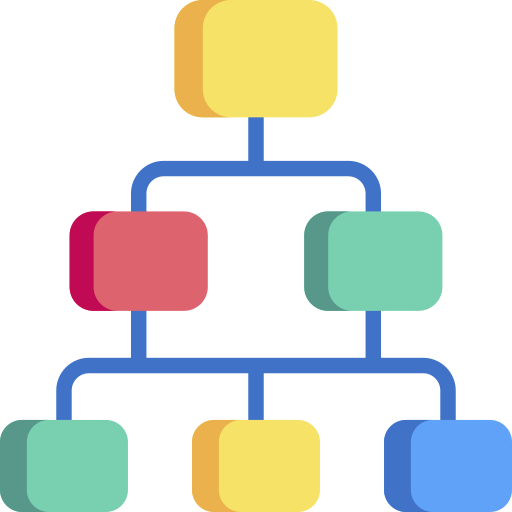
The image displays a simple, three-level hierarchical tree diagram or organizational chart. It consists of colored, rounded rectangular boxes connected by solid blue lines, indicating a parent-child or branching relationship. The diagram is presented on a plain, light gray background. There is **no textual information** (labels, titles, or data) present within any of the boxes or elsewhere in the image.
### Components/Axes
* **Nodes:** Six rounded rectangular boxes, each with a distinct color and a subtle 3D effect created by a darker shade on the left and top edges.
* **Connections:** Solid, medium-blue lines that connect the boxes, forming the hierarchical structure. The lines branch at right angles.
* **Layout:** The diagram is structured in three distinct horizontal levels.
* **Level 1 (Top):** A single yellow box, centered horizontally.
* **Level 2 (Middle):** Two boxes. A red box is positioned to the left of the center line, and a green box is positioned to the right.
* **Level 3 (Bottom):** Three boxes. From left to right: a green box, a yellow box, and a blue box. They are evenly spaced across the width of the diagram.
### Detailed Analysis
* **Spatial Grounding & Structure:**
* The top (yellow) box is the root node. A single blue line descends from its bottom center.
* This line connects to a horizontal blue bar that spans the width between the two middle-level boxes.
* From this horizontal bar, two vertical lines descend to connect to the top centers of the red (left) and green (right) boxes.
* From the bottom center of the red box, a blue line descends to a second, wider horizontal bar.
* From the bottom center of the green box, a blue line also descends to connect to the same horizontal bar.
* From this second horizontal bar, three vertical lines descend to connect to the top centers of the three bottom-level boxes (green, yellow, blue).
* **Color Palette:**
* **Yellow:** Used for the top-level node and the center node of the bottom level.
* **Red:** Used for the left node of the middle level.
* **Green:** Used for the right node of the middle level and the left node of the bottom level.
* **Blue:** Used for the right node of the bottom level and for all connecting lines.
* **Trend Verification:** Not applicable, as this is a structural diagram, not a data chart. The "flow" is strictly top-down and branching.
### Key Observations
1. **Absence of Text:** The most significant observation is the complete lack of any textual labels, identifiers, or data within the diagram. Its meaning is entirely abstract.
2. **Color Repetition:** The colors yellow and green are each used twice, while red and blue are used once for a node. The blue color is exclusively used for the connecting lines and one final node.
3. **Symmetry and Asymmetry:** The structure is symmetrical at the first branching (one node to two), but becomes asymmetrical at the second branching, as the left parent (red) and right parent (green) both connect to all three child nodes, rather than each having their own distinct set.
4. **Visual Style:** The design is flat with minimal depth cues (the 3D shading on the boxes). It uses a simple, clean, and modern aesthetic suitable for presentations or conceptual illustrations.
### Interpretation
This diagram is a **template or abstract representation** of a hierarchical system. Its meaning is not defined by the image itself but would be provided by context or accompanying text.
* **What it demonstrates:** It visually models a one-to-many, multi-level relationship. The top node is the primary category or origin. It splits into two secondary categories. Both of these secondary categories then share or contribute to three tertiary items or outcomes at the bottom level.
* **How elements relate:** The blue lines explicitly define the relationships and flow of authority, dependency, or categorization. The shared connection from both middle nodes to all bottom nodes suggests a **matrix or combined influence** structure, rather than a strict, siloed tree. For example, the bottom three items could be projects that receive input from both departments (red and green).
* **Notable anomalies:** The key anomaly is the **lack of semantic content**. Without labels, the diagram is purely syntactic. The color choices appear arbitrary for meaning-coding but may be for visual distinction. The structure implies that the two middle-level entities have equal standing and identical relationships to the bottom level, which is a specific and notable organizational pattern.
**In summary, this is a blank structural template for a two-tiered hierarchy where two parent nodes jointly oversee three child nodes. To extract factual information, the boxes would need to be populated with text.**