## Diagram: Basic Flowchart
### Overview
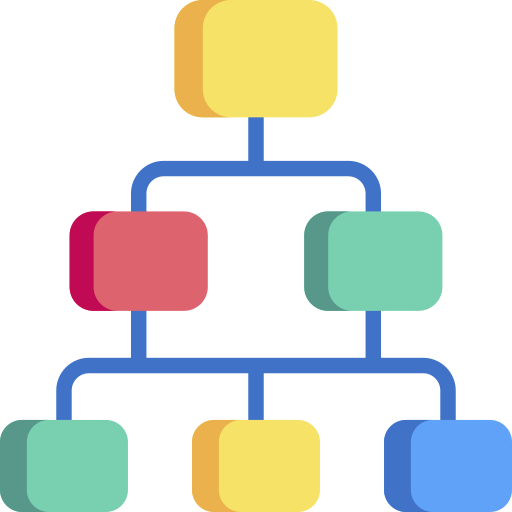
The image is a simple flowchart diagram. It consists of five rounded rectangles (nodes) connected by blue lines, indicating a hierarchical flow from top to bottom. The nodes are colored yellow, red, green, and blue.
### Components/Axes
* **Nodes:** Five rounded rectangles, each representing a step or element in the process.
* Top Node: Yellow
* Middle Row (left to right): Red, Green
* Bottom Row (left to right): Green, Yellow, Blue
* **Connectors:** Blue lines with rounded corners, indicating the direction of flow. The lines connect the top node to the two nodes in the middle row, and the two nodes in the middle row to the three nodes in the bottom row.
### Detailed Analysis
The flowchart starts with a single yellow node at the top. This node branches out to two nodes in the second level: a red node on the left and a green node on the right. From the red and green nodes, the flow continues to three nodes in the bottom row: a green node, a yellow node, and a blue node. The lines connecting the nodes are all the same color (blue) and thickness, suggesting a uniform relationship between the elements.
### Key Observations
* The diagram illustrates a hierarchical structure with a single starting point and multiple endpoints.
* The use of different colors for the nodes may indicate different categories or types of elements within the process.
* The flow is strictly top-down, with no loops or feedback mechanisms.
### Interpretation
The flowchart represents a basic process or decision tree. The yellow node at the top could represent an initial state or decision, which then leads to different paths represented by the red and green nodes. The bottom row of nodes could represent final outcomes or actions. The specific meaning of the diagram would depend on the context in which it is used. The different colors likely represent different categories or types of elements within the process.