# Technical Document Extraction: System Architecture Diagram
## Diagram Overview
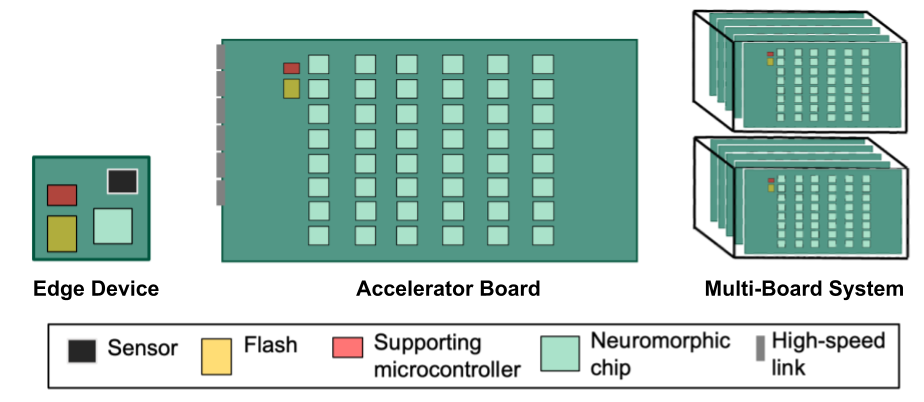
The image depicts a hierarchical system architecture composed of three primary components: **Edge Device**, **Accelerator Board**, and **Multi-Board System**. Each component is represented with color-coded blocks and labeled elements. A legend at the bottom maps colors to functional components.
---
### 1. **Edge Device**
- **Description**: A small green rectangular block representing a compact edge computing device.
- **Components**:
- **Red Block**: Labeled as **Supporting microcontroller** (per legend).
- **Black Block**: Labeled as **Sensor** (per legend).
- **Yellow Block**: Labeled as **Flash** (per legend).
- **Light Green Block**: Labeled as **Neuromorphic chip** (per legend).
- **Spatial Notes**:
- Components are arranged in a 2x2 grid within the Edge Device.
- The black sensor block is positioned at the top-right corner of the Edge Device.
---
### 2. **Accelerator Board**
- **Description**: A large green rectangular block representing a high-performance processing unit.
- **Components**:
- **Grid of Light Green Squares**: Labeled as **Neuromorphic chips** (per legend). The grid contains **10 rows × 10 columns = 100 squares**.
- **Red Block**: Positioned at the top-left corner, labeled as **Supporting microcontroller** (per legend).
- **Yellow Block**: Positioned below the red block, labeled as **Flash** (per legend).
- **Spatial Notes**:
- The red and yellow blocks are isolated from the grid, suggesting dedicated control/management functions.
- The grid occupies the majority of the Accelerator Board's area.
---
### 3. **Multi-Board System**
- **Description**: A 3D-stacked configuration of two Accelerator Boards connected via a **high-speed link**.
- **Components**:
- **Two Accelerator Boards**: Identical to the standalone Accelerator Board (green with light green grid, red/yellow blocks).
- **Gray Link**: Labeled as **High-speed link** (per legend), connecting the two stacked boards.
- **Spatial Notes**:
- The boards are stacked vertically, with the top board slightly offset to the right for visual clarity.
- The gray link spans the width of both boards, emphasizing interconnectivity.
---
### 4. **Legend**
- **Position**: Located at the bottom of the diagram, spanning the full width.
- **Color-Component Mappings**:
- **Black**: Sensor
- **Yellow**: Flash
- **Red**: Supporting microcontroller
- **Light Green**: Neuromorphic chip
- **Gray**: High-speed link
- **Text**: "Sensor", "Flash", "Supporting microcontroller", "Neuromorphic chip", and "High-speed link" are explicitly labeled.
---
### 5. **Key Observations**
- **Hierarchical Design**: The system scales from a single Edge Device (smallest unit) to a Multi-Board System (largest unit).
- **Functional Specialization**:
- Edge Device: Combines sensing, control, and neuromorphic processing.
- Accelerator Board: Focuses on large-scale neuromorphic computation with dedicated microcontroller/flash support.
- Multi-Board System: Enables parallel processing via high-speed interconnects.
- **Color Consistency**: All components adhere strictly to the legend's color coding, with no deviations.
---
### 6. **Structural Analysis**
- **Edge Device**: Acts as a standalone unit for localized data acquisition and preprocessing.
- **Accelerator Board**: Serves as the core computational unit, optimized for neuromorphic workloads.
- **Multi-Board System**: Facilitates distributed computing by linking multiple Accelerator Boards, likely for scalability and fault tolerance.
---
### 7. **Missing Elements**
- No numerical data, trends, or quantitative metrics are present in the diagram.
- No textual descriptions beyond component labels and legend entries.
---
### 8. **Conclusion**
The diagram illustrates a modular, scalable system architecture for neuromorphic computing. The Edge Device handles low-level sensing and control, the Accelerator Board provides high-performance neuromorphic processing, and the Multi-Board System enables distributed computing via high-speed links. All components are color-coded for clarity, with a consistent legend ensuring unambiguous interpretation.