## Technical Diagram: Level-of-Detail (LOD) Management Strategies
### Overview
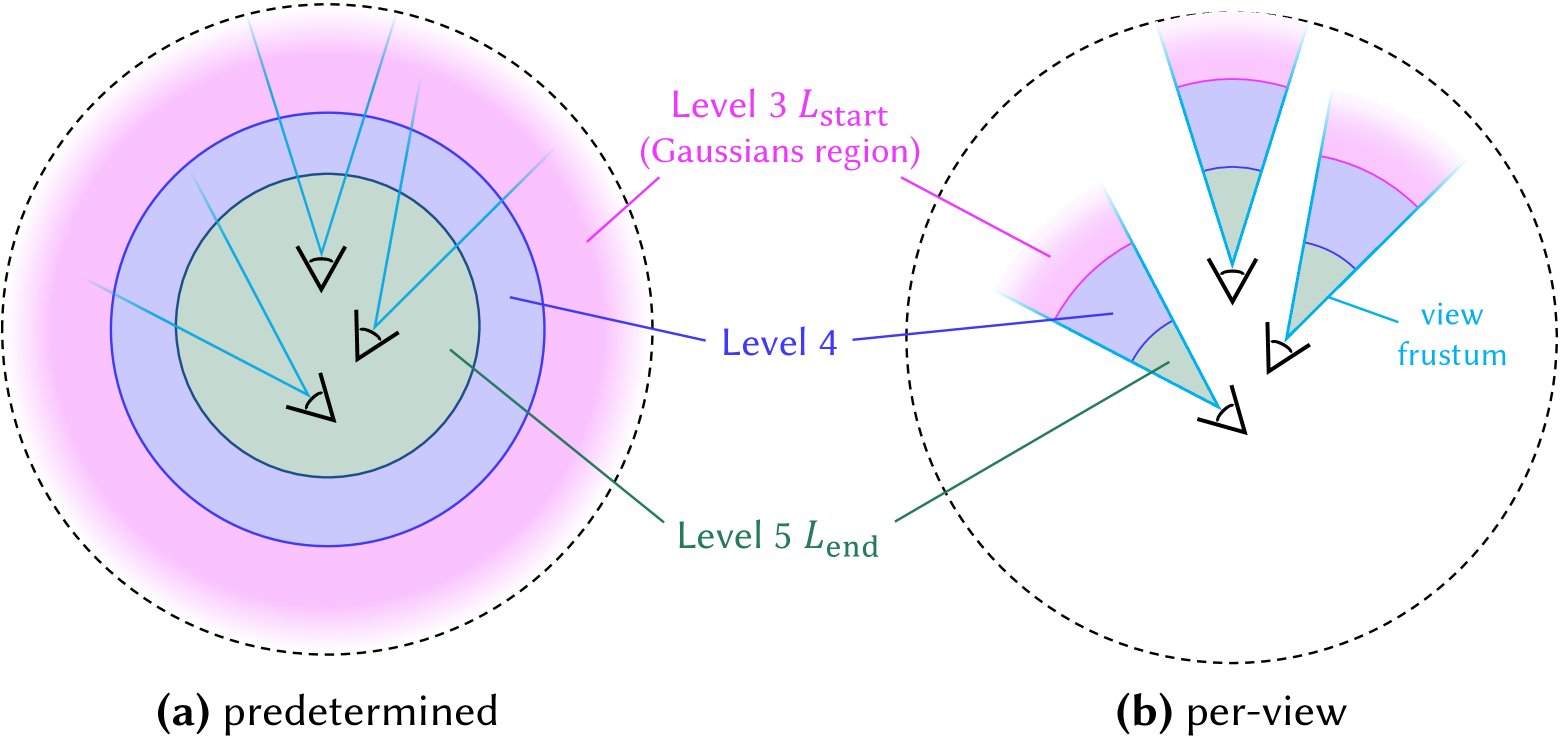
The image is a technical diagram comparing two strategies for managing levels of detail (LOD) in a rendering or simulation system, likely related to 3D graphics or Gaussian splatting. It consists of two side-by-side sub-figures labeled **(a) predetermined** and **(b) per-view**. The diagram uses concentric regions and colored frustums to illustrate how different detail levels are assigned relative to a viewpoint or region of interest.
### Components/Axes
The diagram is not a chart with axes but a conceptual illustration. Its key components are:
**Labels and Text:**
* **(a) predetermined**: Label for the left sub-figure.
* **(b) per-view**: Label for the right sub-figure.
* **Level 3 L<sub>start</sub> (Gaussians region)**: A label in pink text, pointing to the outermost pink-shaded region in both sub-figures.
* **Level 4**: A label in blue text, pointing to the middle blue-shaded ring/region.
* **Level 5 L<sub>end</sub>**: A label in green text, pointing to the innermost green-shaded circle/region.
* **view frustum**: A label in cyan text, pointing to the cone-shaped viewing volumes in sub-figure (b).
**Visual Elements & Spatial Grounding:**
* **Sub-figure (a) - Predetermined:**
* **Structure:** Three concentric circular regions centered in the frame.
* **Innermost (Center):** A solid green circle labeled **Level 5 L<sub>end</sub>**.
* **Middle Ring:** A blue annular region surrounding the green circle, labeled **Level 4**.
* **Outermost Region:** A diffuse pink glow extending from the blue ring to a dashed black circular boundary, labeled **Level 3 L<sub>start</sub> (Gaussians region)**.
* **Viewpoints:** Three stylized eye icons (▼) are placed within the green circle. Cyan lines (representing view rays or frustum edges) emanate from these eyes, passing through the blue and pink regions. The lines are straight and radiate outward, suggesting fixed viewing directions from predetermined positions.
* **Sub-figure (b) - Per-view:**
* **Structure:** The concentric circles are replaced by three distinct, wedge-shaped **view frustums** (cyan outlines) originating from a common central point (where the eye icons are clustered).
* **Frustum Composition:** Each frustum is segmented into three colored zones corresponding to the levels:
* The tip (closest to the center) is **green** (Level 5).
* The middle segment is **blue** (Level 4).
* The outer segment is a diffuse **pink** glow (Level 3).
* **Arrangement:** The three frustums are oriented at different angles, covering a wider angular field than the straight lines in (a). They are contained within a dashed black circular boundary.
* **Legend/Label Placement:** The labels **Level 3 L<sub>start</sub>**, **Level 4**, and **Level 5 L<sub>end</sub>** are positioned between the two sub-figures, with leader lines pointing to the corresponding colored regions in *both* (a) and (b), confirming the color-to-level mapping is consistent.
### Detailed Analysis
The diagram contrasts two LOD assignment philosophies:
1. **Predetermined (a):** Detail levels are assigned based on **absolute distance** from a central point or region. The green (highest detail, Level 5) is at the core, surrounded by medium (blue, Level 4) and low-detail (pink, Level 3) zones. The view rays are straight and radial, implying the LOD is fixed regardless of the specific viewing angle.
2. **Per-view (b):** Detail levels are assigned **relative to each specific view frustum**. The LOD zones (green, blue, pink) are not concentric circles but are instead mapped directly onto the volume of each individual view frustum. The highest detail (green) is always at the frustum's near plane, with detail decreasing (blue, then pink) as distance from the camera increases along the view direction. This means the LOD is dynamically calculated for each viewpoint.
### Key Observations
* **Color Consistency:** The color coding (Green=Level 5/High, Blue=Level 4/Medium, Pink=Level 3/Low) is maintained across both strategies and explicitly linked by the central labels.
* **Spatial Reorganization:** The core difference is the transformation of LOD zones from **concentric shells** (distance-based) in (a) to **view-aligned volumes** (camera-based) in (b).
* **Terminology:** The use of "L<sub>start</sub>" and "L<sub>end</sub>" suggests these levels define the start and end of a detail gradient or a specific range of interest (the "Gaussians region").
* **Boundary:** The dashed black circle in both figures likely represents the maximum extent or bounding volume of the system being managed.
### Interpretation
This diagram illustrates a fundamental optimization concept in real-time rendering, such as for Gaussian Splatting or large-scale scene visualization.
* **What it demonstrates:** It contrasts a **static, world-centric LOD system** (a) with a **dynamic, view-centric LOD system** (b). The predetermined method is simpler but may waste resources rendering high detail in areas not currently viewed. The per-view method is more complex but potentially more efficient, as it concentrates the highest detail (Level 5) precisely where the camera is looking, adapting the detail gradient to the view frustum's orientation.
* **Relationship between elements:** The eye icons represent the camera(s). The colored regions represent different tiers of computational or geometric detail. The transition from (a) to (b) shows a shift in strategy from "where things are in the world" to "what the camera sees."
* **Implication:** The "per-view" approach is likely proposed as an improvement for performance or quality, ensuring that the limited budget for high-detail processing (Level 5) is always applied to the most visually critical part of the scene—the area immediately in front of the viewer. The "Gaussians region" label hints this may be specific to a technique that uses Gaussian primitives for rendering.