\n
## Portrait Engraving: Pierre Gassendi
### Overview
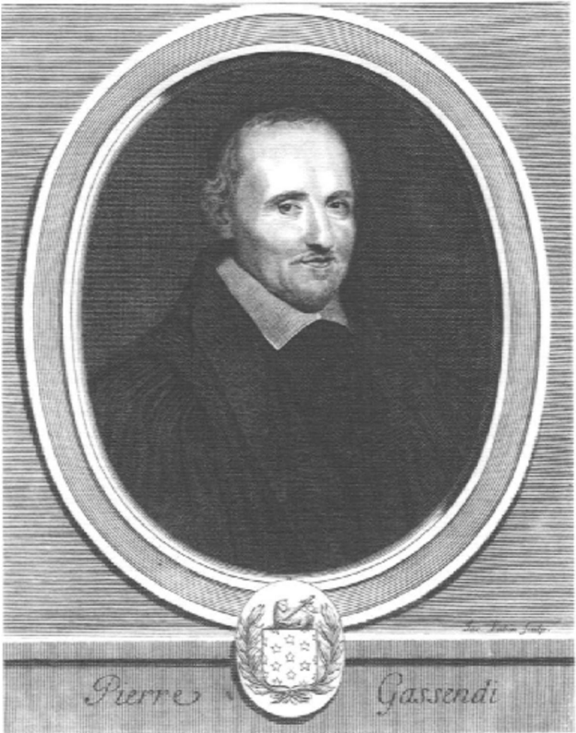
This is a black and white historical portrait engraving, likely from the 17th or 18th century. It depicts a man, identified by the text below as Pierre Gassendi, presented within an oval frame. The style is formal and typical of scholarly or aristocratic portraits of the early modern period.
### Components/Axes
The image is composed of several distinct elements arranged vertically:
1. **Main Portrait (Center):** An oval-shaped engraving containing a bust-length portrait of a man.
2. **Frame:** A multi-layered oval frame surrounds the portrait. The outermost layer features fine, horizontal hatching lines.
3. **Coat of Arms (Bottom Center):** A small, circular emblem is positioned directly below the oval frame, overlapping its bottom edge. It contains a heraldic shield.
4. **Text Inscription (Bottom):** Below the coat of arms, a horizontal band contains text.
5. **Signature (Bottom Right):** A small, cursive signature is etched into the background hatching to the right of the oval frame.
### Detailed Analysis
**Subject Description:**
* The subject is a middle-aged man with a receding hairline, short curly hair on the sides, and a mustache.
* He is turned slightly to his right (viewer's left) but looks directly out at the viewer with a calm, serious expression.
* He wears a dark, heavy robe or gown with a simple, wide, white collar that lies flat against the shoulders. This attire suggests a scholar, cleric, or professional of the period.
**Textual Elements (Transcription & Translation):**
* **Primary Inscription (Bottom Center):**
* **Text:** `Pierre Gassendi`
* **Language:** French.
* **Translation:** Pierre Gassendi (This is a proper name).
* **Signature (Bottom Right):**
* **Text:** `Le Pautre sculp.`
* **Language:** French.
* **Translation:** "Le Pautre engraved [this]." ("Sculp." is an abbreviation for the Latin *sculpsit*, meaning "he/she engraved it"). This identifies the engraver, likely Jean Le Pautre (1618-1682), a French engraver.
**Coat of Arms:**
* The shield within the wreath is divided into four quarters.
* The first and fourth quarters (top-left, bottom-right) appear to contain three small, star-like charges (mullets or estoiles).
* The second and third quarters (top-right, bottom-left) contain a single, larger charge that is difficult to discern clearly but may be a bird or other figure.
* The shield is surrounded by a laurel wreath, a symbol of honor or achievement.
### Key Observations
1. **Formal Presentation:** The use of an oval frame, classical engraving technique, and inclusion of a coat of arms are conventions meant to confer dignity and status upon the subject.
2. **Direct Gaze:** The subject's direct eye contact creates a sense of engagement and intellectual presence, common in portraits of thinkers.
3. **Attribution:** The work is clearly attributed to both the subject (Gassendi) and the engraver (Le Pautre).
4. **Material:** The image is a reproduction of an engraving, evidenced by the use of parallel lines (hatching) to create tone and shadow, particularly visible in the background and on the subject's robe.
### Interpretation
This image is a formal, commemorative portrait of **Pierre Gassendi** (1592-1655), a prominent French philosopher, priest, scientist, and astronomer. The portrait's style and elements serve to legitimize and memorialize his status.
* **Social & Intellectual Context:** The inclusion of a coat of arms, even if not his familial one, was a common device in portraits of this era to associate the subject with nobility, virtue, or institutional authority. The simple, scholarly dress contrasts with the heraldic element, emphasizing his intellectual rather than aristocratic standing.
* **Artistic Collaboration:** The signature "Le Pautre sculp." highlights the collaborative nature of printed portraits in the period. The engraver (Le Pautre) was a skilled artisan who translated a painting or drawing into a reproducible print, which was crucial for disseminating the image and fame of a public figure like Gassendi.
* **Purpose:** Such an engraving would have been produced for inclusion in a book (perhaps one of Gassendi's own works), as a standalone print for collectors, or as frontispiece material. Its purpose was to create a definitive, authoritative visual record of the scholar for posterity and to circulate his likeness among an educated audience.
**In summary, this is not a data chart but a historical document. It provides the visual identity of Pierre Gassendi, attributes the artwork to engraver Jean Le Pautre, and uses symbolic elements (frame, coat of arms) to frame Gassendi as a figure of scholarly importance and dignity.**