## Diagram: Matrix Multiplication and GPU Memory Layout for Quantized Neural Network Inference
### Overview
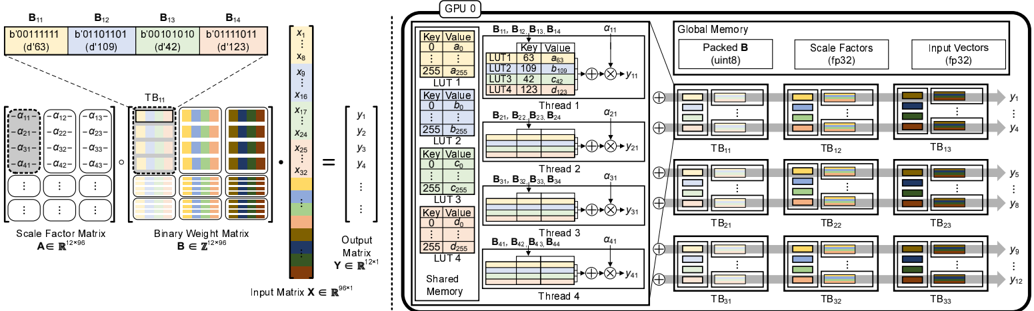
The image depicts a technical diagram illustrating the process of matrix multiplication for quantized neural network inference, optimized for GPU execution. It combines two primary components:
1. **Mathematical Operations**: Matrix multiplication of scale factors and binary weights to produce output.
2. **GPU Memory Layout**: Parallel processing architecture showing thread distribution, memory organization, and data flow.
### Components/Axes
#### Left Diagram (Mathematical Operations)
- **Scale Factor Matrix A**:
- Dimensions: 12×96
- Values: Contains decimal values (e.g., 63, 109, 42, 123) in a 4×4 block format.
- Legend: Orange color represents this matrix.
- **Binary Weight Matrix B**:
- Dimensions: 12×96
- Values: Binary values (0/1) in a 4×4 block format.
- Legend: Blue color represents this matrix.
- **Output Matrix Y**:
- Dimensions: 12×1
- Legend: Green color represents this matrix.
- **Legend**: Located at the bottom-right of the left diagram, mapping colors to matrices.
#### Right Diagram (GPU Memory Layout)
- **Threads (1-4)**:
- Each thread processes a subset of the computation.
- Thread 1: Handles `B11`, `B12`, `B13`, `B14` with scale factors `a11`, `a12`, `a13`, `a14`.
- Thread 2: Handles `B21`, `B22`, `B23`, `B24` with scale factors `a21`, `a22`, `a23`, `a24`.
- Thread 3: Handles `B31`, `B32`, `B33`, `B34` with scale factors `a31`, `a32`, `a33`, `a34`.
- Thread 4: Handles `B41`, `B42`, `B43`, `B44` with scale factors `a41`, `a42`, `a43`, `a44`.
- **Global Memory**:
- Contains `Packed B` (uint8), `Scale Factors` (fp32), and `Input Vectors` (fp32).
- **Look-Up Tables (LUTs)**:
- LUT 1: Key-value pairs (e.g., 63→63, 109→109, 42→42, 123→123).
- LUT 2: Key-value pairs (e.g., 255→255, 255→255, 255→255, 255→255).
- LUT 3: Key-value pairs (e.g., 0→0, 255→255, 255→255, 255→255).
- LUT 4: Key-value pairs (e.g., 0→0, 255→255, 255→255, 255→255).
- **Legend**: Located at the top-right of the right diagram, mapping colors to threads and memory components.
### Detailed Analysis
#### Left Diagram
- **Matrix Multiplication**:
- Scale Factor Matrix `A` (orange) is multiplied by Binary Weight Matrix `B` (blue) to produce Output Matrix `Y` (green).
- Example values: `A` contains 63, 109, 42, 123; `B` contains 0, 1, 0, 1.
- **Binary Weight Matrix**:
- Structured as a 12×96 matrix with binary values (0/1) in a 4×4 block format.
- **Scale Factor Matrix**:
- Structured as a 12×96 matrix with decimal values in a 4×4 block format.
#### Right Diagram
- **Thread Distribution**:
- Four threads process different subsets of the computation in parallel.
- Each thread accesses specific blocks of `B` and scale factors.
- **Memory Organization**:
- `Packed B` (uint8) is stored in global memory, optimized for memory efficiency.
- `Scale Factors` (fp32) and `Input Vectors` (fp32) are also stored in global memory.
- **LUTs**:
- LUT 1 maps specific decimal values to themselves (e.g., 63→63).
- LUT 2-4 map values to 255 or 0, likely representing quantization thresholds.
### Key Observations
1. **Quantization**: The use of binary weights (`B`) and scale factors (`A`) indicates quantization for reduced memory usage and faster computation.
2. **Parallelism**: The GPU layout distributes the computation across four threads, each handling a subset of the matrix multiplication.
3. **Memory Efficiency**: `Packed B` (uint8) reduces memory footprint compared to full-precision storage.
4. **LUT Usage**: LUTs simplify scale factor adjustments, with LUT 1 preserving values and LUTs 2-4 clamping values to extremes (0/255).
### Interpretation
This diagram illustrates a **quantized matrix multiplication** process optimized for GPU execution. The left side shows the mathematical foundation, where binary weights and scale factors are combined to produce outputs. The right side details how this computation is parallelized across GPU threads, with memory optimized for efficiency (e.g., `Packed B` in uint8). The LUTs suggest a mechanism to handle scale factor adjustments, likely for dynamic range compression or calibration. The architecture emphasizes **parallelism** (four threads) and **memory efficiency**, critical for real-time inference in deep learning models. The use of binary weights and scale factors aligns with techniques like **binary neural networks** or **quantized convolution**, which trade precision for speed and reduced memory usage.