## Diagram: SWE-ContextBench Overview
### Overview
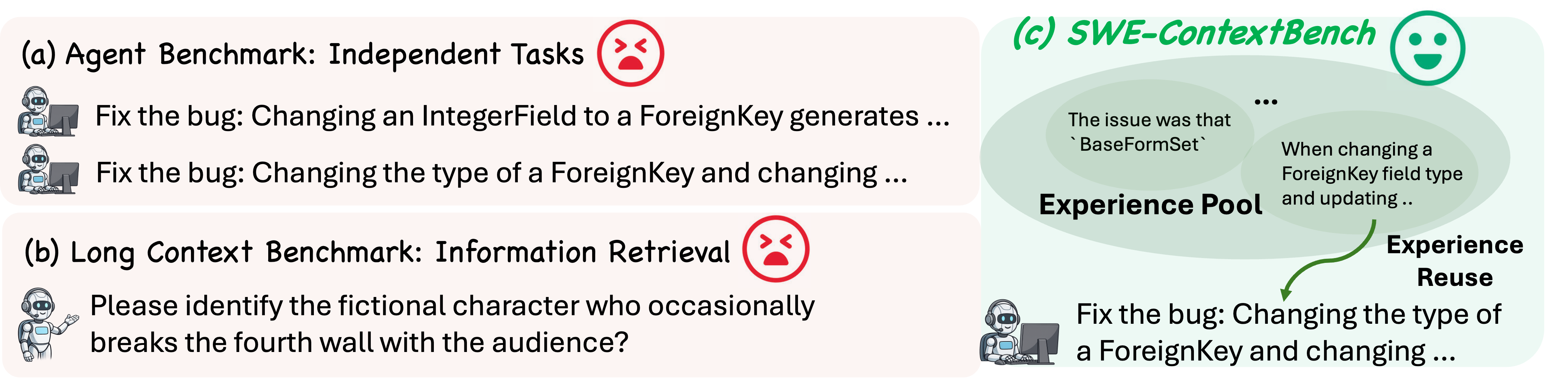
The image presents a diagram comparing different benchmark types for software engineering tasks. It highlights the challenges and potential solutions in agent benchmarks, long context benchmarks, and SWE-ContextBench. The diagram uses visual cues like robot avatars, red "sad face" icons, and a green "happy face" icon to indicate the success or failure of each benchmark type.
### Components/Axes
* **(a) Agent Benchmark: Independent Tasks**: This section describes a benchmark focused on independent tasks for agents.
* **(b) Long Context Benchmark: Information Retrieval**: This section describes a benchmark focused on information retrieval in a long context.
* **(c) SWE-ContextBench**: This section describes the SWE-ContextBench approach.
* **Robot Avatars**: Each benchmark type is associated with a robot avatar, possibly representing an automated agent.
* **Red "Sad Face" Icon**: Located next to the titles of the Agent Benchmark and Long Context Benchmark, indicating a negative outcome or challenge.
* **Green "Happy Face" Icon**: Located next to the title of the SWE-ContextBench, indicating a positive outcome or success.
* **Experience Pool**: A green oval shape containing the text "The issue was that `BaseFormSet` ... When changing a ForeignKey field type and updating...".
* **Experience Reuse**: A green oval shape containing the text "Experience Reuse".
* **Green Arrow**: A curved green arrow pointing from the "Experience Pool" to the "Experience Reuse" oval, indicating the flow of information or experience.
### Detailed Analysis or ### Content Details
* **(a) Agent Benchmark: Independent Tasks**
* Task 1: "Fix the bug: Changing an IntegerField to a ForeignKey generates ..."
* Task 2: "Fix the bug: Changing the type of a ForeignKey and changing ..."
* **(b) Long Context Benchmark: Information Retrieval**
* Task: "Please identify the fictional character who occasionally breaks the fourth wall with the audience?"
* **(c) SWE-ContextBench**
* The "Experience Pool" contains the text: "The issue was that `BaseFormSet` ... When changing a ForeignKey field type and updating..."
* The "Experience Reuse" oval is connected to the "Experience Pool" via a green arrow.
* Task: "Fix the bug: Changing the type of a ForeignKey and changing ..."
### Key Observations
* Agent Benchmark and Long Context Benchmark are marked with a red "sad face" icon, suggesting they face challenges or limitations.
* SWE-ContextBench is marked with a green "happy face" icon, suggesting it is a successful approach.
* The "Experience Pool" and "Experience Reuse" components in SWE-ContextBench suggest a mechanism for leveraging past experiences to improve performance.
### Interpretation
The diagram illustrates a comparison of different benchmark types for software engineering tasks. The Agent Benchmark and Long Context Benchmark appear to have limitations, as indicated by the red "sad face" icons. SWE-ContextBench, on the other hand, seems to offer a more effective approach, possibly by leveraging an "Experience Pool" and "Experience Reuse" mechanism. The diagram suggests that SWE-ContextBench addresses the challenges faced by the other benchmark types by incorporating a way to learn from and reuse past experiences. The specific tasks mentioned provide examples of the types of problems each benchmark is designed to address.