## Diagram: Comparison of Benchmark Methodologies
### Overview
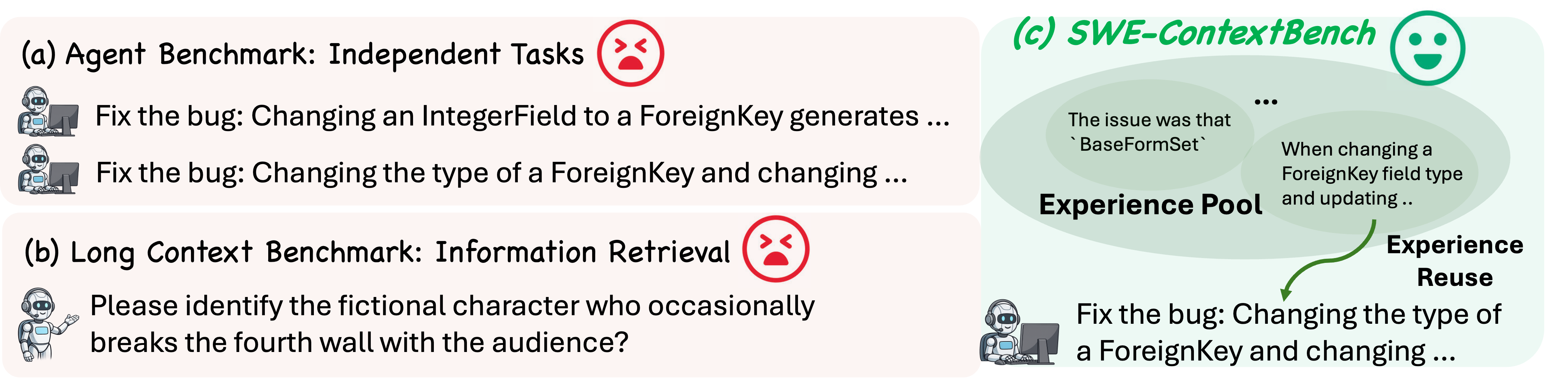
This diagram illustrates a comparison between traditional benchmark methodologies—specifically "Agent Benchmark: Independent Tasks" and "Long Context Benchmark: Information Retrieval"—and a proposed methodology titled "SWE-ContextBench." The diagram uses visual cues (emojis) to suggest that the traditional methods are problematic or insufficient (indicated by red angry faces), while the proposed "SWE-ContextBench" is effective (indicated by a green happy face).
### Components/Axes
The image is divided into two primary vertical regions:
* **Left Region:** Contains two stacked sections, labeled (a) and (b).
* **Right Region:** Contains one large section, labeled (c).
**Visual Elements:**
* **Icons:** Robot icons are used to denote tasks or agents.
* **Emojis:** Red angry face emojis (😡) are placed next to sections (a) and (b). A green happy face emoji (😊) is placed next to section (c).
* **Flow/Relationship:** In section (c), a green arrow indicates a flow of information from an "Experience Pool" to a specific task, labeled "Experience Reuse."
### Detailed Analysis
#### Left Region
**Section (a): Agent Benchmark: Independent Tasks**
* **Status:** Marked with a red angry face emoji.
* **Content:**
* Task 1: "Fix the bug: Changing an IntegerField to a ForeignKey generates ..."
* Task 2: "Fix the bug: Changing the type of a ForeignKey and changing ..."
* **Context:** These tasks are presented as isolated, independent units of work.
**Section (b): Long Context Benchmark: Information Retrieval**
* **Status:** Marked with a red angry face emoji.
* **Content:**
* Task: "Please identify the fictional character who occasionally breaks the fourth wall with the audience?"
* **Context:** This represents a standard information retrieval task.
#### Right Region
**Section (c): SWE-ContextBench**
* **Status:** Marked with a green happy face emoji.
* **Central Component:** A light green oval labeled "Experience Pool."
* Inside the pool are two text bubbles containing technical context:
1. "The issue was that `BaseFormSet`"
2. "When changing a ForeignKey field type and updating .."
* **Flow:** A green arrow labeled "Experience Reuse" originates from the "Experience Pool" and points downward to a task.
* **Task:** "Fix the bug: Changing the type of a ForeignKey and changing ..."
* **Context:** This section demonstrates a mechanism where previous knowledge (the pool) is applied to a current task.
### Key Observations
* **Sentiment Contrast:** The diagram explicitly contrasts the "Independent Tasks" and "Information Retrieval" benchmarks (negative sentiment) with "SWE-ContextBench" (positive sentiment).
* **Methodological Difference:** The core differentiator for "SWE-ContextBench" is the inclusion of an "Experience Pool" and the explicit "Experience Reuse" mechanism.
* **Task Similarity:** The bug-fixing task in section (c) is identical to the second task in section (a), suggesting that "SWE-ContextBench" is designed to solve the same problems as the "Agent Benchmark" but with a more sophisticated, context-aware approach.
### Interpretation
The diagram serves as a conceptual argument for why traditional benchmarks are inadequate for Software Engineering (SWE) tasks.
* **The Problem:** Sections (a) and (b) represent "cold start" or isolated problem-solving scenarios. The red emojis imply that treating software engineering tasks as either isolated bug fixes (a) or simple information retrieval (b) fails to capture the reality of software development.
* **The Solution:** Section (c) proposes that effective software engineering agents require context. By maintaining an "Experience Pool"—likely a repository of past issues, solutions, and technical insights (e.g., the `BaseFormSet` note)—the agent can perform "Experience Reuse."
* **Conclusion:** The diagram suggests that the ability to retrieve and apply relevant historical context is the key missing component in traditional benchmarks, and that "SWE-ContextBench" successfully addresses this by integrating a knowledge-retrieval loop into the task-solving process.