## Flowchart: Ethical Decision-Making Process
### Overview
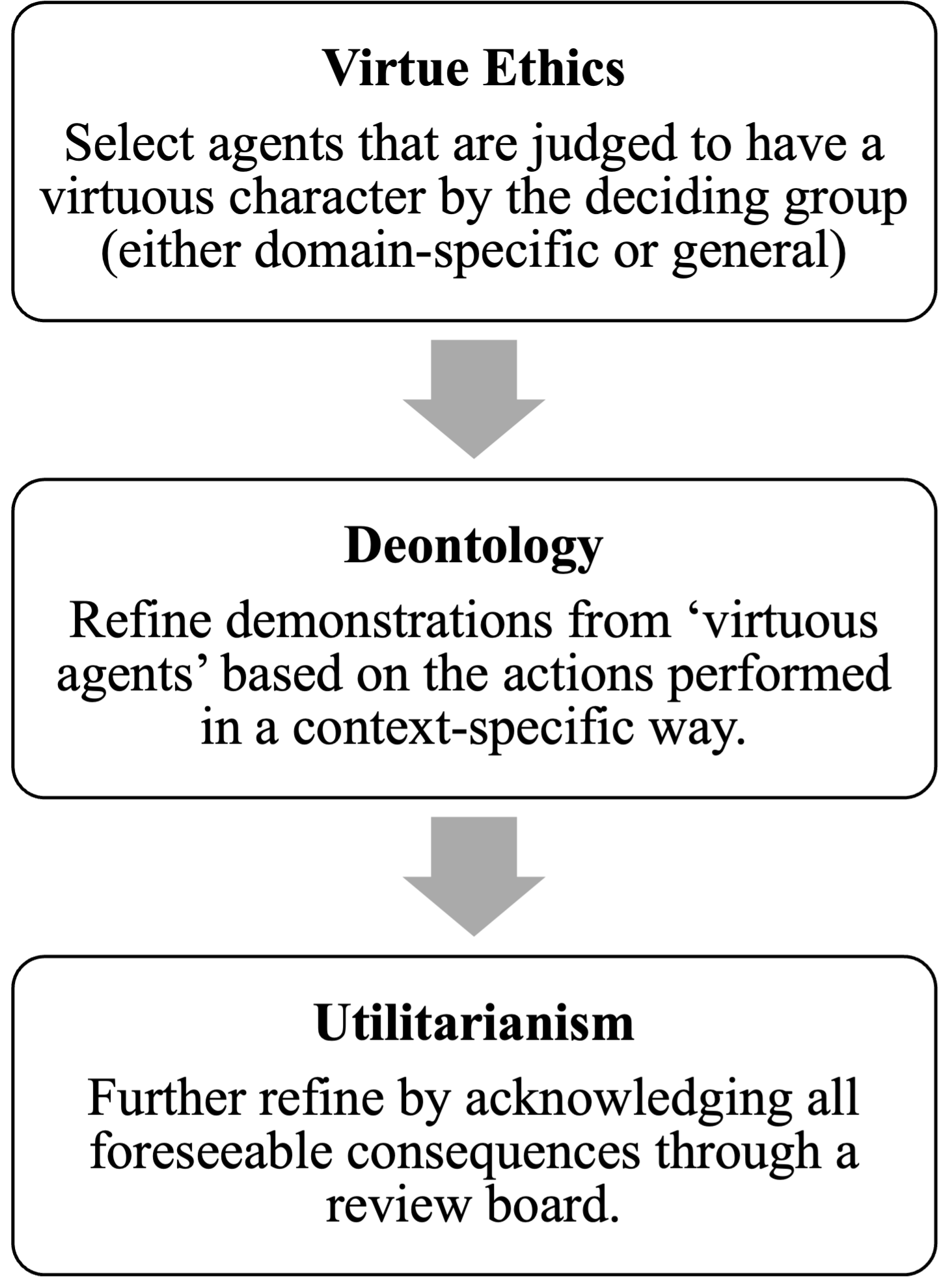
The image depicts a three-step hierarchical flowchart illustrating an ethical decision-making framework. Each step represents a distinct ethical philosophy, with directional arrows indicating sequential refinement. The flowchart uses gray arrows on a light gray background with white text boxes containing black text.
### Components/Axes
1. **Virtue Ethics** (Top Box)
- Label: "Virtue Ethics" (bold black text)
- Description: "Select agents that are judged to have a virtuous character by the deciding group (either domain-specific or general)"
- Position: Topmost box, centered
2. **Deontology** (Middle Box)
- Label: "Deontology" (bold black text)
- Description: "Refine demonstrations from ‘virtuous agents’ based on the actions performed in a context-specific way."
- Position: Center box, directly below Virtue Ethics
3. **Utilitarianism** (Bottom Box)
- Label: "Utilitarianism" (bold black text)
- Description: "Further refine by acknowledging all foreseeable consequences through a review board."
- Position: Bottom box, directly below Deontology
4. **Arrows**
- Three gray downward-pointing arrows
- Connect boxes in sequence: Virtue Ethics → Deontology → Utilitarianism
- Positioned centrally between each pair of boxes
### Detailed Analysis
- **Textual Content**: All text is in English, using standard academic phrasing. Parenthetical clarification "(either domain-specific or general)" appears in the Virtue Ethics description.
- **Visual Hierarchy**: Boxes decrease in vertical position from top to bottom, with consistent horizontal centering.
- **Color Scheme**:
- Text boxes: White with black borders
- Arrows: Gray
- Background: Light gray
- Text: Black (bold for labels, regular for descriptions)
### Key Observations
1. **Sequential Refinement**: Each ethical framework builds upon the previous one, suggesting a layered evaluation process.
2. **Contextual Specificity**: Deontology emphasizes context-dependent action analysis, while Utilitarianism introduces consequence-based review.
3. **Agent Evaluation**: The process begins with character judgment (Virtue Ethics) before moving to action analysis and consequence evaluation.
### Interpretation
This flowchart represents a multi-stage ethical evaluation system:
1. **Virtue Ethics** establishes baseline agent selection through character assessment.
2. **Deontology** adds context-aware action analysis, refining the initial selection.
3. **Utilitarianism** completes the process by incorporating consequence evaluation via formal review.
The progression from character → action → consequence reflects a comprehensive approach to ethical decision-making, where each stage addresses different dimensions of moral evaluation. The use of "refine" in both Deontology and Utilitarianism descriptions suggests iterative improvement rather than replacement of prior criteria.