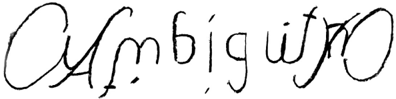
## Handwritten Text: "Ambiguity"
### Overview
The image consists of a single word written in black ink on a plain white background. The image does not contain any quantitative data, charts, diagrams, or structured information. It is a purely textual representation of a concept.
### Components/Axes
* **Data Type:** Handwritten text.
* **Axes:** None present.
* **Legend:** None present.
* **Structure:** A single string of cursive script.
### Detailed Analysis
The image contains the word "Ambiguity" written in a cursive, stylized script.
* **Transcription:** "Ambiguity"
* **Character Breakdown:**
* **A:** Capitalized, stylized with a loop at the top.
* **m:** Two distinct humps, connected to the 'b'.
* **b:** Ascender is clear, connecting to the 'i'.
* **i:** Dot is visible above the stem.
* **g:** Descender loops below the baseline.
* **u:** Standard cursive form.
* **i:** Dot is visible above the stem.
* **t:** Crossbar is visible, connecting to the 'y'.
* **y:** Descender loops below the baseline.
The ink stroke width is relatively consistent throughout the word, suggesting a felt-tip pen or marker was used. The alignment is slightly slanted, consistent with standard cursive handwriting.
### Key Observations
* **Legibility:** The word is legible, though the handwriting style is informal.
* **Stylization:** The initial 'A' is stylized, which creates a slight visual ambiguity regarding whether it is an 'A' or an 'O' at first glance, though context confirms it is an 'A'.
* **Lack of Data:** There are no numerical values, scales, or comparative elements.
### Interpretation
The image presents a meta-textual irony. The word "Ambiguity" is written in a handwritten style that is itself slightly ambiguous (the initial letter 'A' is formed in a way that could be misread as an 'O' or a 'C' without the context of the subsequent letters).
From a Peircean semiotic perspective, the *signifier* (the handwritten word) and the *signified* (the concept of ambiguity) are unified. The image does not merely label a concept; it performs the concept. By presenting the word "Ambiguity" in a format that requires the viewer to interpret the strokes, the image forces the viewer to engage in the very act of resolving ambiguity to understand the message.