## Handwritten Text: "Ambiguity"
### Overview
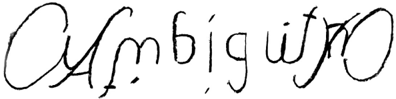
The image displays a single word, "Ambiguity," written in a flowing, cursive script. The handwriting is in black ink on a plain white background. The style is elegant with pronounced flourishes, particularly on the initial and final letters.
### Components / Text Details
* **Text Content:** The word is "Ambiguity".
* **Script Style:** Cursive, with connected letters.
* **Notable Features:**
* The initial 'A' is a large, ornate capital letter with a prominent loop and flourish.
* The letters 'm', 'b', 'i', 'g', 'u', 'i', 't', 'y' follow in a connected sequence.
* The dot above the first 'i' is clearly visible.
* The dot above the second 'i' is present but slightly less distinct.
* The final 'y' ends with a long, downward-sweeping tail that curves back to the left.
* The cross for the 't' is integrated into the connecting stroke from the preceding 'i'.
### Detailed Analysis
* **Transcription (Direct):** "Ambiguity"
* **Language:** English.
* **Character Breakdown (Approximate):**
* **A:** Large, uppercase cursive form.
* **m:** Three humps, connected to 'b'.
* **b:** Tall loop, connected to 'i'.
* **i:** Short stroke with a dot above.
* **g:** Descending loop below the baseline.
* **u:** Two peaks, connected to the second 'i'.
* **i:** Short stroke with a dot above.
* **t:** Vertical stroke, crossed by a horizontal line that connects from the previous 'i'.
* **y:** Descending tail that sweeps left.
### Key Observations
* The handwriting is legible but stylized, which itself introduces a minor, meta-level ambiguity in reading the precise formation of some connecting strokes.
* The word's meaning ("the quality of being open to more than one interpretation") is reflected in the artistic, non-standard cursive style.
* There are no other graphical elements, charts, diagrams, or data present in the image. It is purely a textual artifact.
### Interpretation
The image is a straightforward presentation of the word "Ambiguity" in an artistic handwritten form. The primary information is the word itself. The cursive style adds an aesthetic layer but does not obscure the core textual data. The choice of this specific word in this specific style may be intended as a visual pun or a commentary on the nature of interpretation—where even a clearly written word can be rendered with stylistic flourishes that require careful observation to parse definitively. The image contains no quantitative data, trends, or relational diagrams; its entire informational content is the lexical item and its stylistic presentation.