## Diagram: Sharp Surgical Instruments (Sastras)
### Overview
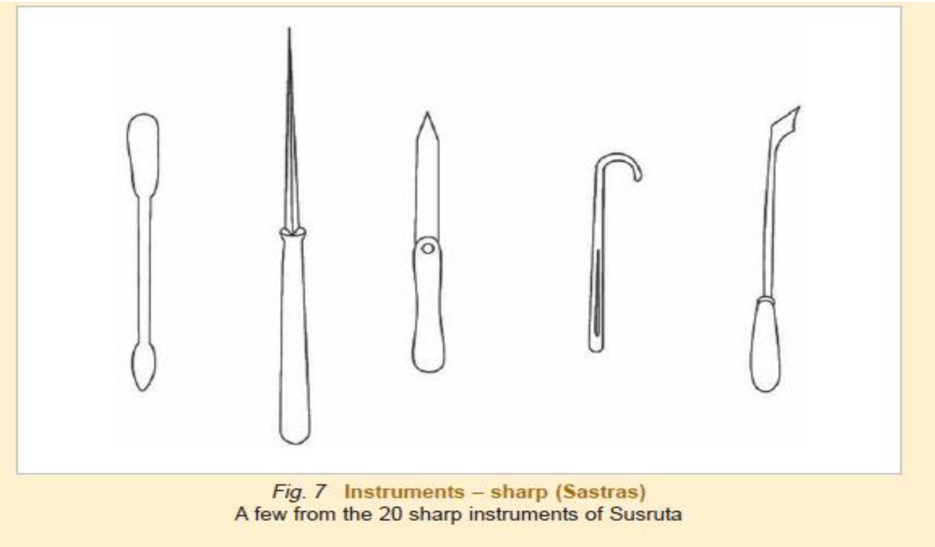
The image presents a diagram showcasing five different sharp surgical instruments, referred to as "Sastras." These instruments are a subset of the 20 sharp instruments described by Susruta. The diagram provides a visual representation of the instruments' shapes and designs.
### Components/Axes
* **Title:** Fig. 7 Instruments - sharp (Sastras)
* **Subtitle:** A few from the 20 sharp instruments of Susruta
* **Instruments:** Five distinct instruments are depicted in a row.
### Detailed Analysis
The image contains line drawings of five different surgical instruments. From left to right, the instruments appear to be:
1. A long, thin instrument with a rounded, elongated tip and a slightly wider handle.
2. A long, thin instrument with a sharp, pointed tip and a handle. The tip appears to be a needle or probe.
3. A thin, flat instrument with a pointed tip and a handle. There is a small circular detail near the center of the instrument, possibly indicating a joint or pivot point.
4. A long, thin instrument with a curved, hook-like tip.
5. A long, thin instrument with a sharp, angled blade at the tip and a handle.
### Key Observations
* The instruments vary significantly in their tip design, suggesting different surgical applications.
* All instruments have a long, thin shaft, likely for precision and control.
* The handles appear to be designed for a comfortable grip.
### Interpretation
The diagram illustrates a selection of sharp surgical instruments (Sastras) used in ancient surgical practices, as documented by Susruta. The variety in instrument design highlights the specialized nature of surgical tools and the range of procedures performed. The image provides a glimpse into the sophistication of surgical techniques in ancient times.