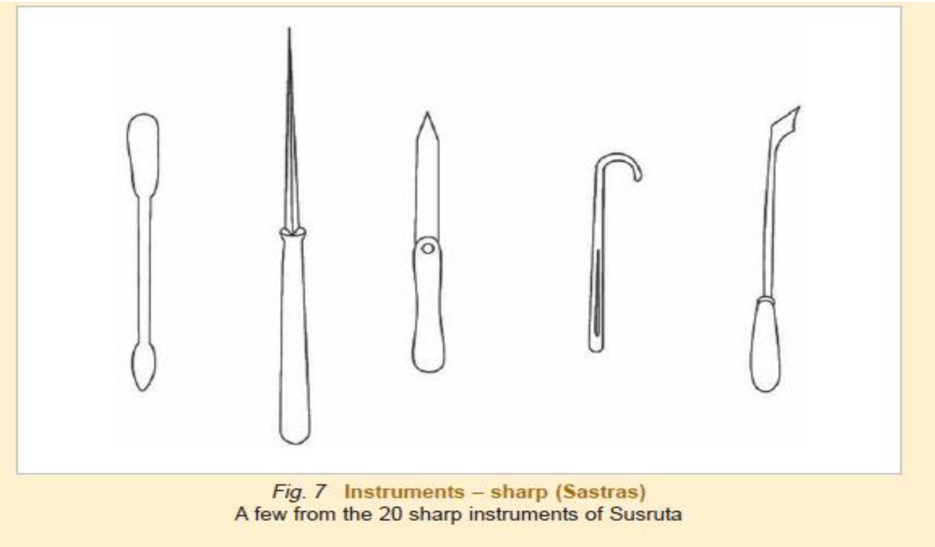
## Diagram: Fig. 7 Instruments – sharp (Sastras)
### Overview
The image is a black-and-white line diagram titled "Fig. 7 Instruments – sharp (Sastras)" with a subtitle: "A few from the 20 sharp instruments of Susruta." It depicts five distinct surgical instruments, labeled as "sharp" tools, likely referencing ancient medical practices. The instruments are arranged vertically in a single column, with minimal contextual background.
### Components/Axes
- **Title**: "Fig. 7 Instruments – sharp (Sastras)" (centered at the top).
- **Subtitle**: "A few from the 20 sharp instruments of Susruta" (centered below the title).
- **Instruments**: Five line-drawn tools, each with a handle and a sharp tip, labeled as "sharp" (Sastras). No axes, legends, or numerical scales are present.
### Detailed Analysis
1. **Instrument 1 (Leftmost)**:
- Shape: Spoon-like with a rounded, concave tip.
- Handle: Straight, tapering slightly toward the base.
- Function: Likely for scooping or probing.
2. **Instrument 2 (Second from Left)**:
- Shape: Long, slender, and sharply pointed.
- Handle: Curved ergonomic grip.
- Function: Precision probing or incision.
3. **Instrument 3 (Center)**:
- Shape: Double-edged blade with a hinge mechanism (suggesting a foldable design).
- Handle: Short, straight.
- Function: Scalpel or cutting tool.
4. **Instrument 4 (Second from Right)**:
- Shape: Curved hook with a sharp inner edge.
- Handle: Straight, with a slight bend near the base.
- Function: Retraction or extraction.
5. **Instrument 5 (Rightmost)**:
- Shape: Curved blade with a serrated edge.
- Handle: Straight, with a flared base.
- Function: Cutting or sawing.
### Key Observations
- All instruments share a common theme of sharpness, emphasizing their surgical purpose.
- The designs reflect ergonomic considerations (e.g., curved handles for grip).
- The subtitle implies these are a subset of 20 instruments attributed to Susruta, an ancient Indian surgeon.
### Interpretation
The diagram highlights the diversity of surgical tools used in Susruta’s medical system, showcasing specialized designs for probing, cutting, and retraction. The absence of numerical data or legends suggests the focus is on anatomical accuracy rather than quantitative analysis. The instruments’ simplicity and sharpness underscore the precision required in ancient surgical practices. The reference to "20 sharp instruments" implies a comprehensive toolkit, reflecting Susruta’s advanced understanding of anatomy and surgery.