\n
## Scatter Plot: Principal Component Analysis of Cognitive Tasks
### Overview
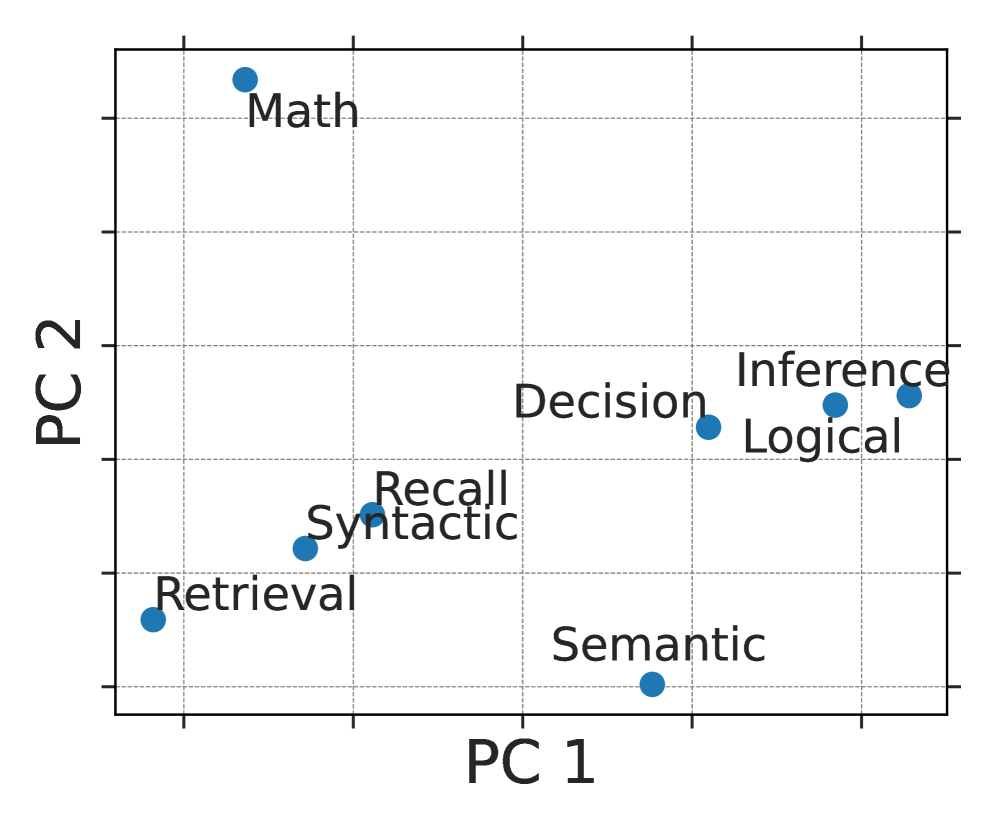
This image presents a scatter plot visualizing the results of a Principal Component Analysis (PCA). The plot displays the distribution of several cognitive tasks across two principal components, PC1 and PC2. Each task is represented by a blue dot, labeled with its corresponding name. The axes represent the principal components, indicating the variance explained by each.
### Components/Axes
* **X-axis:** Labeled "PC 1" (Principal Component 1). The scale is not explicitly defined, but appears to range from approximately -0.5 to 0.5.
* **Y-axis:** Labeled "PC 2" (Principal Component 2). The scale is not explicitly defined, but appears to range from approximately -0.5 to 1.0.
* **Data Points/Labels:** The following cognitive tasks are represented:
* Math
* Retrieval
* Recall
* Syntactic
* Semantic
* Decision
* Logical
* Inference
### Detailed Analysis
The data points are scattered across the plot, suggesting varying degrees of correlation with the principal components.
* **Math:** Located at approximately (0.2, 0.8).
* **Retrieval:** Located at approximately (-0.3, -0.2).
* **Recall:** Located at approximately (-0.1, -0.1).
* **Syntactic:** Located at approximately (-0.1, 0.1).
* **Semantic:** Located at approximately (-0.4, -0.4).
* **Decision:** Located at approximately (0.2, 0.3).
* **Logical:** Located at approximately (0.3, 0.4).
* **Inference:** Located at approximately (0.4, 0.5).
**Trends:**
* A general trend exists where tasks related to reasoning and logic (Inference, Logical, Decision, Math) are positioned towards the upper-right quadrant, indicating positive correlations with both PC1 and PC2.
* Tasks related to memory and language processing (Retrieval, Recall, Semantic, Syntactic) are positioned towards the lower-left quadrant, indicating negative correlations with PC1 and potentially lower correlations with PC2.
### Key Observations
* "Math", "Inference", "Logical", and "Decision" tasks cluster together in the upper-right quadrant, suggesting they share similar characteristics in terms of the principal components.
* "Retrieval", "Recall", "Syntactic", and "Semantic" tasks cluster together in the lower-left quadrant, suggesting they share similar characteristics.
* "Semantic" is the most negative value on PC1.
* "Inference" is the most positive value on PC2.
### Interpretation
This PCA plot suggests that the cognitive tasks can be differentiated based on two underlying dimensions (PC1 and PC2). PC1 appears to separate tasks based on a dimension of complexity or reasoning ability, with tasks like Math and Inference having higher values. PC2 may represent a dimension related to the type of processing involved, with tasks like Inference and Math having higher values.
The clustering of tasks indicates that they share underlying cognitive processes. For example, the grouping of Retrieval, Recall, Syntactic, and Semantic suggests that these tasks rely on similar memory and language processing mechanisms. The separation between these clusters and the reasoning tasks suggests that different cognitive processes are involved in these types of tasks.
The plot provides a visual representation of the relationships between these cognitive tasks, which can be useful for understanding the underlying structure of cognition. It is important to note that the interpretation of the principal components is based on the observed distribution of the tasks and may require further investigation to confirm the underlying cognitive processes.