## Scatter Plot: Principal Component Analysis of Cognitive/Linguistic Categories
### Overview
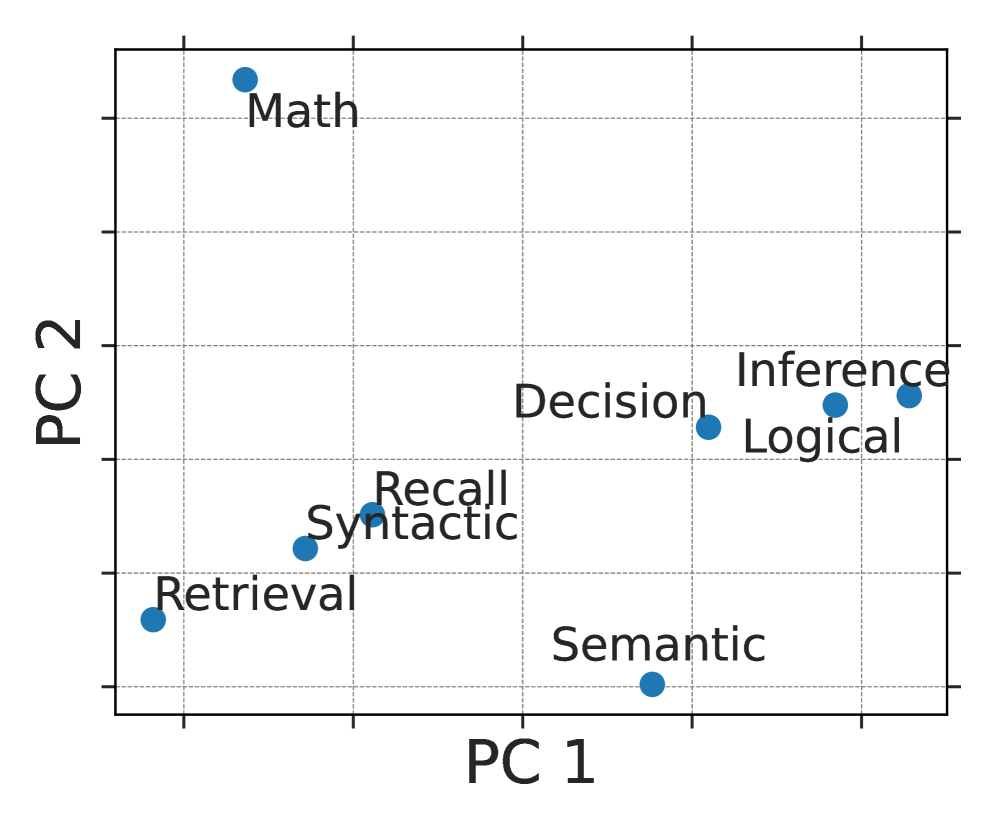
The image is a 2D scatter plot visualizing the distribution of cognitive/linguistic categories across two principal components (PC1 and PC2). Eight labeled data points are plotted, with positions indicating their relative relationships in the reduced-dimensional space.
### Components/Axes
- **X-axis (PC1)**: Represents the first principal component, capturing the greatest variance in the data.
- **Y-axis (PC2)**: Represents the second principal component, capturing the second greatest variance.
- **Data Points**: Labeled directly on the plot (no separate legend). Colors are uniform (blue), with no gradient or categorical differentiation.
### Detailed Analysis
1. **Math**: Positioned at the top-left quadrant (high PC2, low PC1).
2. **Retrieval**: Located at the bottom-left (low PC2, low PC1).
3. **Syntactic**: Clustered near the center-left (moderate PC1, moderate PC2).
4. **Recall**: Slightly above Syntactic (moderate PC1, slightly higher PC2).
5. **Decision**: Positioned mid-right (higher PC1, moderate PC2).
6. **Semantic**: Near the bottom-right (high PC1, low PC2).
7. **Logical**: Top-right quadrant (high PC1, high PC2).
8. **Inference**: Furthest top-right (highest PC1 and PC2).
### Key Observations
- **Clustering**:
- "Logical" and "Inference" dominate the top-right, suggesting strong alignment with both PC1 and PC2.
- "Retrieval" and "Math" occupy extreme left positions, indicating low PC1 but differing PC2 values.
- "Semantic" and "Decision" form a mid-right cluster, emphasizing PC1 dominance.
- **Spread**:
- PC1 ranges from ~-3 (Retrieval) to ~+3 (Inference).
- PC2 ranges from ~-2 (Semantic) to ~+3 (Math/Inference).
- **Outliers**:
- "Math" is isolated in the top-left, distinct from other categories.
- "Semantic" is the only point in the bottom-right quadrant.
### Interpretation
The plot suggests that the first principal component (PC1) primarily distinguishes between **logical/reasoning-oriented categories** (e.g., Logical, Inference) and **memory/retrieval-focused categories** (e.g., Retrieval, Recall). The second principal component (PC2) appears to separate **analytical categories** (Math, Inference) from **semantic/linguistic categories** (Semantic, Syntactic).
Notably, "Decision" bridges the mid-right cluster, potentially indicating a hybrid role in both logical reasoning and semantic processing. The isolation of "Math" in the top-left may reflect its unique relationship to abstract reasoning (high PC2) while remaining distinct from other categories in PC1. This visualization highlights how cognitive tasks vary along orthogonal dimensions of processing, with potential implications for understanding task-specific neural or computational mechanisms.