## Linguistic Tree Diagrams: Ukrainian, Belarusian, and Russian
### Overview
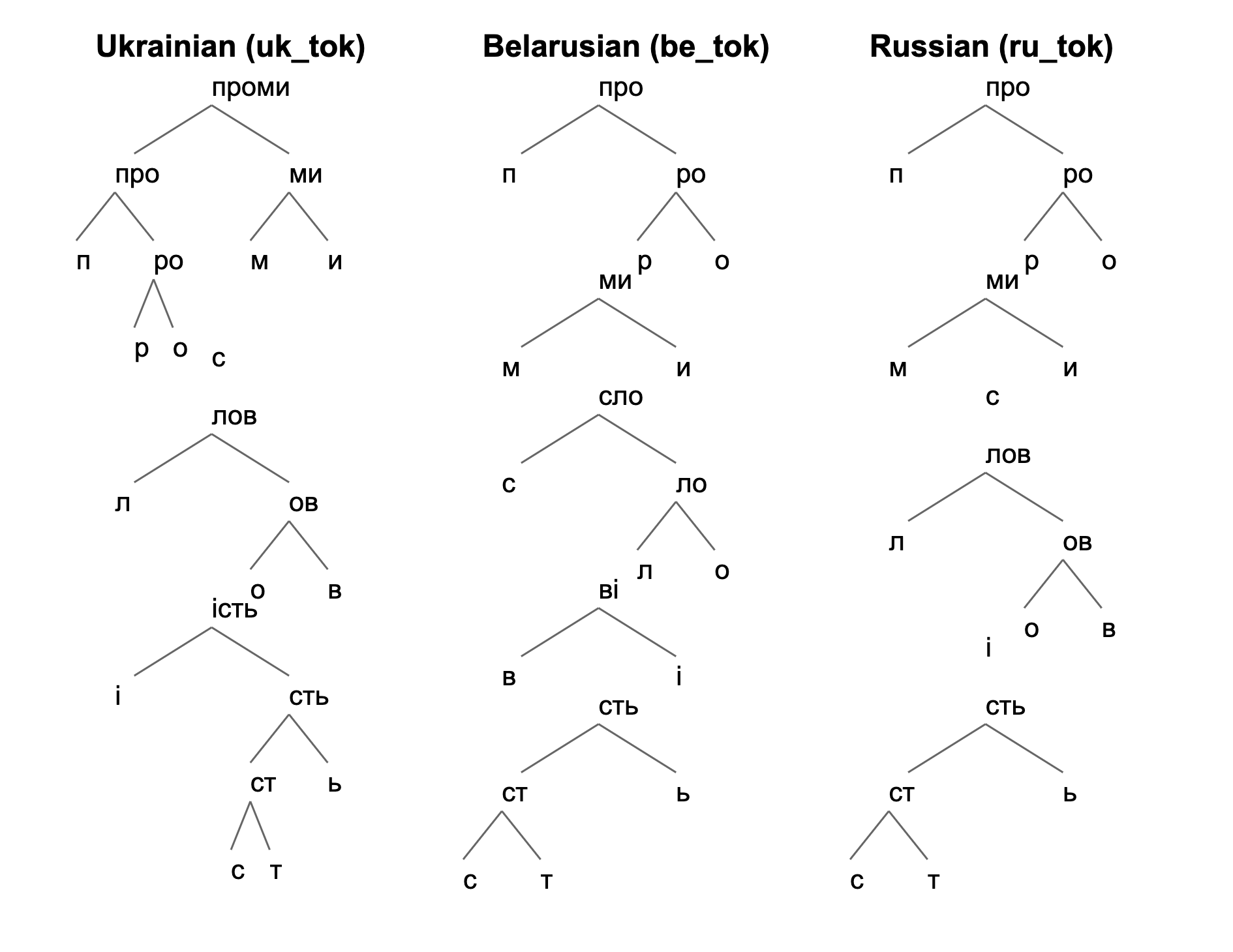
The image presents three tree diagrams illustrating the decomposition of a word or phrase in Ukrainian, Belarusian, and Russian. Each diagram shows a hierarchical structure, breaking down the initial word/phrase into smaller components, potentially representing morphemes or phonemes.
### Components/Axes
* **Titles:**
* Top-left: "Ukrainian (uk\_tok)"
* Top-center: "Belarusian (be\_tok)"
* Top-right: "Russian (ru\_tok)"
* **Nodes:** Each node in the tree represents a linguistic unit (word, morpheme, phoneme). The nodes are labeled with Cyrillic characters.
* **Edges:** The lines connecting the nodes represent the hierarchical relationship between the linguistic units.
### Detailed Analysis
**1. Ukrainian (uk\_tok)**
* **Top Node:** проми
* **Level 1:**
* про (left)
* ми (right)
* **Level 2 (from про):**
* п (left)
* ро (right)
* **Level 3 (from ро):**
* р (left)
* о (center)
* с (right)
* **Level 4:**
* лов
* **Level 5:**
* л (left)
* ов (right)
* **Level 6 (from ов):**
* о (left)
* в (right)
* **Level 7:**
* ість
* **Level 8:**
* і (left)
* сть (right)
* **Level 9 (from сть):**
* ст (left)
* ь (right)
* **Level 10 (from ст):**
* с (left)
* т (right)
**2. Belarusian (be\_tok)**
* **Top Node:** про
* **Level 1:**
* п (left)
* ро (right)
* **Level 2 (from ро):**
* р (left)
* о (right)
* **Level 3:**
* ми
* **Level 4:**
* м (left)
* и (right)
* **Level 5:**
* сло
* **Level 6:**
* с (left)
* ло (right)
* **Level 7:**
* ві
* **Level 8:**
* в (left)
* і (right)
* **Level 9:**
* сть
* **Level 10:**
* ст (left)
* ь (right)
* **Level 11 (from ст):**
* с (left)
* т (right)
**3. Russian (ru\_tok)**
* **Top Node:** про
* **Level 1:**
* п (left)
* ро (right)
* **Level 2 (from ро):**
* р (left)
* о (right)
* **Level 3:**
* ми
* **Level 4:**
* м (left)
* и (right)
* **Level 5:**
* с
* **Level 6:**
* лов
* **Level 7:**
* л (left)
* ов (right)
* **Level 8 (from ов):**
* о (left)
* в (right)
* **Level 9:**
* ість
* **Level 10:**
* сть
* **Level 11:**
* ст (left)
* ь (right)
* **Level 12 (from ст):**
* с (left)
* т (right)
### Key Observations
* All three diagrams use a tree structure to represent the decomposition of linguistic units.
* The Ukrainian diagram is the most complex, with the deepest level of decomposition.
* The Belarusian and Russian diagrams share some similarities in their structure, particularly in the lower levels.
* The diagrams use Cyrillic characters to label the nodes, indicating that they represent words, morphemes, or phonemes from the respective languages.
### Interpretation
The diagrams likely represent a linguistic analysis of a specific word or phrase in Ukrainian, Belarusian, and Russian. The tree structure illustrates how the word/phrase can be broken down into its constituent parts, potentially revealing its morphological or phonological structure. The differences in the diagrams suggest variations in how the word/phrase is analyzed or structured in each language. The diagrams could be used to compare and contrast the linguistic features of these three related languages.