## Diagram: Linguistic Tree Decomposition of "About"
### Overview
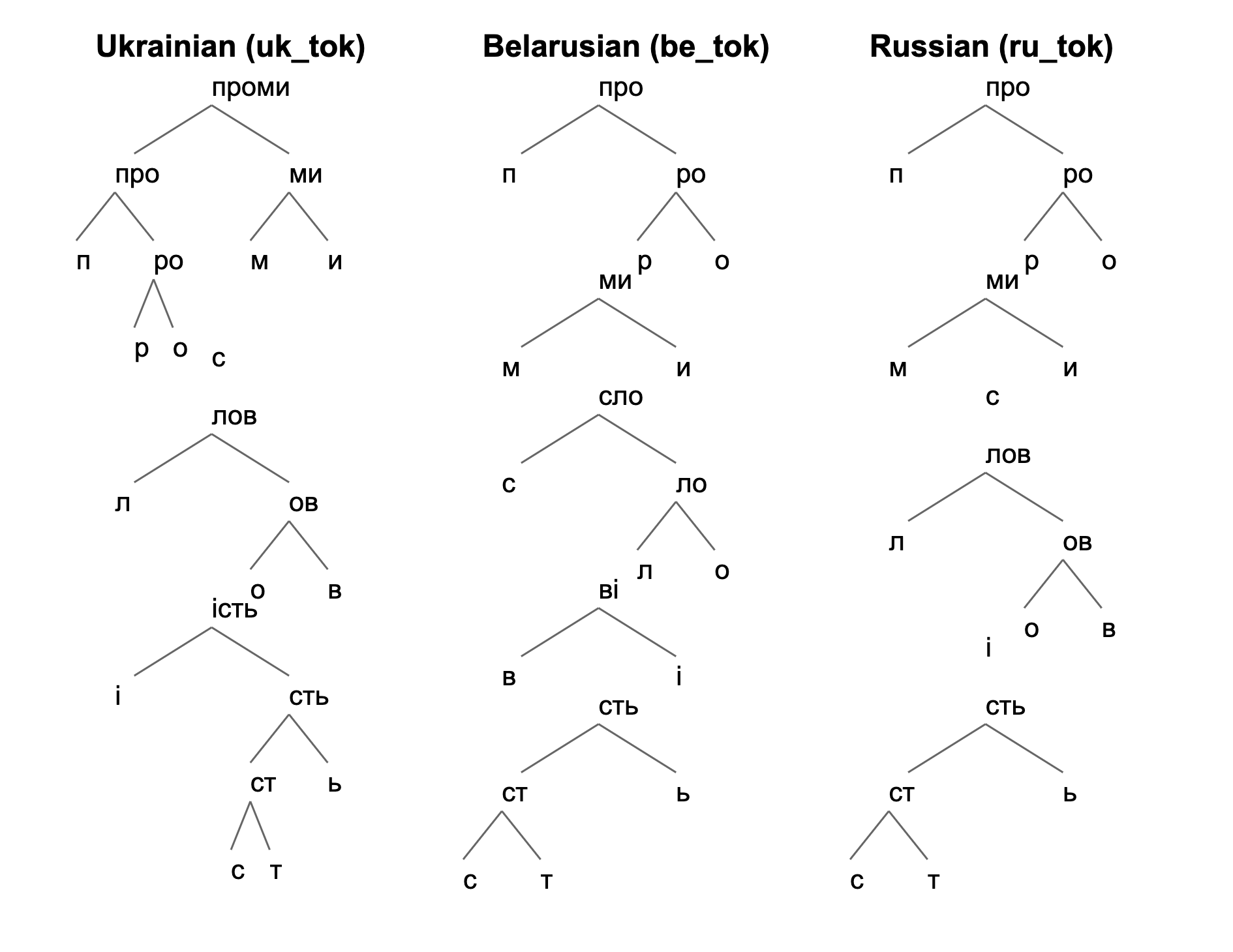
The image presents three tree diagrams, visually representing the decomposition of the word "about" in Ukrainian, Belarusian, and Russian. Each tree illustrates the breakdown of the word into its constituent phonetic elements (likely phonemes or morphemes). The diagrams are arranged horizontally, with each language's tree positioned side-by-side for comparison.
### Components/Axes
The diagram consists of three separate tree structures, one for each language: Ukrainian (labeled "Ukrainian (uk_tok)"), Belarusian (labeled "Belarusian (be_tok)"), and Russian (labeled "Russian (ru_tok)"). Each tree is composed of nodes representing phonetic elements, connected by branches indicating the sequential breakdown of the word. The root node of each tree represents the complete word "about" in that language. The leaves of the trees represent the smallest phonetic units.
### Detailed Analysis or Content Details
**Ukrainian (uk_tok):**
The Ukrainian tree starts with "проми" at the top. It branches into:
* "про" and "ми"
* "про" further branches into "п" and "ро"
* "ро" branches into "р" and "о"
* "ми" branches into "м" and "и"
* "по" branches into "п" and "о"
* "слов" branches into "л" and "ов"
* "ість" branches into "і" and "сть"
* "сть" branches into "с" and "ть"
* "ть" branches into "т" and "ь"
**Belarusian (be_tok):**
The Belarusian tree starts with "про" at the top. It branches into:
* "п" and "о"
* "ми" and "р"
* "ми" branches into "м" and "и"
* "сло" branches into "с" and "ло"
* "ло" branches into "л" and "о"
* "Bi" branches into "B" and "i"
* "і" and "сть"
* "сть" branches into "с" and "т"
* "т" branches into "т" and "ь"
**Russian (ru_tok):**
The Russian tree starts with "про" at the top. It branches into:
* "п" and "о"
* "ми" and "р"
* "ми" branches into "м" and "и"
* "слов" branches into "с" and "лов"
* "лов" branches into "л" and "ов"
* "і" and "о"
* "B"
* "сть" branches into "с" and "ть"
* "ть" branches into "т" and "ь"
### Key Observations
* All three trees share a common initial breakdown into "про" (or a similar sound) and a subsequent element.
* The decomposition paths diverge significantly after the initial split, reflecting the unique phonetic structures of each language.
* The final branches in each tree consistently break down into individual consonants and vowels.
* The use of "ь" (soft sign) appears in the final stages of decomposition for all three languages.
### Interpretation
The diagrams illustrate a linguistic analysis of the word "about" in three closely related Slavic languages. The trees represent a phonetic or morphemic decomposition, showing how the word is built up from smaller sound units. The differences in the tree structures highlight the distinct phonetic evolution and grammatical structures of Ukrainian, Belarusian, and Russian. The diagrams are not presenting quantitative data, but rather a qualitative representation of linguistic structure. The trees are a visual aid for understanding how the pronunciation and composition of the word "about" differ across these languages. The diagrams suggest a common linguistic ancestor, as evidenced by the initial similarities in decomposition, but also demonstrate the independent development of each language over time. The diagrams are likely used for comparative linguistic studies or for teaching the phonetic structures of these languages.