## Diagram: Comparative Linguistic Tree Structures of Ukrainian, Belarusian, and Russian
### Overview
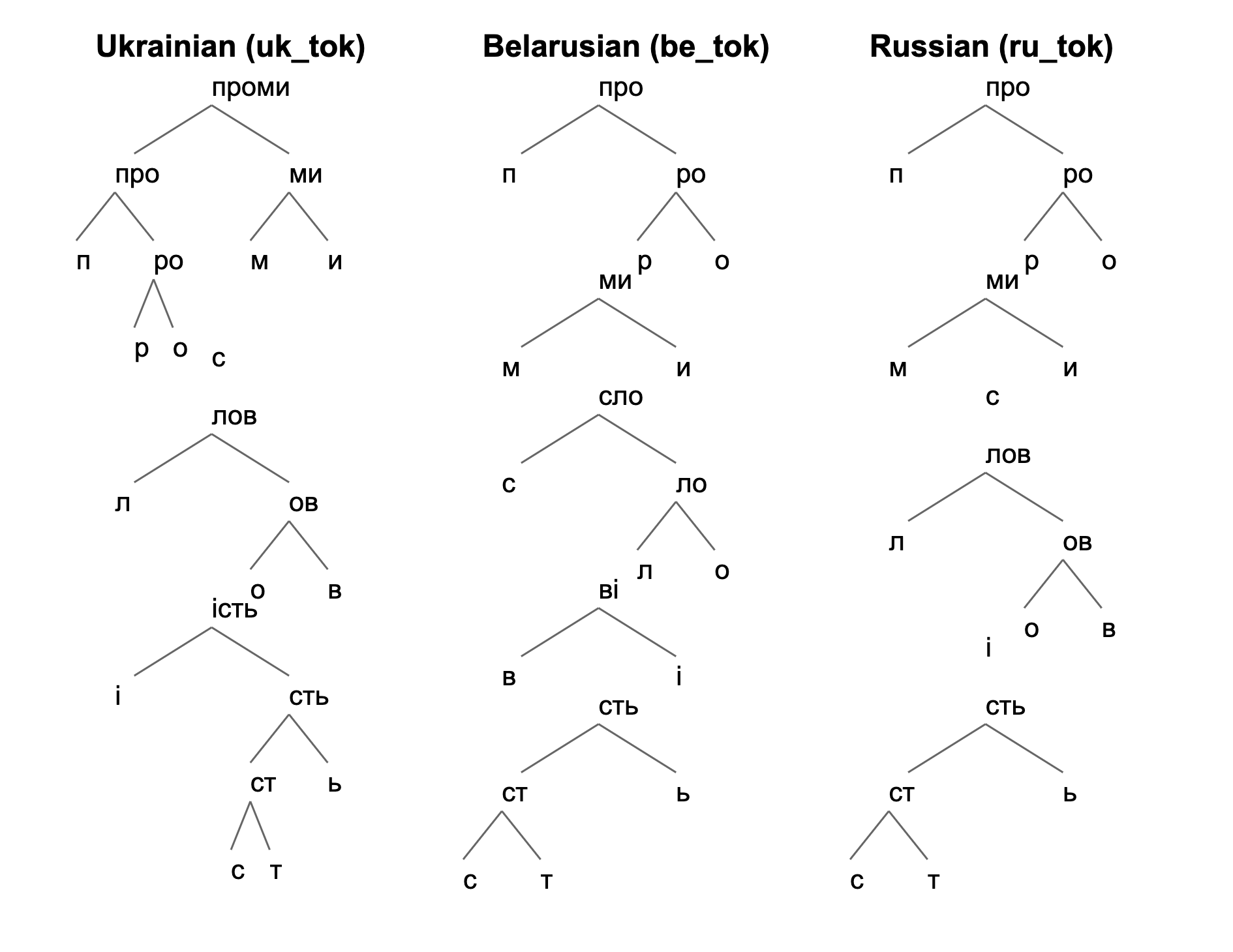
The image presents three comparative linguistic tree diagrams representing the morphological or syntactic structures of Ukrainian (uk_tok), Belarusian (be_tok), and Russian (ru_tok). Each tree uses Cyrillic script to label nodes, with hierarchical branching patterns illustrating linguistic relationships. The diagrams are positioned side-by-side, with Ukrainian on the left, Belarusian in the center, and Russian on the right.
### Components/Axes
- **Root Nodes**:
- Ukrainian: "промі" (promi)
- Belarusian: "про" (pro)
- Russian: "про" (pro)
- **Branching Structure**:
- Each tree splits into sub-branches labeled with Cyrillic letters (e.g., "п", "р", "о", "М", "И", "С", "Т", "B", "В").
- Terminal nodes include combinations like "CT", "CTb", "CTb", and "CTb" (with variations in subscripts).
- **Positioning**:
- Trees are vertically aligned, with roots at the top and terminal nodes at the bottom.
- No explicit legend or color coding; all elements use black lines and nodes.
### Detailed Analysis
#### Ukrainian (uk_tok)
- **Root**: "промі" (promi) → branches into "про" (pro) and "МИ" (mi).
- **Sub-branches**:
- "про" → "п" (p) and "ро" (ro).
- "МИ" → "р" (r) and "о" (o).
- Further splits include "с" (s) under "ро" and "CTb" (C-T-b) under "і" (i).
#### Belarusian (be_tok)
- **Root**: "про" (pro) → branches into "п" (p) and "ро" (ro).
- **Sub-branches**:
- "п" → "М" (M) and "и" (i).
- "ро" → "C" (C) and "ПО" (po).
- Terminal nodes include "CT" (C-T) and "B" (b).
#### Russian (ru_tok)
- **Root**: "про" (pro) → branches into "п" (p) and "ро" (ro).
- **Sub-branches**:
- "п" → "М" (M) and "и" (i).
- "ро" → "C" (C) and "С" (s).
- Terminal nodes include "CTb" (C-T-b) and "B" (b).
### Key Observations
1. **Shared Roots**: Belarusian and Russian share the root "про" (pro), while Ukrainian uses "промі" (promi), suggesting divergent lexical origins.
2. **Branching Patterns**:
- Ukrainian trees exhibit more complex sub-branching (e.g., "CTb" with subscripts).
- Belarusian and Russian trees show simpler, more linear splits.
3. **Terminal Nodes**: All trees converge on terminal nodes labeled with combinations of Cyrillic letters (e.g., "CT", "B", "V"), indicating shared morphological components.
### Interpretation
The diagrams highlight structural similarities and differences in the three Slavic languages:
- **Linguistic Relationships**: Shared roots ("про") and terminal nodes ("CT", "B") suggest common etymological roots, while divergent root structures ("промі" vs. "про") reflect historical linguistic evolution.
- **Morphological Complexity**: Ukrainian's more intricate branching may indicate richer inflectional morphology compared to Belarusian and Russian.
- **Phonetic Patterns**: Repeated use of "C" (ts) and "T" (t) in terminal nodes points to shared consonant clusters in Slavic languages.
The trees likely represent computational models of word segmentation or morphological analysis, illustrating how words decompose into phonetic or syntactic units across languages. The absence of numerical data suggests a focus on structural relationships rather than quantitative analysis.