\n
## Diagram: Conceptual Influence Map of Transparency and Explainability
### Overview
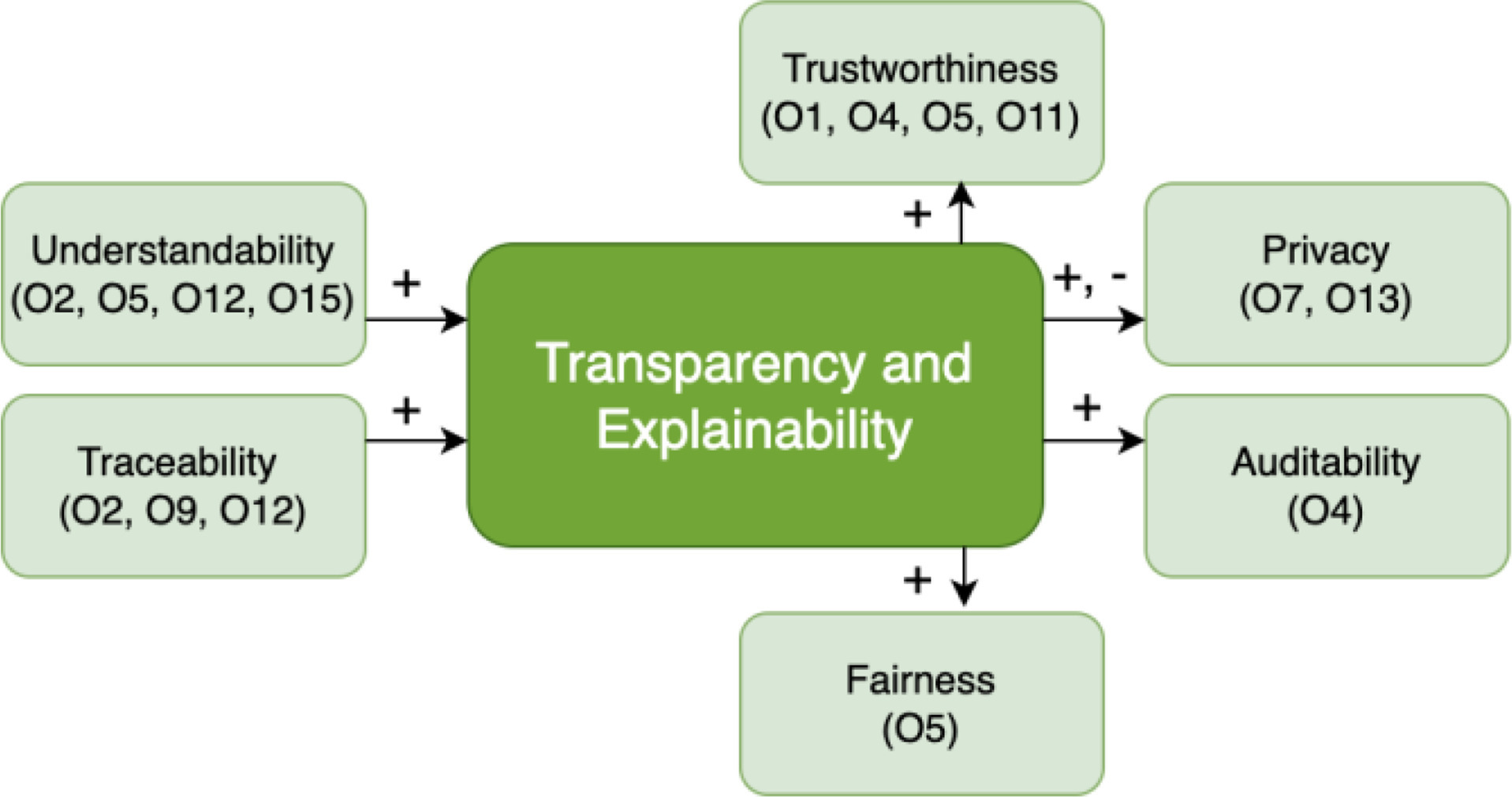
The image displays a conceptual diagram illustrating the relationships between "Transparency and Explainability" and six other ethical or quality attributes of a system (likely an AI or data system). The diagram uses a node-and-arrow structure to show directional influences, with signs indicating the nature of the influence (positive or mixed). All text is in English.
### Components/Axes
The diagram consists of seven rectangular nodes with rounded corners, connected by directional arrows.
1. **Central Node (Dark Green):**
* **Label:** "Transparency and Explainability"
* **Position:** Center of the diagram.
2. **Surrounding Nodes (Light Green):** Six nodes are arranged around the central node.
* **Top-Center:** "Trustworthiness (O1, O4, O5, O11)"
* **Top-Left:** "Understandability (O2, O5, O12, O15)"
* **Bottom-Left:** "Traceability (O2, O9, O12)"
* **Top-Right:** "Privacy (O7, O13)"
* **Middle-Right:** "Auditability (O4)"
* **Bottom-Center:** "Fairness (O5)"
3. **Connections (Arrows with Signs):**
* Arrows originate from the central "Transparency and Explainability" node and point to each of the six surrounding nodes.
* Each arrow is labeled with a symbol indicating the nature of the influence:
* **"+" (Plus sign):** Indicates a positive influence. This symbol is present on arrows pointing to Trustworthiness, Understandability, Traceability, Auditability, and Fairness.
* **"+, -" (Plus and Minus signs):** Indicates a mixed or dual influence (both positive and negative). This symbol is present on the arrow pointing to Privacy.
### Detailed Analysis
* **Text Transcription:** All text from the nodes has been extracted verbatim above. The codes in parentheses (e.g., O1, O4) appear to be identifiers, likely referencing specific objectives, criteria, or requirements from a separate framework or document not shown in the image.
* **Spatial Grounding & Flow:**
* The central concept, "Transparency and Explainability," is positioned as the primary influencer.
* The flow is unidirectional, from the center outward to the six attributes.
* The legend (the +/- symbols) is placed directly on the connecting arrows, not in a separate box.
* **Component Isolation:**
* **Header/Title:** There is no explicit title at the top of the image. The central node's label serves as the diagram's subject.
* **Main Diagram:** Contains all nodes and connections as described.
* **Footer:** There is no footer, caption, or source information visible in the provided image.
### Key Observations
1. **Central Hub:** "Transparency and Explainability" is modeled as a foundational concept that directly impacts a suite of other important system qualities.
2. **Predominantly Positive Influence:** Five of the six relationships are marked as purely positive (+), suggesting that increasing transparency and explainability is theorized to enhance Trustworthiness, Understandability, Traceability, Auditability, and Fairness.
3. **The Privacy Exception:** The relationship with "Privacy" is uniquely marked as having both positive and negative aspects (+, -). This is a critical nuance, indicating a potential trade-off or tension. For example, making a system more transparent might expose sensitive data patterns (negative for privacy), while explainability might help users understand and control their data (positive for privacy).
4. **Overlapping Codes:** Several codes appear in multiple nodes (e.g., O5 is in Trustworthiness, Understandability, and Fairness; O4 is in Trustworthiness and Auditability). This suggests these objectives are interconnected and can be served by multiple attributes.
### Interpretation
This diagram presents a conceptual model for understanding the role of Transparency and Explainability within a broader framework of ethical and operational system design, likely for AI or automated decision-making systems.
* **What it Suggests:** The model posits that investing in transparency (making processes and data visible) and explainability (making system decisions understandable) is a powerful lever for improving a system's overall ethical and technical robustness. It acts as a catalyst for other desirable properties.
* **Relationships:** The central node is an *enabler*. The surrounding nodes are *beneficiaries* or *related concepts*. The arrows define a causal or influential relationship, not a hierarchical one. The inclusion of specific objective codes (O1, O2, etc.) ties this abstract model to a concrete set of requirements, implying that achieving those objectives depends on addressing transparency and explainability.
* **Notable Anomaly/Tension:** The mixed influence on Privacy is the most significant insight. It highlights a classic dilemma in system design: the need for openness and the need for confidentiality are often in conflict. This diagram explicitly acknowledges that improving transparency and explainability is not an unqualified good for all attributes; it requires careful balancing, particularly concerning privacy. This makes the model more realistic and useful for design trade-off analysis.
* **Peircean Investigation:** The diagram is an *icon* (it resembles the structure of the relationships it describes) and a *symbol* (the codes and labels are conventional). To fully understand it, one would need the legend for the "O" codes. However, even without that key, the diagram successfully communicates that Transparency and Explainability are central, broadly beneficial, but must be managed carefully in relation to Privacy.