## Diagram: AI Agent Math Problem Generation and Solution Workflow
### Overview
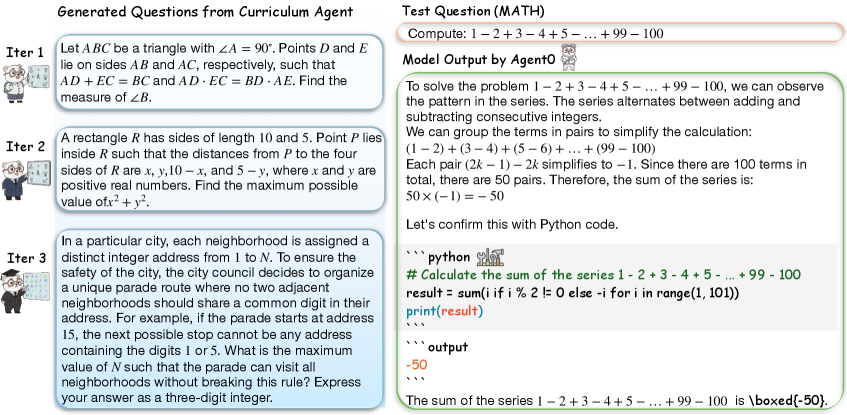
The image is a diagram illustrating a two-part process involving AI agents. On the left, a "Curriculum Agent" generates a series of mathematical problems across different iterations. On the right, a "Test Question (MATH)" is presented, and an "Agent0" provides a detailed, step-by-step solution, including verification with Python code. The diagram visually separates the problem generation phase from the problem-solving phase.
### Components/Axes
The diagram is divided into two main vertical panels:
1. **Left Panel: "Generated Questions from Curriculum Agent"**
* **Header:** "Generated Questions from Curriculum Agent" (centered at the top).
* **Content:** Three distinct problem boxes, each labeled with an iteration number ("Iter 1", "Iter 2", "Iter 3") and accompanied by a small cartoon icon of a person (likely representing the agent).
* **Spatial Layout:** The three problem boxes are stacked vertically.
2. **Right Panel: "Test Question (MATH)" and "Model Output by Agent0"**
* **Header 1:** "Test Question (MATH)" (centered at the top of this panel).
* **Test Question Box:** A single box containing a mathematical series problem.
* **Header 2:** "Model Output by Agent0" (centered below the test question box), accompanied by a small icon of a robot or AI agent.
* **Solution Box:** A large box containing the textual solution, a Python code block, and the final answer.
### Detailed Analysis / Content Details
**Left Panel - Generated Questions:**
* **Iter 1:**
* **Text:** "Let \(ABC\) be a triangle with \(\angle A = 90^\circ\). Points \(D\) and \(E\) lie on sides \(AB\) and \(AC\), respectively, such that \(AD + EC = BC\) and \(AD \cdot EC = BD \cdot AE\). Find the measure of \(\angle B\)."
* **Type:** Geometry problem involving a right triangle and conditions on points on its legs.
* **Iter 2:**
* **Text:** "A rectangle \(R\) has sides of length 10 and 5. Point \(P\) lies inside \(R\) such that the distances from \(P\) to the four sides of \(R\) are \(x\), \(10 - x\), \(y\), and \(5 - y\), where \(x\) and \(y\) are positive real numbers. Find the maximum possible value of \(x^2 + y^2\)."
* **Type:** Optimization problem within a rectangle, involving distances to sides.
* **Iter 3:**
* **Text:** "In a particular city, each neighborhood is assigned a distinct integer address from 1 to \(N\). To ensure the safety of the city, the city council decides to organize a unique parade route where no two adjacent neighborhoods should share a common digit in their addresses. For example, if the parade starts at address 15, the next possible address cannot be any address containing the digits 1 or 5. What is the maximum value of \(N\) such that the parade can visit all neighborhoods without breaking this rule? Express your answer as a three-digit integer."
* **Type:** Combinatorics/number theory problem about constructing a sequence of integers with no shared digits between consecutive terms.
**Right Panel - Test Question and Solution:**
* **Test Question:**
* **Text:** "Compute: \(1 - 2 + 3 - 4 + 5 - \dots + 99 - 100\)"
* **Model Output by Agent0:**
* **Solution Text:**
* "To solve the problem \(1 - 2 + 3 - 4 + 5 - \dots + 99 - 100\), we can observe the pattern in the series. The series alternates between adding and subtracting consecutive integers."
* "We can group the terms in pairs to simplify the calculation: \((1 - 2) + (3 - 4) + (5 - 6) + \dots + (99 - 100)\)"
* "Each pair \((2k - 1) - 2k\) simplifies to \(-1\). Since there are 100 terms in total, there are 50 pairs. Therefore, the sum of the series is: \(50 \times (-1) = -50\)"
* "Let's confirm this with Python code."
* **Python Code Block:**
```python
# Calculate the sum of the series 1 - 2 + 3 - 4 + 5 - ... + 99 - 100
result = sum(i if i % 2 != 0 else -i for i in range(1, 101))
print(result)
```
* **Output:**
```
-50
```
* **Final Answer Line:** "The sum of the series \(1 - 2 + 3 - 4 + 5 - \dots + 99 - 100\) is \(\boxed{-50}\)."
### Key Observations
1. **Problem Diversity:** The Curriculum Agent generates problems from distinct mathematical domains: Euclidean geometry (Iter 1), optimization in coordinate geometry (Iter 2), and combinatorial number theory (Iter 3).
2. **Solution Methodology:** Agent0's solution to the test question employs two complementary methods: a logical mathematical pattern recognition (pairing terms) and computational verification (Python code).
3. **Clarity and Structure:** The solution is presented in a clear, pedagogical step-by-step manner, explaining the reasoning before showing the code.
4. **Visual Confirmation:** The Python code's output (`-50`) directly matches the analytically derived answer and the final boxed answer, providing a self-consistency check.
### Interpretation
This diagram demonstrates a pipeline or a comparison within an AI system designed for mathematical reasoning. The "Curriculum Agent" appears to be responsible for creating a diverse set of challenging math problems, potentially for training or evaluation purposes. The "Test Question" represents a specific instance fed to "Agent0," which then showcases its problem-solving capability.
The core message is the agent's ability to not only compute an answer but to explain its reasoning process transparently. The inclusion of code verification highlights a modern approach to mathematical problem-solving, where analytical insight is bolstered by computational proof. The contrast between the complex, multi-step problems on the left and the seemingly simple (but pattern-based) series on the right suggests the system is being tested on a range of difficulties. The overall setup implies a research or development context focused on advancing AI's capacity for structured, logical, and verifiable mathematical reasoning.