## Curriculum Agent and Model Output
### Overview
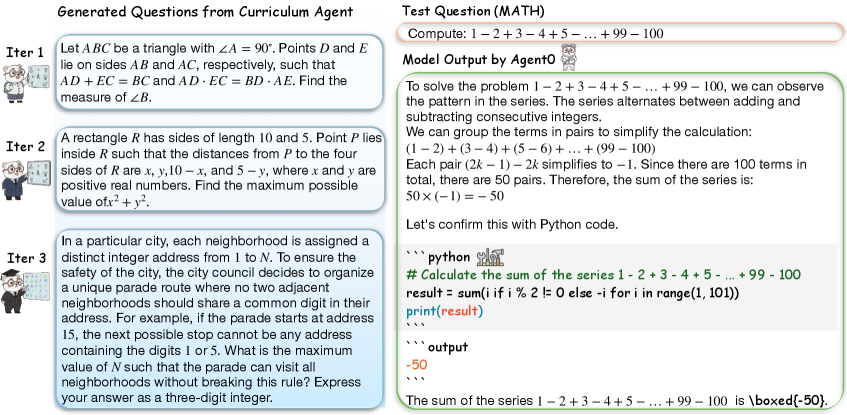
The image presents a comparison between questions generated by a curriculum agent and the model's output for a specific math test question. It showcases three iterations of questions generated by the curriculum agent, each with a different level of complexity. On the right side, it shows a math test question, the model's step-by-step solution, and a Python code verification.
### Components/Axes
* **Left Side:** "Generated Questions from Curriculum Agent" with three iterations (Iter 1, Iter 2, Iter 3). Each iteration presents a different math problem.
* **Right Side:** "Test Question (MATH)" with the question "Compute: 1 - 2 + 3 - 4 + 5 - ... + 99 - 100". Below that is "Model Output by Agent0" which includes the model's solution, Python code for verification, and the output.
### Detailed Analysis or ### Content Details
**Left Side: Generated Questions from Curriculum Agent**
* **Iter 1:**
* Problem: "Let ABC be a triangle with ∠A = 90°. Points D and E lie on sides AB and AC, respectively, such that AD + EC = BC and AD · EC = BD · AE. Find the measure of ∠B."
* **Iter 2:**
* Problem: "A rectangle R has sides of length 10 and 5. Point P lies inside R such that the distances from P to the four sides of R are x, y, 10 - x, and 5 - y, where x and y are positive real numbers. Find the maximum possible value of x² + y²."
* **Iter 3:**
* Problem: "In a particular city, each neighborhood is assigned a distinct integer address from 1 to N. To ensure the safety of the city, the city council decides to organize a unique parade route where no two adjacent neighborhoods should share a common digit in their address. For example, if the parade starts at address 15, the next possible stop cannot be any address containing the digits 1 or 5. What is the maximum value of N such that the parade can visit all neighborhoods without breaking this rule? Express your answer as a three-digit integer."
**Right Side: Test Question (MATH) and Model Output**
* **Test Question:**
* "Compute: 1 - 2 + 3 - 4 + 5 - ... + 99 - 100"
* **Model Output by Agent0:**
* Solution: The model explains the pattern in the series, groups the terms in pairs, and simplifies the calculation. It states that each pair (2k - 1) - 2k simplifies to -1. Since there are 100 terms in total, there are 50 pairs. Therefore, the sum of the series is 50 × (-1) = -50.
* Python Code: