\n
## Document: Curriculum Agent Generated Questions & Solutions
### Overview
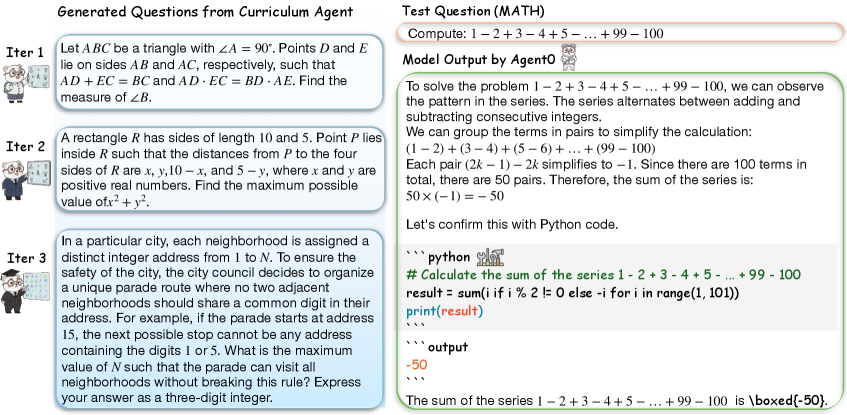
The image presents a document showcasing a curriculum agent generating math questions and providing model outputs. It's structured into three iterations (Iter 1, Iter 2, Iter 3), each presenting a question, and a corresponding "Test Question (MATH)" and "Model Output by Agent0" section. The document also includes Python code for verification and its output.
### Components/Axes
The document is divided into the following sections:
* **Generated Questions from Curriculum Agent:** Contains the problem statements for each iteration.
* **Test Question (MATH):** Presents the mathematical expression to be solved.
* **Model Output by Agent0:** Provides the agent's solution and reasoning.
* **Python Code:** Shows the Python code used to verify the solution.
* **Output:** Displays the result of the Python code execution.
### Detailed Analysis or Content Details
**Iter 1:**
* **Question:** "Let ABC be a triangle with ∠A = 90°. Points D and E lie on sides AB and AC, respectively, such that AD + EC = BC and AD⋅EC = BD⋅AE. Find the measure of ∠B."
* **Test Question (MATH):** "Compute: 1 - 2 + 3 - 4 + 5 - ... + 99 - 100"
* **Model Output by Agent0:** The agent observes the alternating pattern of addition and subtraction. It groups terms in pairs, simplifying the calculation to (1-2) + (3-4) + (5-6) + ... + (99-100). Each pair sums to -1, and there are 50 pairs, resulting in a total sum of -50. The agent then provides Python code to confirm this.
* **Python Code:**
```python
# Calculate the sum of the series 1 - 2 + 3 - 4 + 5 - ... + 99 - 100
result = sum([i if i % 2 else -i for i in range(1, 101)])
print(result)
```
* **Output:** -50
* **Final Statement:** "The sum of the series 1 - 2 + 3 - 4 + 5 - ... + 99 - 100 is \\boxed{-50}."
**Iter 2:**
* **Question:** "A rectangle R has sides of length 10 and 5. Point P lies inside R such that the distances from P to the four sides of R are x, y, 10 - x, and 5 - y, where x and y are positive real numbers. Find the maximum possible value of x² + y²."
**Iter 3:**
* **Question:** "In a particular city, each neighborhood is assigned a distinct integer address from 1 to N. To ensure the safety of the city, the city council decides to organize a unique parade route where no two adjacent neighborhoods should share a common digit in their address. For example, if the parade starts at address 10, the next possible stop cannot be any address containing the digits 1 or 5. What is the maximum value of N such that the parade can visit all neighborhoods without breaking this rule? Express your answer as a three-digit integer."
### Key Observations
* The agent consistently provides a solution and then verifies it with Python code.
* The Python code is concise and directly implements the logic described in the model output.
* The final answer in Iter 1 is clearly highlighted using the `\boxed{}` notation.
* The questions in Iter 2 and Iter 3 are incomplete in the image.
### Interpretation
The document demonstrates the functionality of a curriculum agent capable of generating math problems and providing step-by-step solutions. The agent utilizes pattern recognition and simplification techniques to solve the problems. The inclusion of Python code for verification suggests a focus on computational validation and transparency. The document highlights the agent's ability to not only solve problems but also explain its reasoning and confirm its results programmatically. The incomplete questions in Iter 2 and 3 suggest that the document is a work in progress or a partial screenshot of a larger system. The agent's approach is logical and methodical, making it a potentially valuable tool for educational purposes.