## Screenshot: Math Problem Set with Model Output and Python Code
### Overview
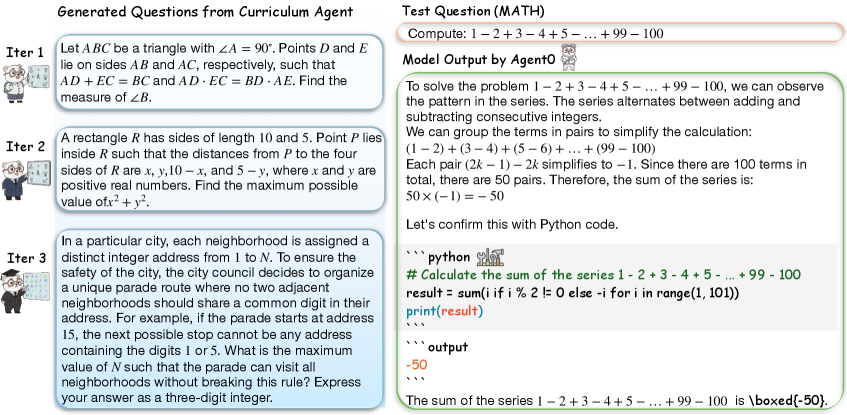
The image displays a structured math problem set with three generated questions (Iter 1-3) and a test question (MATH) involving series summation. It includes a model output explaining the solution approach and Python code to verify the result.
### Components/Axes
- **Question Sections**:
- **Iter 1**: Triangle geometry problem with labeled points (A, B, C, D, E) and angle constraints.
- **Iter 2**: Rectangle optimization problem with coordinate constraints.
- **Iter 3**: Combinatorial optimization problem involving digit constraints.
- **Test Question (MATH)**:
- Problem: Compute the alternating sum `1 - 2 + 3 - 4 + 5 - ... + 99 - 100`.
- Model Output: Explanation of pairing terms to simplify calculation.
- Python Code: Implementation to calculate the sum programmatically.
### Detailed Analysis
#### Iter 1
- **Problem**: Triangle ABC with ∠A = 90°. Points D and E on AB and AC satisfy AD + EC = BC and AD · EC = BD · AE. Find ∠B.
- **Key Elements**: Right triangle, geometric constraints, angle measurement.
#### Iter 2
- **Problem**: Rectangle R (10x5) with point P inside. Distances from P to sides are x, y, 10−x, 5−y. Maximize x² + y².
- **Key Elements**: Coordinate geometry, optimization under constraints.
#### Iter 3
- **Problem**: City parade route with digit constraints (digits 1/5). Find maximum N allowing visitation of all neighborhoods without breaking rules.
- **Key Elements**: Integer constraints, combinatorial pathfinding.
#### Test Question (MATH)
- **Problem**: Compute `1 - 2 + 3 - 4 + 5 - ... + 99 - 100`.
- **Model Output**:
- **Approach**: Pair terms as (1-2), (3-4), ..., (99-100), each simplifying to -1.
- **Calculation**: 50 pairs × (-1) = -50.
- **Python Code**: