# Technical Document Extraction: Chain of Thought (CoT) Reasoning Process Diagram
## 1. Image Overview
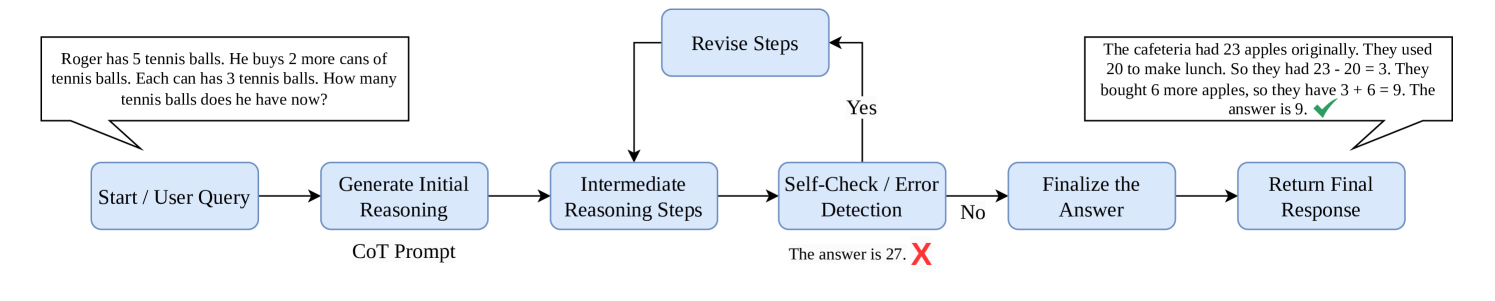
This image is a technical flowchart illustrating a multi-step logical reasoning process for an AI model, specifically focusing on "Chain of Thought" (CoT) prompting with an integrated self-correction loop. The diagram uses light blue rounded rectangles for process nodes, black arrows for flow direction, and callout bubbles for example text.
---
## 2. Component Isolation & Transcription
### Region A: Input (Far Left)
* **Callout Bubble (User Query):** "Roger has 5 tennis balls. He buys 2 more cans of tennis balls. Each can has 3 tennis balls. How many tennis balls does he have now?"
* **Process Node 1:** "Start / User Query"
### Region B: Initial Processing (Center-Left)
* **Process Node 2:** "Generate Initial Reasoning"
* **Sub-label (below Node 2):** "CoT Prompt"
* **Process Node 3:** "Intermediate Reasoning Steps"
### Region C: Iterative Loop (Center-Top)
* **Process Node 4:** "Self-Check / Error Detection"
* **Sub-label (below Node 4):** "The answer is 27. ❌" (Red 'X' symbol indicates an error detected).
* **Decision Path (Upward):** Labeled "Yes" (indicating an error was found).
* **Process Node 5 (Top):** "Revise Steps"
* **Return Path:** Arrow leads from "Revise Steps" back down to "Intermediate Reasoning Steps".
### Region D: Finalization (Far Right)
* **Decision Path (Rightward):** Labeled "No" (indicating no error was found in the self-check).
* **Process Node 6:** "Finalize the Answer"
* **Process Node 7:** "Return Final Response"
* **Callout Bubble (Final Output):** "The cafeteria had 23 apples originally. They used 20 to make lunch. So they had 23 - 20 = 3. They bought 6 more apples, so they have 3 + 6 = 9. The answer is 9. ✅" (Green checkmark indicates a verified correct response).
---
## 3. Logical Flow & Process Description
The diagram describes a linear process with a conditional feedback loop:
1. **Initialization:** The process begins with a **User Query** (e.g., a math word problem).
2. **Prompting:** The system uses a **CoT Prompt** to **Generate Initial Reasoning**.
3. **Reasoning:** The system develops **Intermediate Reasoning Steps**.
4. **Verification Loop:**
* The system enters **Self-Check / Error Detection**.
* **If an error is detected ("Yes"):** The system identifies the mistake (e.g., "The answer is 27. ❌"), moves to **Revise Steps**, and feeds back into the **Intermediate Reasoning Steps** to try again.
* **If no error is detected ("No"):** The system proceeds to the next stage.
5. **Completion:** The system will **Finalize the Answer** and **Return Final Response** to the user (e.g., a correctly calculated multi-step word problem marked with ✅).
---
## 4. Technical Observations
* **Language:** The entire diagram is in **English**.
* **Visual Logic:** The use of the red "X" and green "Checkmark" serves as a visual shorthand for the success/failure states of the internal "Self-Check" mechanism.
* **Context Discrepancy:** Note that the input query (Tennis balls) and the final response example (Apples) are different word problems, likely used to demonstrate the system's capability across different types of queries rather than a single continuous example.